Slack Who-Is-Off Digest Guide
A guide for team leads and HR admins on configuring the BreezeLeave Slack who-is-off digest: daily versus weekly cadence, channel patterns, and the slash command teams reach for first.
Monday morning, a team lead pings the engineering channel: "who is around this week?" A product manager replies, "I think Anna is out Thursday." A designer corrects: "Anna is out the whole week, and so am I on Friday." The thread drifts for ten messages, the team meeting starts five minutes late, and the standup begins with a half-accurate map of who is at their desk. The Slack who-is-off digest exists for exactly this Monday. Once configured, the bot posts a single message at a fixed time, listing approved leave for the next several days. Nobody has to remember to ask.
This article is for team leads and HR admins who want the digest configured well the first time. It covers the daily versus weekly choice, where to post it, how the slash command differs from the scheduled message, and the failure cases that come up most.
What the digest actually posts
The who-is-off digest is a scheduled Slack message posted to a channel of your choice. It lists employees with approved leave in a forward-looking window, by date, with the employee name and the leave type. The list reads from the same approval records the rest of BreezeLeave uses, so an approved request shows up in the digest without a separate setup step.
Two cadences are supported:
- Daily digest. Posts every working day, lists approved leave for the next N days (configurable). Best for teams where coverage decisions are made daily.
- Weekly digest. Posts once a week, typically Monday morning, lists approved leave for the rest of the week or the next two weeks. Best for teams where standups already cover the week.
The team lead picks the cadence based on how often their schedule moves. A support team that does shift coverage usually wants daily. A consultancy team that plans by sprint usually prefers weekly.
The two-channel pattern
BreezeLeave's Slack integration is designed around two channels per company. Index 0 is the action channel where requests and approvals live. Index 1 is the away channel where the who-is-off digest and absence notifications post. Splitting these matters more than it sounds.
| Channel | Audience | What posts there |
|---|---|---|
| Action channel (index 0) | Approvers and HR | New requests, approve/reject cards, escalations |
| Away channel (index 1) | The full team or company | Who-is-off digest, sick day notifications, returning today |
The mistake teams make is collapsing both into one channel. Approval pings get buried under absence notifications, and approvers stop opening the channel. The two-channel pattern keeps the action channel focused and lets the away channel become a passive read for everyone else.
Setting up the digest
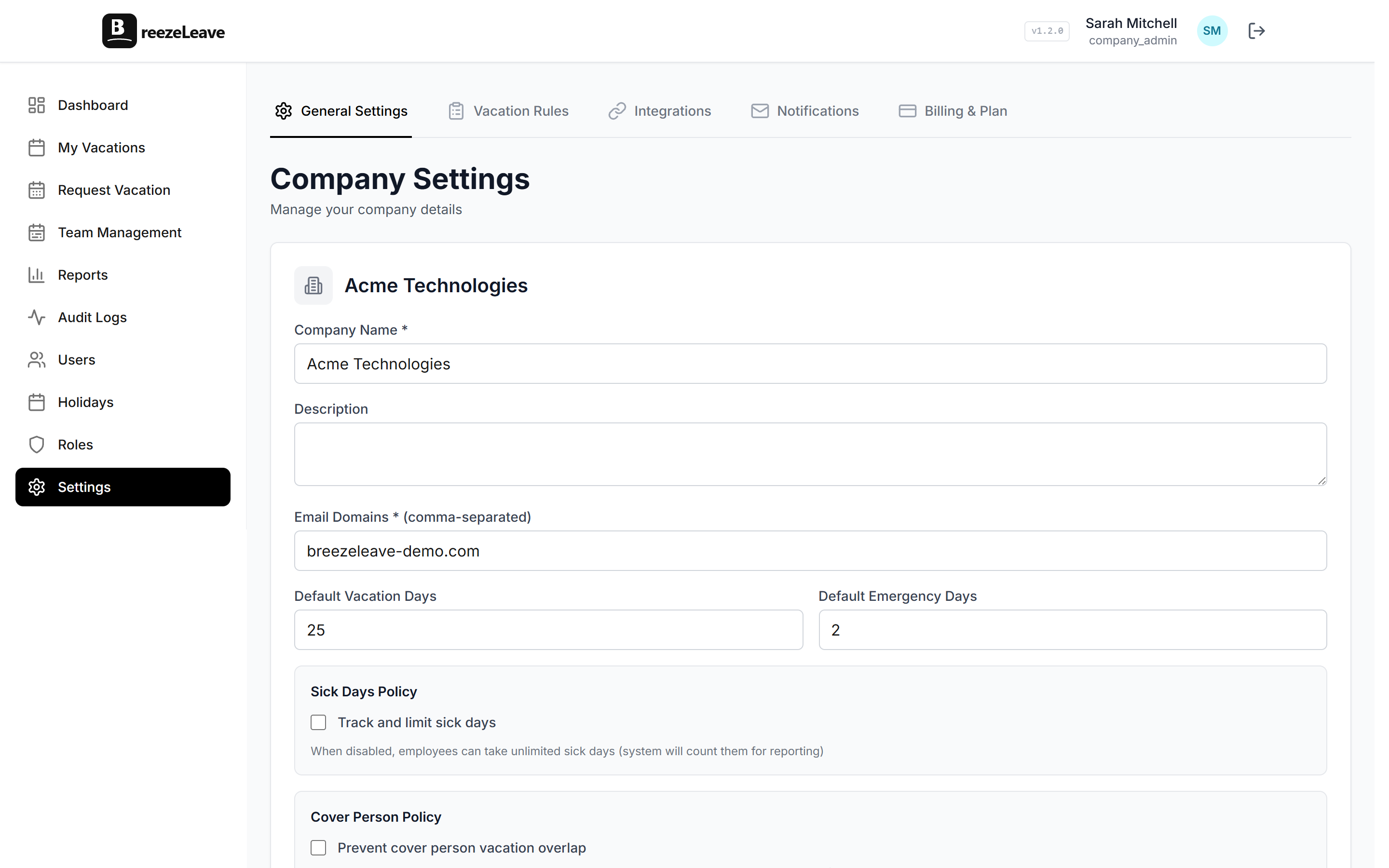
The setup itself is short. Before you start, the Slack integration has to be connected to BreezeLeave. The post on setting up the Slack vacation bot covers the connection step. Once Slack is connected, the digest is a few choices in Company Settings:
- Pick the channel for the away digest (this becomes Slack channel index 1).
- Pick the cadence (daily or weekly).
- Pick the post time (most teams use 09:00 local).
- Pick the window length (3 working days for daily, 5-10 for weekly).
- Decide whether to include sick leave or only planned leave.
The last choice is more cultural than technical. Including sick leave makes the digest more honest about who is unavailable today, but it can feel intrusive in some teams. Some HR admins post the planned-leave digest in a wide channel and reserve sick-day notifications for a smaller team channel. Both options are supported.
The slash command: who-is-off on demand
Alongside the scheduled digest, BreezeLeave exposes a slash command. The default is /breezeleave who-is-off, optionally scoped to a team:
/breezeleave who-is-offreturns the next N days of approved leave for the whole company./breezeleave who-is-off [team]returns the same list scoped to a single team.
The slash command is what team leads reach for when a meeting starts and they need a fast answer. It is ephemeral by default, meaning only the person who ran it sees the result. That avoids polluting busy channels with one-off lookups.
Encourage the team to learn the command. A digest that posts at 09:00 covers the scheduled rhythm; the slash command covers the meeting that starts at 11:30 when someone asks "wait, is Tomas around right now?" Both have a place.
Common digest mistakes
Four patterns come up often when reviewing existing Slack integrations.
- Wrong cadence for the team rhythm. A daily digest in a consultancy channel that only meets weekly becomes noise. A weekly digest in a support team changes too slowly to be useful.
- Window too long. A 14-day window catches every approved request but buries the actually-relevant information about today and tomorrow.
- Post time before approvals. A 07:00 digest misses anything approved earlier that morning. 09:00 or 10:00 catches the overnight approvals.
- One channel for everything. Action and away mixed. Approvers tune out. See the two-channel pattern above.
Each of these is reversible from Company Settings. Adjust, observe the team's reaction for a week, and adjust again if the digest still feels off.
When the digest does not post
If the digest fails to appear at the scheduled time, three causes account for almost every case:
- The Slack workspace token expired. Reconnect the integration from Company Settings. The bot needs a current token to post.
- The bot was removed from the channel. Re-invite the BreezeLeave bot to the away channel. Slack requires bot membership to post.
- The channel was renamed or archived. The integration stores the channel by ID, not by name, so renames are safe. Archival or deletion is not. Point the away channel setting to a fresh channel.
If none of those are the issue, check the audit log for a recent Slack integration change. The piece on audit logging for leave management covers how to read it. Integration settings changes show up there with a timestamp.
Tuning the digest for hybrid teams
Teams split across time zones have a slightly different problem. A 09:00 digest in Stockholm is 03:00 in San Francisco. Two patterns work for hybrid setups:
- Pick the time zone of the largest office. The smaller offices read the digest a few hours late but still get the day's information before their own morning. Most teams find this acceptable for a passive read.
- Run two digests in two channels. One per time zone, each scoped to its own team. This works when the teams operate independently. It does not work when one team needs to know about the other team's coverage.
BreezeLeave's digest configuration is per-company, so the second pattern requires either two channels with the same content posted at different times, or a single morning post that everyone reads on their own schedule. Most hybrid teams land on the single-post option after one or two iterations.
What the digest does not replace
The digest is a passive read. It is not a replacement for two operational pieces.
- The team calendar. A digest covers the next several days. The shared team vacation calendar covers the next several months. Sprint planning and roadmap conversations still need the calendar, not the digest.
- Coverage assignments. The digest tells the team who is out. It does not tell anyone who is covering. That is the cover-person field on the request itself, which surfaces in the manager view and in the calendar.
Use the digest for the standup-level question and the calendar for the planning-level question. Both are visible to the team; both serve a different rhythm.
When to use Teams instead of Slack
If half the company lives in Microsoft Teams and the other half in Slack, the digest question gets more interesting. BreezeLeave supports both, with the same two-channel idea. The Teams version uses adaptive cards instead of Block Kit; the digest output is similar but renders with more vertical space. The post on Microsoft Teams adaptive cards for leave approvals covers the Teams side.
Picking one over the other is usually a function of where the company already lives. Both integrations read the same approval records, so the digest content does not change between them.
Quick reference: digest configuration
- Connect Slack to BreezeLeave (see the Slack vacation bot setup post).
- Pick the away channel and confirm the bot is a member.
- Pick daily or weekly cadence based on the team rhythm.
- Pick a post time after most approvals land (09:00 or 10:00 local).
- Pick a window length that is short enough to be relevant (3-10 working days).
- Decide whether sick leave appears in the digest.
- Teach the team the slash command for on-demand lookups.
- Revisit the configuration after two weeks and adjust.
Most teams settle on a 09:00 Monday weekly digest with a 7-working-day window and the slash command available for ad-hoc checks. That covers the planning rhythm and the meeting that starts unexpectedly. To get the digest running in your workspace, head to connecting BreezeLeave to Slack.