Full HR Suite vs Dedicated Leave Management: Do You Need All Those Features?
HR suite vs dedicated leave management: we paid for a full platform when 80% of our team only used the vacation calendar. Here's what we learned.
Reviewed: 2026-05-13. Personio pricing is not published publicly and our last revalidation attempt against the Personio site was rate-limited, so feature scope and pricing references here may not capture the latest plan changes. Confirm details on the Personio site before deciding.
We used a full HR platform for everything. Payroll, onboarding, leave. The leave part was fine, but we were paying for the full suite when all 80% of our team used was the vacation calendar. Every quarter, somebody would ask "are we really getting our money's worth?" and every quarter the answer was "well, payroll uses it." Fair enough. But the leave module specifically? It was adequate. That is the nicest word I can use.
If you are evaluating a full HR suite vs a dedicated leave management tool, this is what I wish someone had told us before we signed that annual contract.
Enterprise HR Suites Are Good Software. That Is the Point.
Let me be upfront: these platforms are not bad products. They are well-built, comprehensive HR suites that have earned their reputation, especially with mid-sized companies. If you need everything in one system, an all-in-one HR tool does that:
- Recruiting pipelines
- Digital employee files
- Onboarding checklists
- Payroll (in supported countries)
- Performance reviews
- Leave management
The data flows between modules, new hires automatically get leave balances, and your HR team has one login for everything. That integration is genuinely valuable when you are using three or more of those modules. We had about 70 people when we started with our HR platform, and our Head of People used recruiting, onboarding, and the employee database daily. For her, it was worth every cent.
The problem was that for the other 65 people in the company, the platform was just the place where you go to request vacation days. And for that specific job, it felt like driving a tour bus to pick up groceries.
When a full HR suite makes sense
If your HR team actively uses 3+ modules (recruiting, payroll, onboarding, performance reviews) and you have 100+ employees, a full HR platform is a solid choice. The cost is justified by the operational efficiency across all those functions. Leave management comes included, and even though it is not the deepest module, it works well enough when it is part of a bigger system you are actually using.
Leave Management Inside a Full HR Suite: What You Actually Get
The leave module in a typical HR suite covers the basics. Employees can submit absence requests, managers approve or decline them, balances update automatically, and there is reporting for HR. It works. I am not going to pretend it does not.
Where It Starts to Grate
After two years of daily use, a few things started to grate:
- Slack integration is surface-level. You get notifications, sure. But you cannot request or approve leave from Slack. Every single time, you are clicking through to the HR platform's web app. For a team that lives in Slack eight hours a day, that context switch adds up. People would just DM their manager "I'm taking Friday off" and skip the system entirely. That defeated the whole purpose.
- The calendar view barely qualifies. It exists. But trying to see who across multiple teams is out next week required more clicks than it should have. We ended up maintaining a separate Google Calendar for "who's actually off" because the platform's view was not practical for quick planning.
- Auto-approval? Not really. We wanted to auto-approve half-day requests or single sick days. The platform's approval workflows are designed for the standard request-then-approve flow. Getting conditional logic in there (like "approve automatically if less than 2 days and team coverage is above 60%") was not possible without workarounds. If that kind of flexibility matters to you, we wrote about it in our guide to auto-approving vacation requests.
- Setup took weeks, not days. Configuring leave policies, accrual rules, carryover limits, approval chains per department. All of it required someone who really understood the platform. We hired a consultant for the initial setup. For a leave tool.
None of these are dealbreakers if you are already deep in a full HR platform. But if vacation tracking is the main thing your employees interact with, these rough edges become your team's daily experience with the tool.
What a Dedicated Leave Management Tool Does Differently
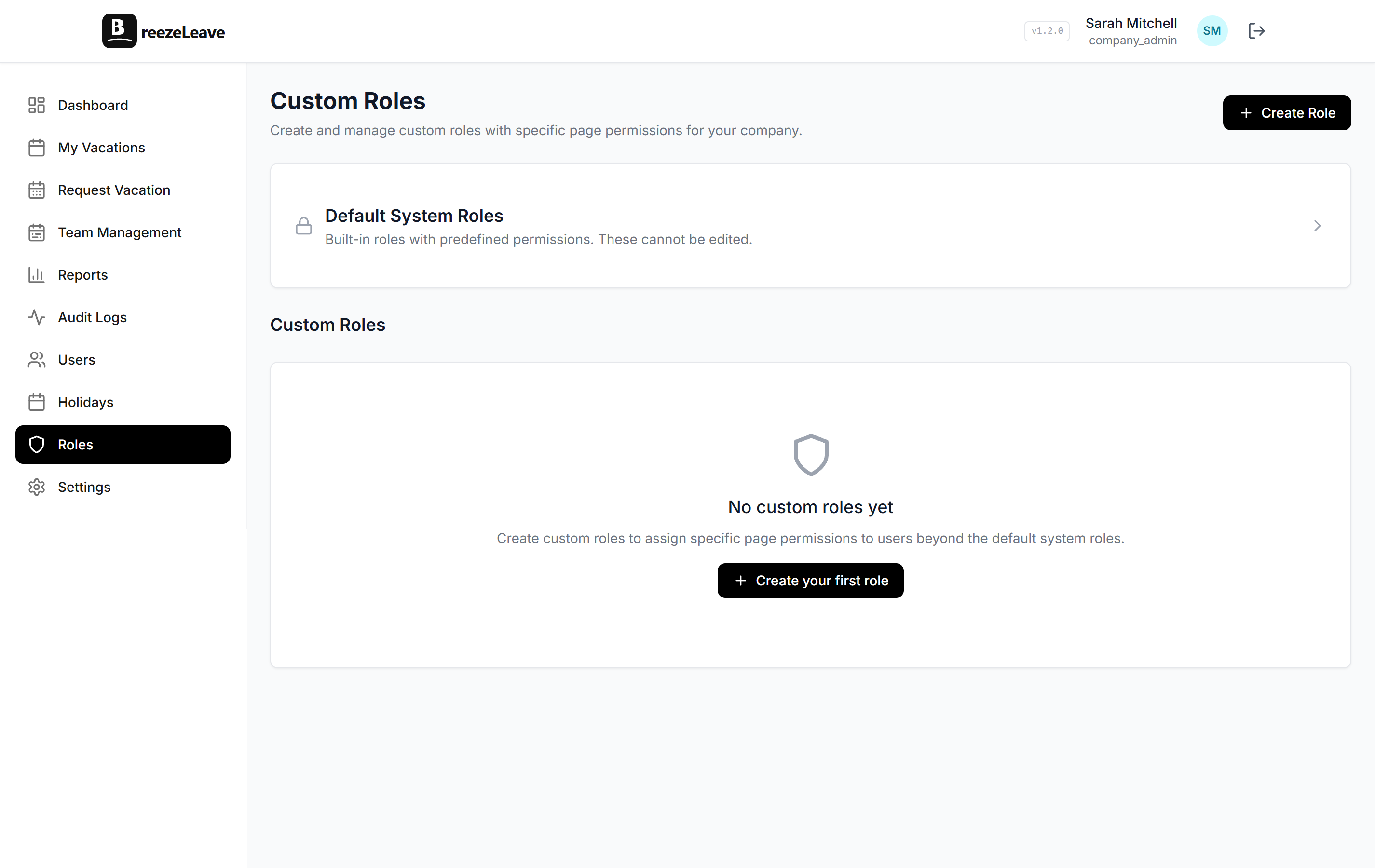
A dedicated leave management tool like BreezeLeave exists to do one thing well: make it dead simple for people to take time off and for everyone else to know about it. That is the whole product. No recruiting module. No payroll engine. No performance review cycles. Leave, and nothing else.
That focus changes the experience in ways that matter more than you would think.
Setup in an Afternoon
You connect Slack (or Teams), add your people, set your leave types and policies, and it is running. No consultant needed. No three-week implementation project. Our team had BreezeLeave working the same day we decided to try it.
Slack Integration That Is the Product
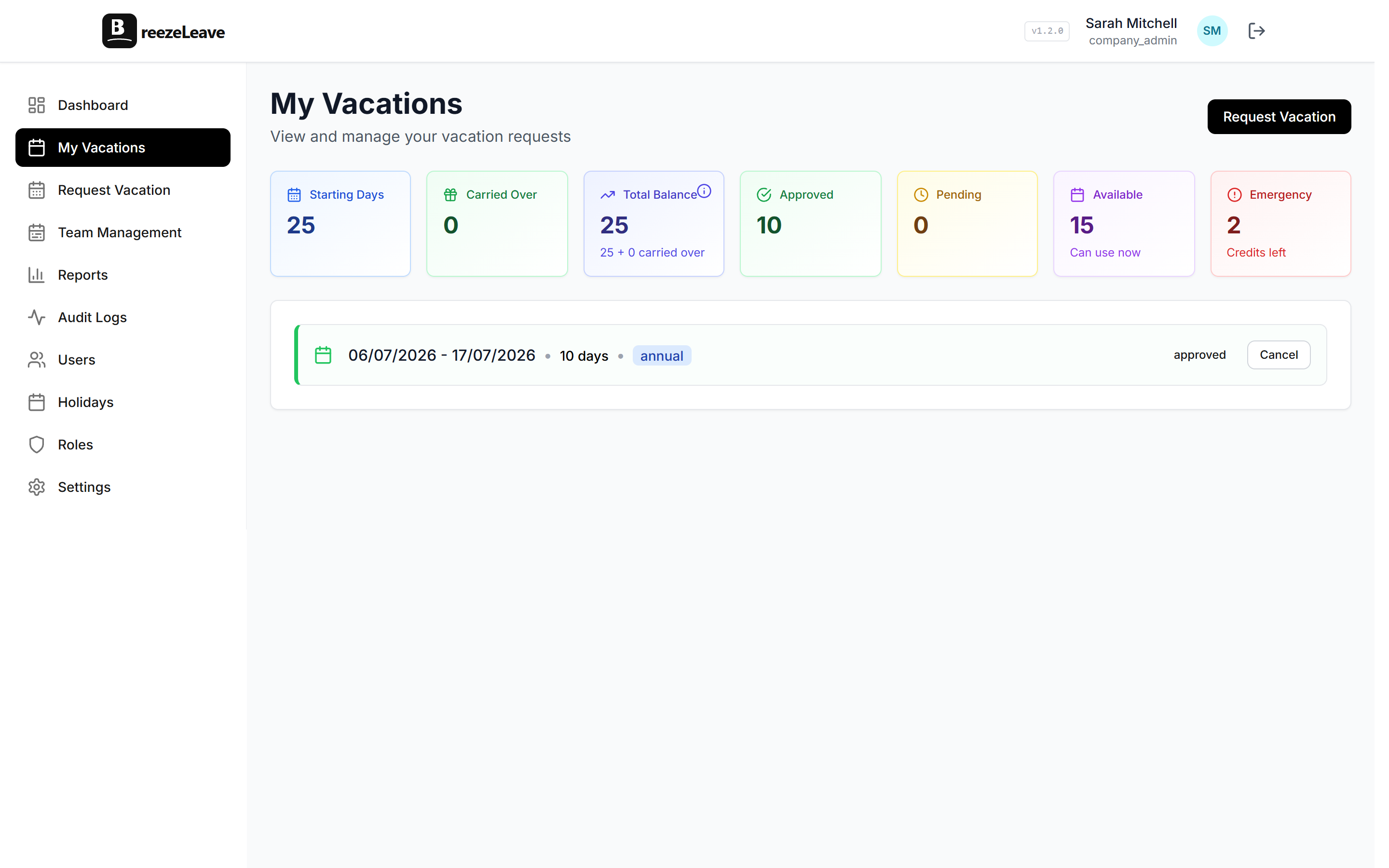
The Slack integration is the product, not a bolted-on notification layer. Employees request time off in Slack. Managers approve in Slack. The daily "who's out today" summary shows up in Slack. Nobody has to open a separate web app for something that takes 10 seconds.
A Calendar Built for the Right Question
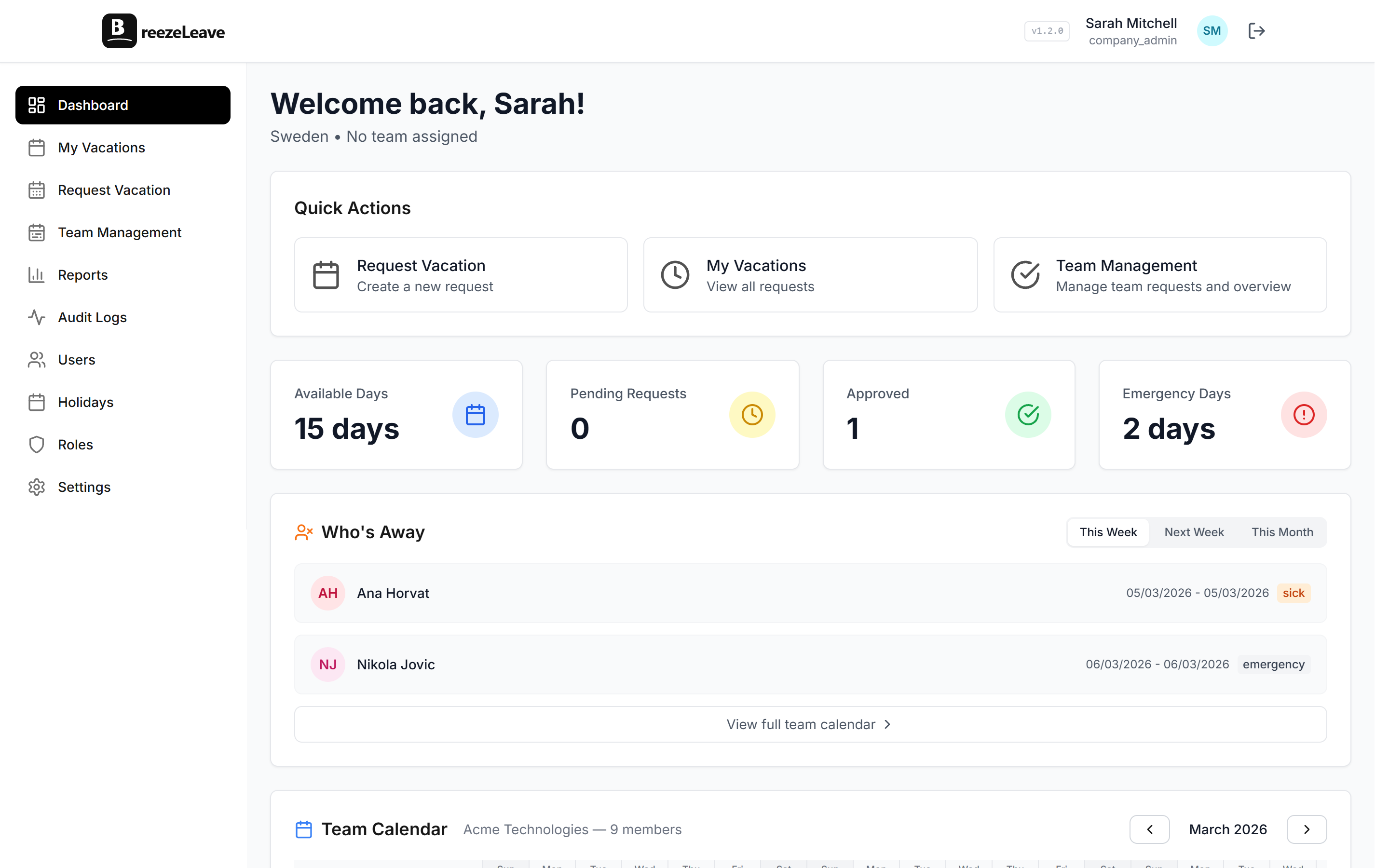
The team calendar is built for the question everyone actually asks: "who's off next week?" One view. All teams. Color-coded. Useful. Not buried three clicks deep inside an HR platform. We covered this topic more broadly in our piece on vacation tracking for growing teams.
Full HR Suite vs BreezeLeave: A Straight Feature Comparison
| Feature | Full HR suite | BreezeLeave |
|---|---|---|
| Primary focus | Full HR suite (leave is one module) | Dedicated leave management |
| Leave requests in Slack | No (notifications only) | Yes |
| Approve from Slack | No | Yes (one tap) |
| Auto-approval rules | Limited | Conditional logic supported |
| Team calendar | Basic (multiple clicks) | One-view, color-coded |
| Multi-country holidays | Supported | Supported |
| Calendar sync | Limited | Slack, Teams, Google Calendar |
| Setup time | Weeks to months | Same day |
| Pricing | ~$5-10/user/month (full suite) | Free <10 users, $1-1.50/user Pro (+ tax) |
This is not a case where one column is clearly better. It depends on what you are buying. If you need the full HR suite, buy one. If your actual day-to-day need is leave management, a dedicated tool will do it better for less money.
The Pricing Gap Between a Full HR Suite and a Dedicated Leave Tool
Most enterprise HR platforms do not publish pricing on their website, so you have to talk to sales. From what we have seen and heard from other teams, expect somewhere in the range of $5 to $10 per user per month depending on which modules you need and your company size. That is for the full HR suite. Annual contracts are standard. Implementation support costs extra.
The Math for a 50-Person Company
| Cost Factor | Full HR Suite | BreezeLeave (Pro) |
|---|---|---|
| Per-user cost | $5 to $10/month | $1 to $1.50/month (+ tax) |
| Annual cost (50 users) | $3,000 to $6,000 | $600 to $900 |
| Implementation cost | Extra (consultant often needed) | None |
| What you get | Full HR platform | Best-in-class leave management |
If your HR team uses everything, a full HR platform is a fine deal. But if 80% of your company only uses the vacation tracking, the math starts to look different. The savings are not the main argument (the better daily experience is), but they do not hurt either.
When You Should Stick with a Full HR Suite
There are real scenarios where a full HR platform is the right call. No question about it.
- You have 150+ employees and a dedicated HR team that manages recruiting, onboarding, performance cycles, and compliance. At that scale, a unified platform reduces data silos and operational overhead.
- You need integrated payroll in a market where your HR platform supports it. Having leave balances flow directly into payroll calculations without manual reconciliation is a real benefit.
- Your HR team is the primary user of the system, not your employees. If the people who interact with the tool most are HR professionals who need the full suite, a platform's breadth is a feature. Not bloat.
The honest take
Enterprise HR suites are strong products for companies that actually need full HR infrastructure. The mistake is not choosing one. The mistake is choosing it when leave management is the only thing 80% of your company will ever use it for. That is an expensive vacation calendar.
When a Dedicated Leave Tool Is the Smarter Move
If your company is between 10 and 200 people, you do not have a complex HR tech stack, and the thing that is actually broken is "nobody knows who's on vacation and we're still using a spreadsheet," then you do not need a full HR suite. You need a tool that solves that one problem well.
What BreezeLeave Is Built For
- Leave requests happen in Slack, where your team already works
- Approvals take one click
- The team calendar actually shows you useful information at a glance
- Public holidays are handled automatically per country
- You are not paying for a recruiting module that sits unused for three years
If your team spans multiple countries, you might also want to read our guide on managing PTO across countries, which covers the specific headaches of multi-country leave policies.
Our Experience After Switching
We switched our leave management from a full HR platform to BreezeLeave about eight months ago. The HR suite is still running for HR's other workflows, and that is fine. The two systems do not conflict. But the daily experience for our team improved right away:
- People actually use the system now instead of sending DMs
- Managers can see team coverage in two seconds
- Our ops person stopped getting "can you check my leave balance?" messages because everyone can just see it themselves
It Comes Down to One Question
Are you buying an HR platform, or are you buying a vacation tracking tool?
If you need an HR platform, evaluate the major enterprise HR suites. They all have trade-offs, but they are solving the same broad problem and doing it reasonably well.
If you need a dedicated leave management tool that your team will actually enjoy using, try BreezeLeave. See how it compares as a Personio alternative for leave management. It is free for small teams, takes 15 minutes to set up, and it does the one thing you need without asking you to pay for twenty things you do not. That is gonna save you a lot of frustration.
We spent two years learning that lesson. Hopefully this saves you the same trip.
Browse other comparisons on the BreezeLeave alternatives hub or check current plans on the pricing page.