
Cash Runway for Agency Owners: Budget Signals to Watch
An agency owner's guide to cash runway. The four signals worth watching each month, what the runway view does and does not do, and a worked scenario for a 12-person agency.
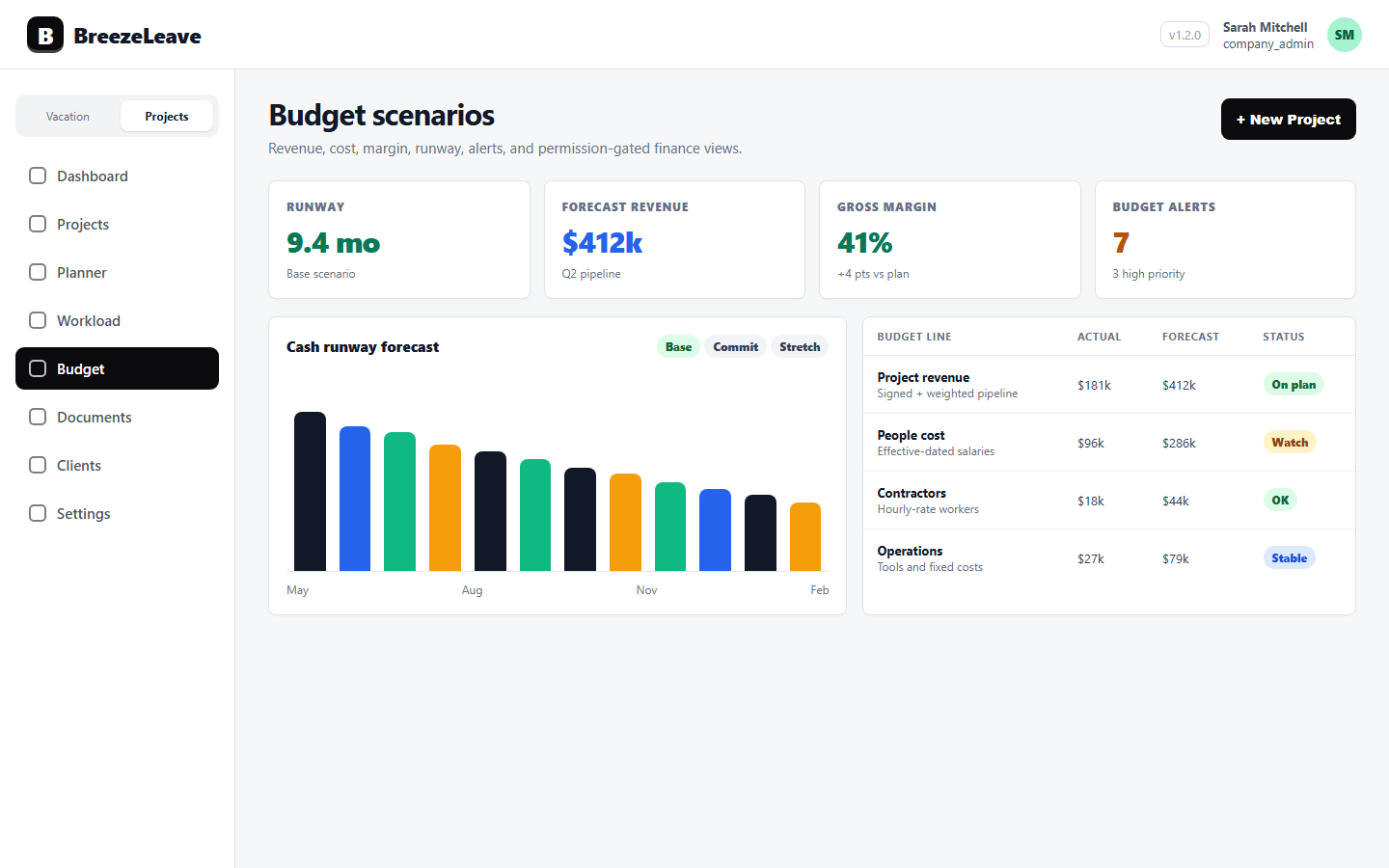
Most agency owners check the bank balance on Friday. The number looks reasonable, the pipeline looks reasonable, and the team is staffed. Three weeks later a retainer cancels, a hire that was supposed to start in 60 days starts in 30, and the same Friday-balance habit turns into a 3 a.m. spreadsheet session. Cash runway is the missing muscle for a lot of agencies between five and 25 people: the bank feels recent, but the burn picture is two months behind, and the gap is where the surprises live.
This article is for the agency owner who wants the runway number to sit next to the bank feed instead of buried in a finance lead's head. It covers what runway is for a service business, why agency runway is its own animal, the four signals worth watching each month, and a worked scenario for a 12-person agency. The numbers in the scenario are illustrative. Treat them as a template for the math, not a promise about your own books.
What runway actually means for a service business
Cash runway is the number of months a business can keep operating at its current monthly cost, using only the cash it already has. The formula is simple: cash on hand divided by monthly net burn. Net burn is monthly cost minus monthly revenue collected, and the word "collected" matters because invoices issued are not the same thing as cash in the account.
For a service business, the inputs to the formula are noisier than people sometimes assume. Cash moves on the invoice cycle, which can be Net 30, Net 45, or Net 60 depending on the client. Cost moves on the payroll cycle, which is fortnightly or monthly and basically non-negotiable. The gap between the two is what determines whether a slow-paying client puts the agency in trouble. The runway number is useful as an early warning, not as a precise prediction.
Runway is a management view. It is not a statutory cash-flow statement, and it does not replace the accountant's monthly close. The job is to show, on the second of every month, whether the agency can survive a quiet quarter at current cost levels.
Why agency runway is different
SaaS businesses have lumpy revenue at the start, then it smooths into ARR. Product businesses have working capital tied up in inventory. Agencies have a different problem: lumpy project revenue sitting beside steady retainer revenue, both colliding with payroll that does not flex.
Three patterns make agency runway its own thing.
- Project revenue arrives unevenly. A $90,000 project signed in March can land as $30,000 in April, $30,000 at milestone two in June, and $30,000 on sign-off in August. The runway view that averages it across the year hides cash gaps in May, July, and September.
- Payroll is fixed and growing. Headcount accounts for 60 to 70 percent of cost for most agencies. Once a person is hired, the cost is fixed until the agency reduces headcount, which is slow, expensive, and damaging to morale and delivery. Burn does not move quickly.
- Retainers are the stabiliser. Retainer revenue arrives in the same week of the month, every month, until a client churns. The retainer book is the closest thing to recurring revenue an agency has, and it is the lever owners pull when project revenue is lumpy. The trade-off is that retainer churn is invisible until it lands.
These three patterns mean the runway number has to be paired with the signals underneath it. A 4-month runway calculated against steady retainer revenue is a different animal from a 4-month runway built on three big project milestones, two of which slip.
The four signals to watch each month
On the first working day of the month, the agency owner and finance lead review four signals. The whole review is 20 minutes once the sources are in place. Decisions get made the same day.
| Signal | Source | What action it informs |
|---|---|---|
| Cash balance trend | Bank feed, monthly close | Whether to hire, defer hiring, or trim cost |
| AR aging | Accounting system aging report | Which clients to chase this week |
| Signed-but-unbilled revenue | Project module, signed contracts | Whether to invoice early or hold the milestone |
| Planned vs actual hiring | Headcount panel, HR pipeline | Whether to delay or accelerate the offer |
Each signal is small in isolation. Together they answer the question the runway number cannot answer alone. The runway number says how many months remain at today's burn. The signals tell you whether the picture is getting better or worse this month, and which lever moves the answer.
What the BreezeLeave runway view shows
The runway view reads starting cash, projected monthly burn, planned headcount, and the active forecast scenario. The result is months of runway expressed as a number that updates when any input changes. A planned hire moves the burn line. An expected retainer signing extends the inflow. A finance lead can toggle the scenario from baseline to downside and see the runway recalculate in place.
The view sits inside the budget section of the product. It is permission-gated, so finance leads and owners see the runway picture while delivery roles see project-level views without the company cash number. For the broader budget review where runway lives, see the agency budget reviews article.
A worked scenario: 12-person agency
Scenario. A 12-person agency with $180,000 in the bank. Monthly burn of $90,000, mostly payroll. Stated assumptions: invoices land on Net 30, retainer revenue is $45,000 a month and stable, project revenue is $40,000 average but lumpy by milestone, taxes and other outflows are inside the $90,000 burn figure. The agency is not loss-making; the runway number reflects worst-case "what if all client revenue stopped tomorrow?"
Baseline runway calculation, no inflows:
- Starting cash: $180,000
- Monthly burn: $90,000
- Runway: 2.0 months
Two months is short. The realistic runway, including expected retainer and project revenue, is much longer. The point of the worst-case number is to show how much pain the agency can absorb before the lights go out. Two months at zero inflow is the line that says "do not lose two retainers and a project at the same time."
Add a planned hire. A senior strategist at $8,000 loaded monthly cost, starting in 60 days. Burn rises to $98,000 from month three onward. Runway calculation against current cash, with the hire included:
- Months 1-2 burn: $90,000 each
- Month 3 onward: $98,000 each
- Cash drains to zero around 1.92 months at the higher burn rate, slightly faster than 2.0 baseline
Now add expected retainer revenue. The retainer book is $45,000 per month, stable. Net burn drops to $45,000 baseline ($90,000 - $45,000) and $53,000 after the hire ($98,000 - $45,000). Runway against current cash, with retainers in:
- Months 1-2 net burn: $45,000 each
- Month 3 onward net burn: $53,000 each
- Runway extends to roughly 3.8 months
Add expected project revenue, $40,000 a month average. Net burn drops further. The realistic runway is six months or more, but with a caveat: that number is sensitive to which project signs and which retainer churns. The "two retainers and a project" stress test from above still holds.
The scenario shows what changes the runway number and by how much. It does not say the agency is healthy or unhealthy. That conversation belongs in a review where the four signals get looked at together.
Where runway sits in the finance review
Runway is the headline number in a monthly budget review. The review itself is usually 45 to 60 minutes and covers:
- Last month closing cash vs forecast.
- Variance explanation for any line item over 10 percent off.
- Updated runway under baseline, stretch, and downside scenarios.
- Planned headcount changes and their cash impact.
- Retainer book status: new signings, churn risk, renewals due.
- Project pipeline weighted by probability.
- Decisions: hire, defer, push invoice, chase AR, raise prices.
Once the cadence is in place, the runway view becomes a referenceable number instead of a memory game. Decisions get made against the same picture every month, and the finance lead is not retyping spreadsheet inputs the night before. For the scenario mechanics, see the agency budget scenario review guide.
What the runway view does not do
A management runway view shows the picture for operating decisions. It does not show:
- Statutory cash-flow statements. Those live in the accounting system and are produced by the accountant. The runway view is faster and rougher than that work, by design.
- Tax planning. Quarterly tax, year-end reserve, VAT, and any country-specific obligations sit with the accountant. The runway view assumes the burn figure already includes them, not that they will appear separately.
- Investor reporting. If the agency has external investors, runway is one input to the report they receive. The report itself has more context and is produced quarterly.
- Operational P&L by client. Runway is a company number. Profitability by client and by project lives in the project budget views and the margin reports.
The runway view earns its keep when the owner and finance lead use it to make hiring and commercial decisions in real time. It does not replace the work the accountant does. It makes the conversations with the accountant faster, because the operational picture is already on the table.
Questions that come up
How often should runway be updated? Monthly is enough for most agencies. Weekly is useful when runway is under three months or when a major event is pending (a hiring round, a big client decision). Daily is overkill and creates noise.
What runway target is healthy? There is no single number that fits every agency. Common ranges are six months as a comfort floor and twelve months as a healthy buffer for an agency planning to hire. These ranges are guidance, not rules. The right target depends on client concentration, retainer share, and pipeline volatility.
Should retainer revenue be discounted in the runway calculation? It depends on retainer stability. Retainers with a long history and a long notice period can be counted at face value. New retainers or retainers with short notice periods are safer at 70 to 80 percent of face. Stating the discount in the assumption line keeps the number defensible.
How does planned headcount tie in? Every offer in the HR pipeline carries a planned start date and a loaded monthly cost. The runway view reads both and shifts the burn line by that amount, so the owner sees a future hire's effect on runway before signing the offer. The agency resource planning page covers the headcount side of the picture.
Setting the routine in place
Runway is a habit, not a tool. The tool makes the habit cheaper. An agency owner who runs the same 20-minute review on the first working day of every month, with the same four signals on the table, will catch most cash problems early enough to act on them. The view is the same the next month. The conversation gets easier. The decisions get faster.
For the underlying product flow, the cash runway and budget planning page shows how the runway view, scenario forecasts, and planned headcount sit together. For the wider budget mechanics, see project budget tracking.
Run a budget review with runway in view. The pricing page shows the plans that include budget views, runway, and scenario planning.
Related articles
Agency Budget Reviews: Categories, Scenarios, Cash Runway, Alerts, and Headcount
Project Financial Forecasting for Agencies: Scenarios, Cash Runway, and Headcount