Agency Budget Scenario Review Guide
A finance lead's guide to running a project budget scenario review. How baseline, stretch, and downside versions are built, defended, and used for staffing decisions.
It is the second Tuesday of the month at a 30-person agency. The owner has booked an hour with the finance lead to decide whether to approve a senior strategist hire. The finance lead opens the budget sheet, points at a row labelled "expected revenue Q3," and starts the argument the agency has every quarter. The owner thinks the number is conservative. The finance lead thinks two of the four proposals will not close. The sales lead believes one of those two is already verbal. Three opinions are circling one number that carries the hire decision. Nobody knows which version of the budget the number came from. This article is for the agency owner and finance lead who want a scenario review where the disagreement is about the assumption, not the spreadsheet.
A scenario is an alternate version of the same project budget with revenue, cost, margin, and capacity assumptions made explicit. The useful versions are "baseline," "stretch," and "downside." Each gets the same structure. Each names the four inputs behind any number. Each ties back to a real decision in the next 60 days. Without that structure, scenario planning is mood lighting.
The three scenarios that earn their seat at the review
Most agency scenario decks end up cluttered with seven versions that nobody can keep in their head. Three is enough if each one is committed to a specific job.
- Baseline. The version the agency would commit to today if no new deals closed and no current projects slipped. It counts signed work, retainers that have renewed, and the costs the agency is already running. The baseline is the boring, defensible number.
- Stretch. The version that adds work the agency is actively pursuing and reasonably expects to win. Stretch is not the aggressive sales forecast. It is the version that adds proposals with a verbal yes, retainer expansions the client has already signalled, and the cost of staffing that work.
- Downside. The version where one or two predictable things go wrong. A retainer pauses. A project slips a quarter. A key hire takes longer to make than planned. The downside is not the apocalypse scenario. It is the version that keeps the agency honest about how much margin and runway it actually has when something slips.
Each scenario answers a different management question. Baseline answers "are we okay if nothing changes." Stretch answers "what do we commit to if the next two deals close." Downside answers "can we afford the hire even if one of the four proposals does not land." Together, they decide hiring, project starts, retainer renegotiation, and discretionary spend.
The four inputs behind any scenario number
A scenario without named inputs is a wish. Every scenario should name four things on the same page as the numbers.
- Which revenue stays. List the signed projects, retainers, and pipeline rows that contribute revenue. State whether each row is invoiced, contracted, or pipeline. Pipeline revenue in a baseline is not the same as pipeline revenue in a stretch scenario.
- Which cost is added or removed. Salaries, employer contributions, freelancer commitments, subcontracts, tools, and overhead. State which costs are included and whether they are loaded with employer contributions or not. Two scenarios with the same headline margin can disagree by 8 points just on what "cost" means.
- Which capacity assumption changes. A new senior designer adds 0.8 FTE of senior design from week 6, not week 1. A delayed project releases 1.2 FTE in Q3, not in Q2. Capacity assumptions are usually where scenario optimism breaks delivery reality.
- What time window the scenario applies to. A scenario for the next 60 days is a hiring discussion. A scenario for the next 12 months is a strategic discussion. Mixing horizons inside one scenario produces a number that nobody can act on.
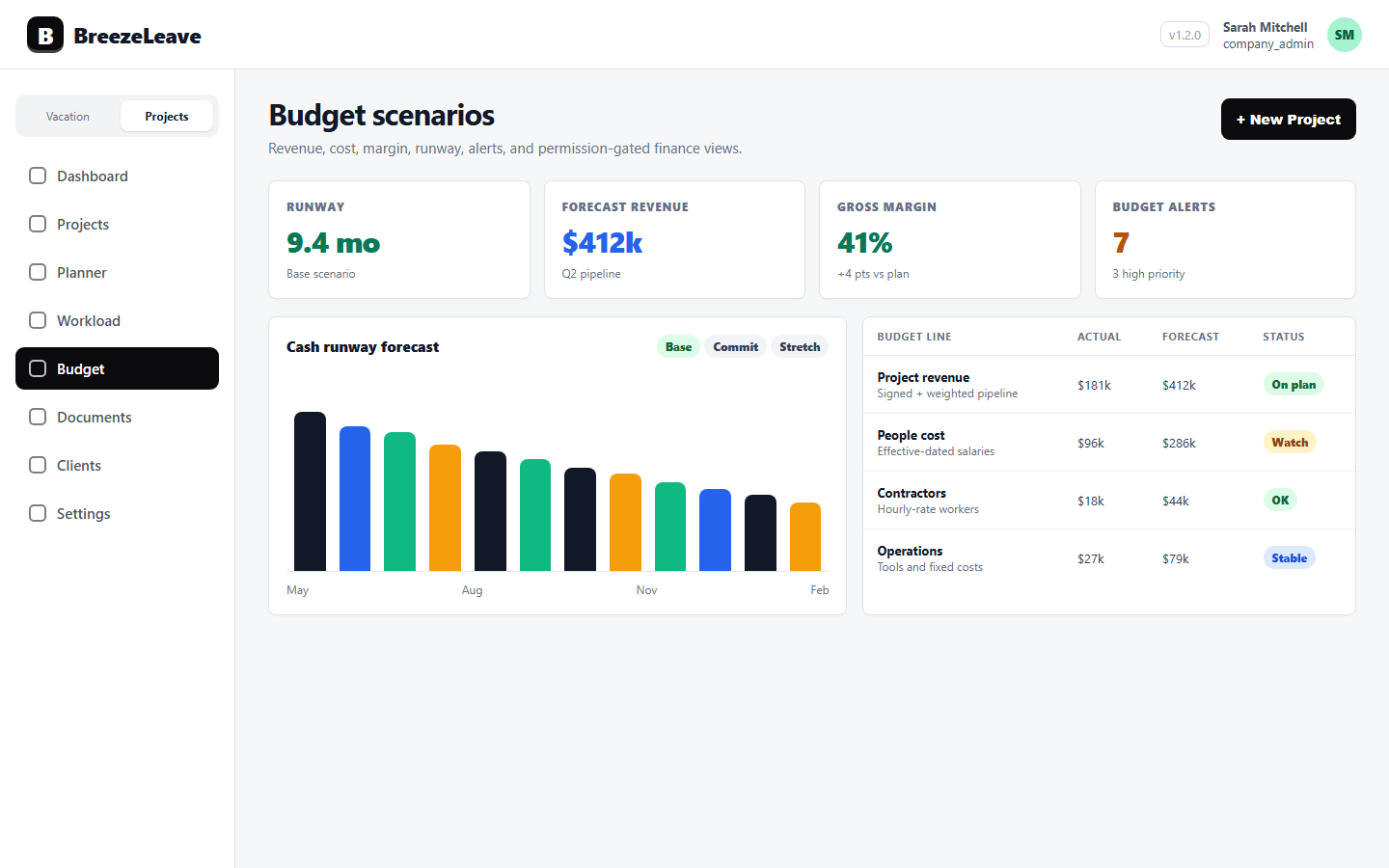
BreezeLeave keeps scenarios beside the live budget so the four inputs can be reviewed in place, with no separate operating plan to rebuild. The discipline is to write each input down. A scenario page that shows only the margin and runway summary is missing the conversation.
Build the baseline first
Most failed scenario reviews start with the stretch case because it is the most interesting. That is backwards. The baseline has to be defensible first, because every other scenario is a variation on it.
A clean baseline build takes about 45 minutes when the data lives in one place:
- List every signed project with its remaining recognized revenue. State the recognition rule, whether it is invoiced, delivered, or cash-based.
- List every retainer at its current monthly revenue. State the next contractual checkpoint.
- List loaded labor cost for the current headcount. Loaded means salary plus employer contributions plus a stated allowance for benefits and overhead.
- List committed freelance and subcontractor cost for the same window.
- Subtract cost from revenue to get baseline margin. Show it as both an absolute number and a percentage.
- Add starting cash. Compute runway by subtracting projected monthly net spend from starting cash until the cash line crosses zero.
Notice what is not in the baseline. No expected new wins. No "we should win that one" pipeline. No planned hires. No retainer expansions. The baseline is the agency without optimism. If the baseline does not survive, no scenario will.
Stretch and downside are deltas, not new sheets
Stretch and downside should always be built as changes from the baseline, not as separate models. That keeps the four inputs visible and prevents the "which sheet are we looking at" problem.
For a hiring decision in the next 60 days, the table below shows the shape of a defensible scenario set. The numbers are illustrative, not benchmarks. They depend on the agency's recognition window, cost definition, capacity assumption, and time horizon.
| Input | Baseline | Stretch (illustrative) | Downside (illustrative) |
|---|---|---|---|
| Which revenue stays | Signed projects, current retainers | Plus two verbal-yes proposals from May | Less one retainer that paused in April |
| Which cost is added or removed | Current loaded labor, committed freelance | Adds senior strategist from month 2 | Removes one freelancer who became unavailable |
| Which capacity assumption changes | Current FTE supply by role | Plus 0.8 FTE senior strategy from week 8 | Minus 0.3 FTE while reallocating coverage |
| Time window | May to September | May to September | May to September |
The hiring decision then becomes a defensible question. If the downside still leaves margin and runway above the agency's chosen thresholds, the hire is safer. If only the stretch case supports the hire, the hire depends on at least one of the two verbal-yes proposals closing, and that fact should be on the page.
Where scenario reviews quietly fail
Four patterns repeat across agency scenario reviews. Catching them early makes the meeting useful.
- Optimistic capacity in the stretch case. If the stretch adds revenue but does not add cost for the people who will deliver it, the stretch is mathematically clean and operationally impossible. Capacity assumptions move with revenue.
- Vague pipeline rows. "We are about to close that one" is not a scenario input. State the deal name, the contract value, and the realistic close date. If the row cannot survive that minimum, it should not be in the stretch case.
- Missing retainer signals. A retainer that quietly ran 30 percent over allocation for the last three months is not in the baseline if only its contract value is in the sheet. Pull the retainer burn into the baseline before any scenario is layered on top.
- Stale starting cash. Starting cash from two weeks ago is not the same number as starting cash today. Label the cash date on every scenario, and refresh it before the meeting.
A useful scenario survives a 60 second challenge
For each scenario, ask: "If I had 60 seconds to defend this margin number to a sceptical board member, can I name the four inputs?" If the answer is "I would have to open another sheet," the scenario is not ready.
Tie scenarios to decisions, not to dashboards
A scenario review without a decision attached is a status report. Before the meeting, the agency owner and finance lead should agree on the two or three decisions the scenarios are meant to inform. Typical ones include:
- Approve or defer a senior hire.
- Move a project start date forward or back by a quarter.
- Renegotiate a retainer that is consistently over allocation.
- Bring in temporary freelance support for a defined window.
- Decide whether to pursue a proposal that pulls a senior person off a profitable retainer.
Each decision needs the same minimum from the scenarios. What does baseline, stretch, and downside say about margin in the relevant window. What does each say about runway. What does each say about capacity by role. If those three answers do not differ across the scenarios, the decision does not need scenario planning. It needs a commitment.
For the profitability side of the same review rhythm, see project profitability review cadence for agency owners. A scenario review answers "what could happen." The profitability review answers "what is happening." Both belong in a monthly cycle.
Make the review permission-aware
Scenario data carries the same sensitivity as the underlying budget. Aggregate margin, runway, and labor cost are usually visible to the agency owner and finance lead. Per-person cost data is gated to a smaller group, because a single 100 percent allocation row can let a viewer reverse-engineer an individual salary. Treat scenario screenshots the same way: if a screenshot would name a person's loaded cost or a client's contract value, it does not belong in a broad channel.
BreezeLeave separates aggregate cost visibility from per-person cost visibility, which lets the finance lead share a scenario with delivery leads but keeps individual salaries hidden. The exact gating is configurable and worth a five-minute audit before a new role joins the review.
A monthly cadence the agency owner will trust
Once a month, in 60 minutes, the agency owner and finance lead can run the full review:
- Refresh baseline numbers and starting cash (15 minutes).
- Update stretch with current pipeline and named hires (15 minutes).
- Update downside with the one or two realistic risks (10 minutes).
- Walk through the two or three decisions on the agenda (15 minutes).
- Write the assumption changes down on the same page as the numbers (5 minutes).
The discipline is the documentation step at the end. Next month's review starts from a record of what changed and why. That is what prevents the same disagreement from happening every quarter.
Ready to run baseline, stretch, and downside scenarios beside the live budget instead of in three different sheets? Review project budget, runway, and staffing scenarios in BreezeLeave, and pair it with the ClickUp time tracking view so the labor cost feeding the scenarios is grounded in actual logged hours.
Related articles
Project Budget Tracking for Agencies: Revenue, Cost, Margin, and Retainers
Agency Budget Reviews: Categories, Scenarios, Cash Runway, Alerts, and Headcount