Project Financial Forecasting for Agencies: Scenarios, Cash Runway, and Headcount
How agencies can connect project revenue, costs, scenarios, cash runway, planned headcount, logged hours, and capacity signals in financial forecasts.
Agency financial forecasts usually look tidy until delivery gets involved. A spreadsheet says the next quarter is covered. Sales is confident about two proposals. Finance can see the expected revenue. Then delivery points out that the senior developer is on leave for two weeks, the retainer is already over its normal hour pattern, and the new project needs a designer before the hiring plan starts.
That does not mean the forecast was useless. It means it was incomplete. Agencies need forecasts that connect commercial assumptions to the delivery reality underneath them: project revenue, costs, cash runway, planned headcount, logged hours, workload, PTO, and available capacity.
A good forecast does not only ask, "Will the work close?" It also asks, "Can we deliver it, with the team we actually have, at the margin we expect?"
Start with the operating question
The most useful agency forecast starts with a plain operating question. What happens if the work we expect actually arrives?
That sounds obvious, but many forecasts stop at revenue probability. A proposal is weighted at 60%. A retainer is assumed to renew. A project is expected to expand. Those assumptions are important, but they are only the commercial layer. The delivery layer needs its own checks before the forecast can be trusted.
- Use project revenue and retainer expectations as the commercial input.
- Use project costs and expected margin to understand whether the work is worth taking.
- Use logged hours and workload to check whether delivery is already drifting.
- Use planned headcount and capacity forecasts before hiring decisions harden.
- Use cash runway and alerts to understand timing risk.
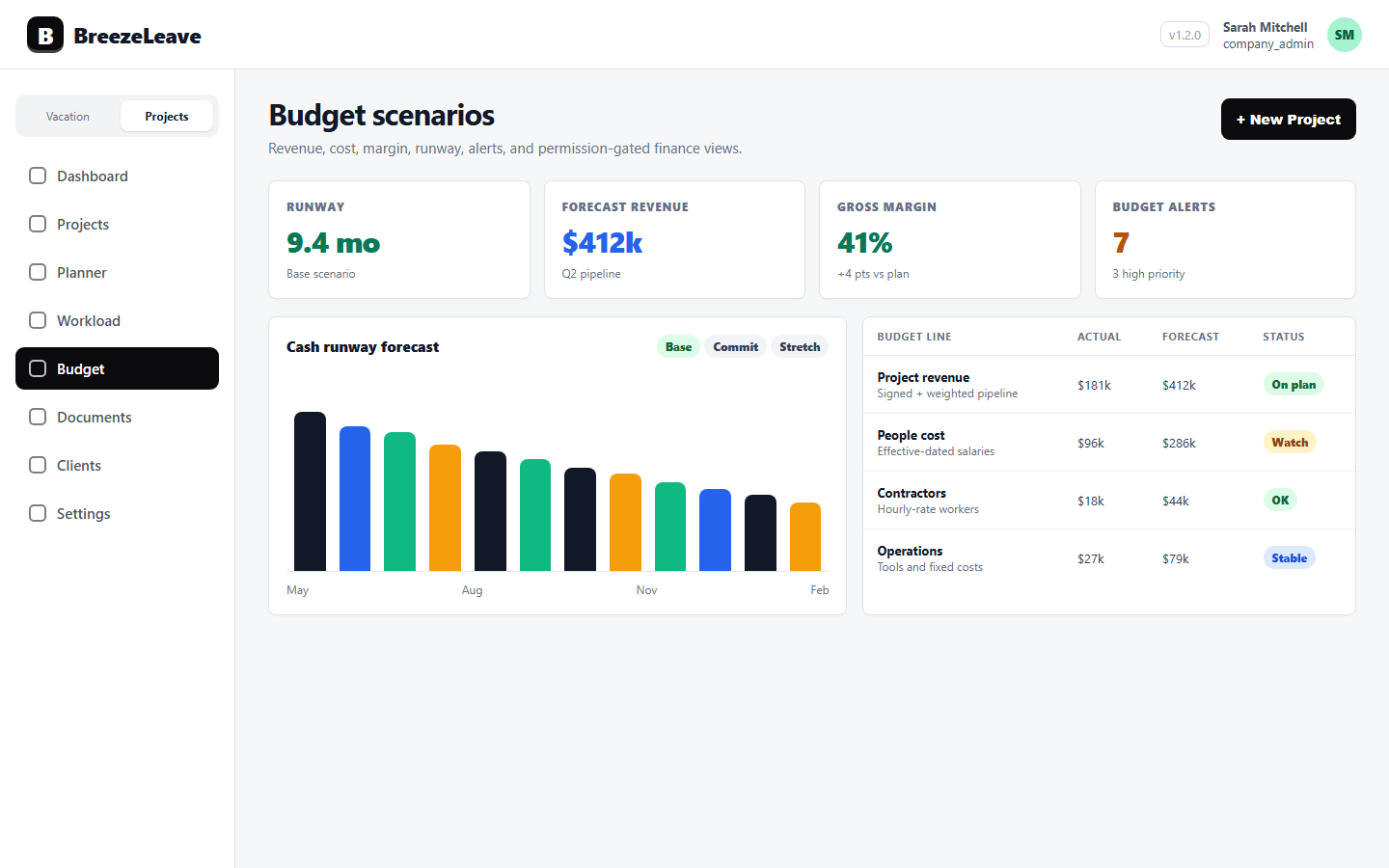
BreezeLeave connects project financial data, budget scenarios, forecast methods, report views, cash runway, planned headcount, logged hours, workload, and capacity planning so an agency can review the business with operational context. Finance gets the numbers. Delivery gets the capacity picture. Leadership gets a forecast that is less dependent on optimism.
If your team is still separating these conversations, start with the related workflows for project budget tracking and project capacity planning. The financial forecast becomes much cleaner once budgets and capacity are reviewed together.
Build scenarios from delivery reality
Scenario planning is where forecasting becomes useful. Not because agencies can predict the future perfectly, but because they can see what changes when assumptions move.
A simple agency forecast often needs three scenarios:
| Scenario | What It Tests | Delivery Question |
|---|---|---|
| Base case | Expected retainers, signed work, likely renewals | Can the current team deliver without planned margin erosion? |
| Upside case | New project wins, expanded retainers, faster starts | Which roles become constrained first? |
| Downside case | Delayed starts, reduced scope, slower collections | How long can the agency protect runway and avoid rushed cuts? |
The mistake is treating these as finance-only versions of the same spreadsheet. The upside case is not just "more revenue." It may also mean more subcontractor cost, lower utilization while onboarding a new hire, or a delivery bottleneck in one role. The downside case is not just "less revenue." It may mean bench time, delayed hiring, or moving people from lower margin work to protect a strategic client.
This is where logged hours matter. If a project is halfway through its timeline and has already consumed 70% of the expected effort, the base case should change. If a retainer usually burns 90 hours a month but is tracking toward 140, the next month should not be forecast as normal unless the scope has changed or the team has corrected the pattern. For the delivery side of that review, see workload capacity planning with PTO and logged hours.
Model cash runway as timing, not just totals
Agencies rarely get into trouble because nobody knew revenue mattered. They get into trouble because timing gets compressed. Payroll is monthly. Contractors invoice on schedule. Clients pay later than the delivery team does the work. A forecast that only looks at total project value can miss the cash pressure in the middle.
Cash runway should be reviewed with timing assumptions attached:
- When does the project actually start producing billable work?
- When is revenue expected to be invoiced?
- When is payment realistically expected?
- Which costs arrive before cash comes in?
- Does planned headcount increase before the work is signed or after?
A practical example: an agency expects a $90,000 project to start in June. The forecast looks healthy on paper. But the project requires two months of heavy delivery before the first major payment arrives, and the agency also wants to hire a full-time specialist in July. The scenario should show both versions: one where hiring begins before collection, and one where the agency uses existing capacity or short-term support until payment timing is clearer.
Runway review habit
Review cash runway alongside project start dates, likely payment timing, and planned headcount. The question is not only whether the work is profitable. It is whether the agency can carry the delivery cost before cash arrives.
BreezeLeave's financial forecasting context is useful here because cash runway, scenarios, budget views, logged hours, and capacity signals can be reviewed in the same operating conversation. The goal is not to replace accounting. It is to give agency leaders earlier warning when a delivery plan and a cash plan are pulling in different directions.
Use headcount planning carefully
Hiring decisions are where forecast optimism becomes expensive. A new person can be exactly the right move, but the forecast should show why the role is needed, when the capacity is needed, and what happens if the work slips.
Before adding planned headcount to the forecast, separate three different signals:
- Role demand. Which role is actually constrained: design, engineering, account management, QA, strategy, or leadership review?
- Timing. Is the constraint steady for the next six months, or is it a four-week spike caused by overlapping deadlines?
- Utilization quality. Are people truly full, or are logged hours revealing rework, scope creep, meetings, and underpriced support?
A forecast can then compare options without pretending every capacity problem requires the same answer. One scenario may add a full-time hire in September. Another may move work between teams, delay a lower priority project, or use temporary support for a defined period. For agencies, that distinction matters because permanent headcount changes the cost base even if project timing changes.
Capacity planning gives this discussion a firmer base. PTO, public holidays, planned slots, current workload, and logged hours all affect whether a team is actually available. A team with ten people is not ten full-time people every week. Vacations, holidays, part-time schedules, and client commitments all reduce usable capacity. That is why headcount forecasting belongs next to project capacity planning for agencies, not in a disconnected hiring spreadsheet.
Keep finance data permission-aware
Forecasting often involves sensitive fields: salary assumptions, person-cost, cost per hour, project margin, client commercial terms, and runway. Those numbers should not be exposed broadly just because delivery teams need operational context.
The clean pattern is to separate financial visibility from planning visibility. Leadership and finance can review revenue, cost, margin, cash runway, scenarios, and alerts. Delivery managers can still review the parts they need to run the work: project demand, planned hours, logged hours, workload, PTO, and capacity. BreezeLeave supports permission-gated financial views so sensitive finance data can stay role-aware while the operating picture remains useful.
This is not only about privacy. It also makes the forecast easier to use. Account managers should not need salary-level access to see that a project is short on delivery capacity. Team leads should not need margin dashboards to know that a July launch overlaps with two planned vacations. Finance should be able to review cost and runway without asking managers to rebuild the workload picture in another file.
Review the forecast weekly, not perfectly
A forecast that is updated once a quarter is usually too stale for agency work. Projects move, retainers expand, people take leave, logged hours drift, and hiring plans change. The review does not need to become a two-hour ceremony. It needs a consistent set of questions.
- Which projects changed commercial status since last week?
- Which budgets or retainers are consuming hours faster than expected?
- Which roles are becoming constrained in the next 30 to 60 days?
- Which PTO or public holiday periods reduce delivery capacity?
- Which scenario now looks most realistic: base, upside, or downside?
- Does cash runway still support the planned hiring and delivery timing?
The value comes from seeing the same signals together. A delayed project might improve short-term capacity but weaken runway. A new project might strengthen revenue but overload a role that is already behind. A clean week of logged hours might confirm that the forecast is still usable. A messy week might tell finance that margin assumptions need another look.
For margin-focused reviews, the natural companion is our guide to project profitability metrics for agency owners. Forecasting sets the expectation. Profitability review tells you whether reality is following it.
The bottom line
Project financial forecasting is not about building a prettier spreadsheet. It is about making better operating decisions before the agency is boxed in.
The forecast should help leadership decide when to hire, when to slow down, when to protect cash, when to renegotiate scope, and when to say yes to new work. To do that well, it needs the same information delivery teams use every week: planned work, logged hours, PTO, workload, role demand, and capacity.
The best agency forecast is not the most optimistic one. It is the one that shows what the business can actually deliver, fund, and staff.