Project Profitability Metrics for Agency Owners
Which project profitability signals agency owners should review across revenue, cost, margin, logged hours, retainers, owners, and client work.
Project profitability looks simple when it is reduced to one margin number. The project made money or it did not. The client is profitable or it is not. The owner dashboard is green or red.
Agency owners know the real story is messier. A fixed project can show a good margin while QA is quietly running over. A retainer can look healthy until the last week of the month. A client can be profitable on paper but absorb too much senior attention. A delivery team can hit the budget and still be one vacation overlap away from slipping the next milestone.
The goal of a profitability review is not to turn every owner into a finance analyst. It is to give leadership a practical operating rhythm: revenue, cost, margin, logged hours, retainers, client health, owner accountability, and capacity all reviewed together while there is still time to adjust.
Start with the core profitability numbers
The basic project profitability view starts with expected revenue, delivery cost, and margin. Those are still the numbers owners need first because they answer the simplest question: after the agency delivers the work, what is left?
- Revenue is the value of the project, retainer, or billing period.
- Delivery cost is the cost attached to the effort required to deliver the work.
- Margin is the difference between revenue and cost, usually reviewed as both an amount and a percentage.
The mistake is treating those numbers as a finished answer. A project with a 35% expected margin can still be in trouble if the team has already used 70% of the planned hours before the first milestone is accepted. A retainer can show positive margin while the account owner knows the client is asking for more meetings, more revisions, and more senior review than the agreement assumed.
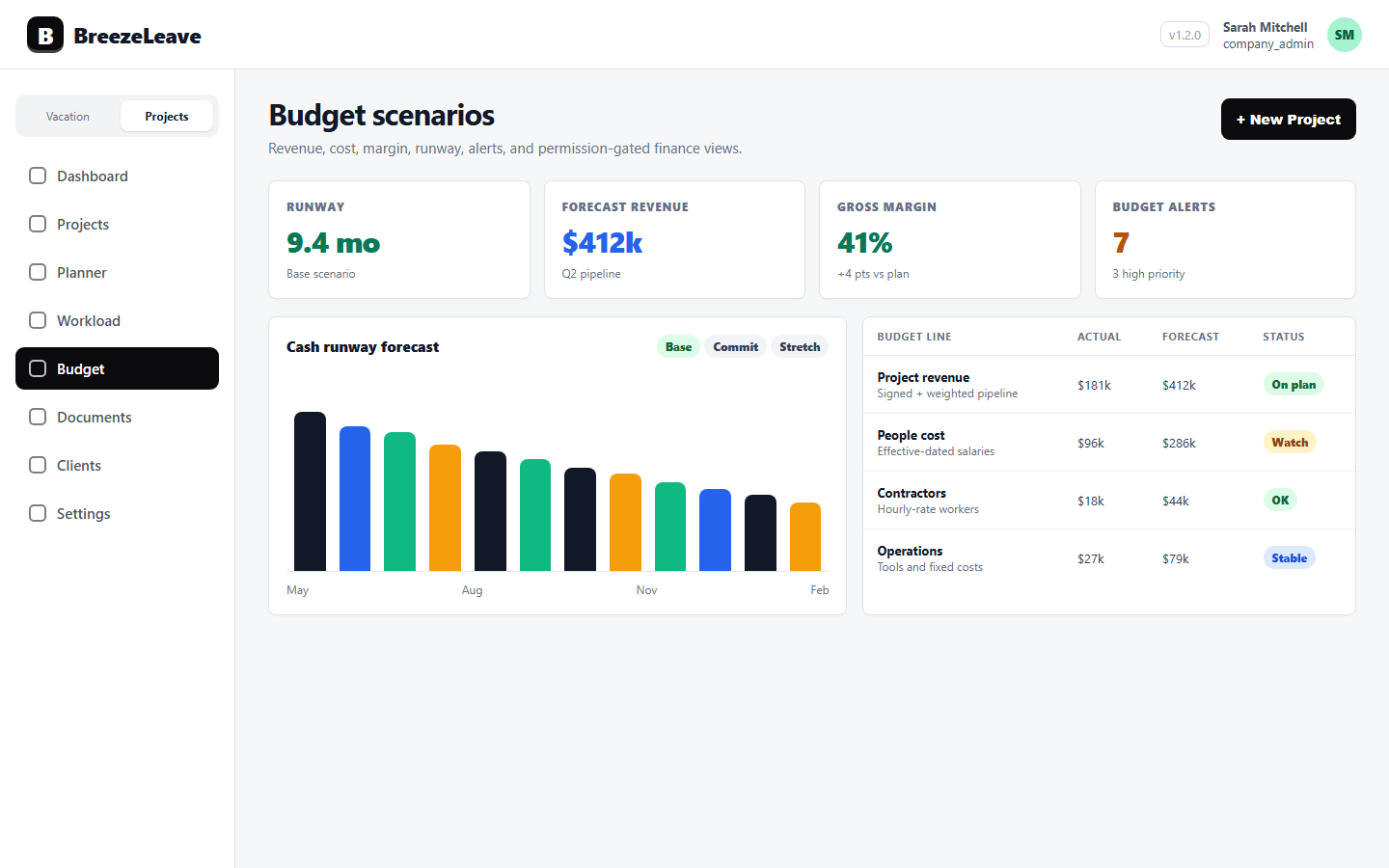
BreezeLeave supports project revenue, cost visibility, margin context, retainers, payment schedules, owner analytics, budget views, and permission gates for sensitive financial data. That gives owners a better way to connect the finance view with the delivery reality instead of reviewing them in separate spreadsheets.
For the budget side of this workflow, start with project budget tracking.
Use logged hours to explain why margin moved
Profitability changes for a reason. Logged hours are usually where that reason first shows up. If a project is losing margin, the owner needs to know whether the problem is scope, estimation, staffing, time hygiene, or a normal short-term spike that will settle down.
A useful owner review does not stop at "this project has too many hours." It asks better questions:
- Are hours moving faster than the project plan expected?
- Is one phase, such as discovery, QA, or client revisions, heavier than planned?
- Are senior people doing work that should have been handled by a lower-cost role?
- Are missing or late time logs making the margin look cleaner than it really is?
- Is the team logging time to the right client, project, retainer, or internal work?
This is where ClickUp time data becomes more than a timesheet. When logged hours sit next to project budgets and client records, owners can see whether delivery is drifting before the monthly finance review turns it into a surprise.
BreezeLeave connects profitability review with ClickUp time tracking and project budget tracking.
Safe example
A $30,000 project is planned at $18,000 of delivery cost, leaving $12,000 of expected margin. Halfway through the timeline, logged hours suggest the team has already consumed $12,000 of cost. The project is not automatically doomed, but it needs review now: remaining scope, staffing mix, client feedback loops, and whether the next milestone can be delivered without turning the final margin into guesswork.
Review retainers on a monthly rhythm
Retainers deserve their own profitability habit because they rarely fail all at once. They leak. A few extra calls, a few unplanned requests, one overloaded specialist, one month of "just this once" work. By the time the agency notices, the client relationship may already expect a service level the retainer does not support.
Owners should review retainer profitability with three layers in view:
- Commercial layer. Monthly revenue, expected delivery cost, payment schedule, and margin.
- Delivery layer. Planned hours, logged hours, open work, milestones, recurring commitments, and handoffs.
- Relationship layer. Client health, account owner notes, change requests, and whether the client is asking for work outside the agreement.
A retainer that is slightly over hours one month may be fine. A retainer that is over hours three months in a row is not a time-tracking issue. It is a commercial conversation. The owner needs to decide whether to reduce scope, increase the retainer, adjust staffing, or accept the lower margin intentionally because the account has strategic value.
BreezeLeave supports retainers with client and project structure, monthly allocation context, logged hours, and budget visibility. That keeps the retainer review close to the work instead of leaving it as a separate finance exercise.
Separate project profit from owner performance
Owner analytics are useful when they create coaching and clarity. They become harmful when they turn every difficult account into a blame exercise. A project owner can inherit a bad estimate, a difficult handoff, an understaffed team, or a client that changed direction after kickoff. Profitability review should make those causes visible.
A balanced owner review looks at the portfolio, not just one project:
- Which projects under this owner are ahead, on plan, or drifting?
- Which clients are profitable but operationally heavy?
- Which retainers need a scope or pricing discussion?
- Which projects need clearer documents, milestones, or handoffs?
- Which risks repeat across the owner's accounts?
The point is pattern recognition. If one owner has three projects where client revisions are consuming the margin, the agency may need a better change-control process. If another owner has profitable clients but constant delivery pressure, the issue may be capacity planning, not account management.
Connecting profitability to client project management for agencies helps the agency move from reporting to decision-making because the owner can inspect the client, project, retainer, documents, health status, and budget context in the same operating loop.
Add capacity before making margin promises
A profitability review that ignores capacity can create false confidence. The budget may say the agency can deliver the remaining work profitably, but the team calendar may say the right people are unavailable when the work needs to happen.
That matters for agencies because margin is often protected or lost through scheduling:
- A senior developer covers a gap because the planned developer is out.
- A designer context-switches across too many accounts and work takes longer.
- A public holiday reduces the week, but the milestone date stays unchanged.
- A project looks profitable until PTO pushes work into rushed overtime or rework.
None of those are reasons to block vacation by default. They are reasons to connect leave, workload, and project planning before committing to dates or margin targets. BreezeLeave brings project capacity context into the same conversation as logged hours and budget health, so owners can see whether the remaining work has enough real capacity behind it.
For the planning side, see project capacity planning and the agency guide to connecting PTO, workload, and budget.
A practical profitability review workflow
The healthiest agencies do not wait for a quarterly postmortem to learn which work is profitable. They build a short weekly review and a deeper monthly review.
Weekly owner review
- Check active projects and retainers by owner, client, and health status.
- Review expected revenue, current cost, and margin direction.
- Compare planned work with logged ClickUp hours.
- Identify projects where hours are moving faster than milestones.
- Check upcoming PTO, holidays, and workload before promising new dates.
- Assign the next action: scope clarification, staffing change, client conversation, or budget review.
Monthly leadership review
- Review profitability by client, project type, retainer, and owner.
- Look for repeated margin pressure, not just one-off exceptions.
- Compare client health with profitability so relationship risk is not hidden.
- Review payment schedules and cash timing where they affect operating decisions.
- Decide which retainers need repricing, scope changes, or capacity changes.
- Document what changed so next month's review starts from a shared baseline.
This workflow keeps the review practical. Owners do not need every possible metric on the screen. They need the few signals that change decisions: which work is healthy, which work is drifting, why it is drifting, and who owns the next move.
Profitability review is most useful before it becomes accounting history. Once the project is closed, the margin can only explain what happened. During delivery, it can still change what happens next.
Keep sensitive data permission-aware
Project profitability often includes sensitive information: cost rates, salary-derived assumptions, person-cost data, margin, and client financial details. Owners need access to the full picture, but that does not mean every project participant should see every number.
A good agency workflow separates operational visibility from sensitive financial access. Delivery leads may need project health, planned work, logged hours, capacity, documents, and client context. Finance and owners may need cost, margin, payment schedules, scenarios, and reporting. BreezeLeave supports permission gates for sensitive financial data so the review can be useful without spreading cost information through exports and chat threads.
That balance matters. If the data is too restricted, delivery teams cannot act. If it is too open, the agency creates unnecessary risk. The right design gives each role enough context to make better decisions and keeps sensitive fields where they belong.
The owner-level scorecard
If you want a simple owner dashboard, keep it boring. The best scorecard is not the one with the most charts. It is the one leadership actually reviews every week.
| Metric | What it tells you | What to do with it |
|---|---|---|
| Expected margin | Whether the work is commercially healthy on the current plan | Review pricing, scope, or staffing if the trend weakens |
| Logged vs. planned hours | Whether delivery effort is moving faster than expected | Inspect phase, role, card, and time hygiene patterns |
| Retainer burn | Whether recurring work is staying inside the monthly agreement | Adjust scope, monthly allocation, or account expectations |
| Client health | Whether financial health matches relationship health | Escalate before a profitable account becomes operationally risky |
| Capacity risk | Whether the team can deliver the remaining work with real availability | Move dates, shift staffing, or reduce committed scope |
That is enough to run a serious review. Revenue, cost, margin, retainers, logged hours, client health, owner accountability, and capacity give the agency a clean path from "what changed?" to "what do we do next?"
Related articles
Project Budget Tracking for Agencies: Revenue, Cost, Margin, and Retainers
Agency Budget Reviews: Categories, Scenarios, Cash Runway, Alerts, and Headcount