Agency Capacity Planning Across Multi-Country Holidays
An agency owner and delivery lead guide to capacity planning that respects multi-country public holidays, PTO, and logged hours across distributed delivery teams.
At a 35-person digital agency with delivery teams in three countries, the delivery lead opens the workload view on a Wednesday and notices the design team is over-allocated for the next two weeks. The capacity number says 240 hours. The plan says 280. The gap is 40 hours she has to find somewhere. On closer look, the German designers are out for Pentecost on Monday, the Polish team is off for Constitution Day on Friday, and one senior designer is on vacation the second week. Three of those four facts were not in the planning sheet the agency owner reviewed at the partner meeting on Monday. The plan was wrong before anyone touched it.
This article is for the agency owner or delivery lead running capacity planning across a distributed team that spans more than one country. The thing that breaks agency capacity is not the PTO calendar by itself, or the public holiday calendar by itself. It is the union of both, applied per person, in the same week-view the plan is built in. The work below is about getting that union right when the team has a single capacity view rather than three tabs.
Why multi-country holidays compound the capacity problem
A single-country agency loses 8 to 14 working days per year per person to public holidays. The number is stable, the dates are predictable, and the planning plan can hardcode them. The math gets harder fast when the team is distributed:
- Different days off per person. A US designer has July 4. A UK designer has bank holidays. A German developer has Pentecost. The agency's combined capacity per week depends on the country mix on each project.
- Bridge day patterns vary by country. In Croatia, a Thursday holiday often becomes a long weekend. In Sweden, the same dates lead to a full week off because of the Midsommar tradition. The planning math has to account for cultural patterns, not just statutory holidays.
- Holiday clusters in some countries are dense. May in Poland is a dense holiday window. June in Croatia and Slovenia stacks two or three national days. December in much of Europe involves a year-end shutdown. Project timelines that cross these months need explicit buffer.
- One project, three countries, one delivery date. The client does not care whether the team is missing the Polish designer or the Croatian PM. Either way, the deadline is the deadline.
Agencies that ignore the holiday math under-deliver in May, June, and December every year. Agencies that name the math get faster at planning realistic timelines.
The capacity formula that respects holidays
Per person, per week:
- Working days = 5 minus public holidays in the person's country for that week.
- Available days = working days minus approved PTO.
- Billable hours = available days times daily billable target (typically 6 to 7).
Sum across the team for the team's available billable hours. Sum across the sprint or month for project-level capacity. The math is simple. The hard part is keeping the inputs current, which is where the leave tool earns its place in the agency stack.
Holiday calendars per country, configured once
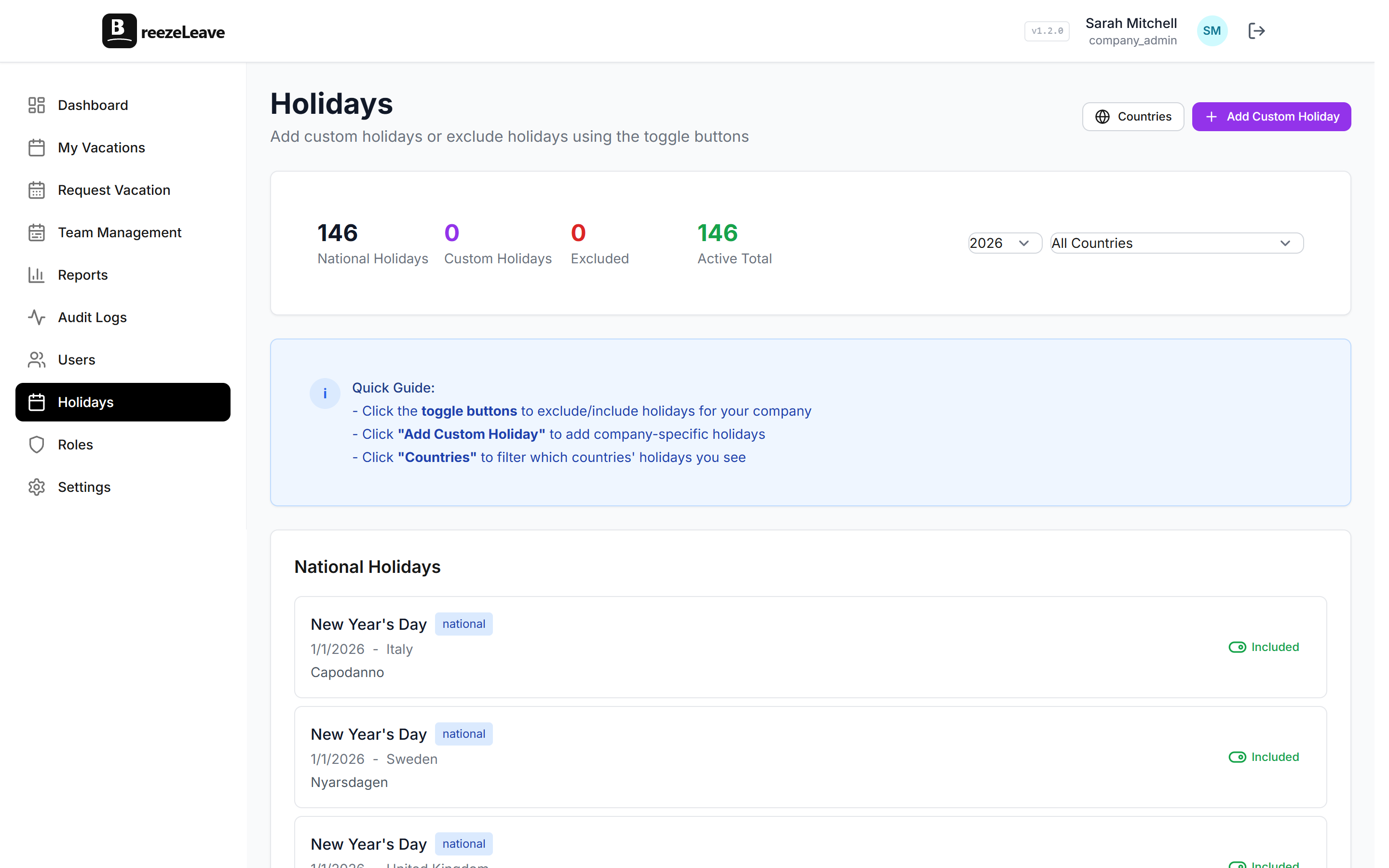
BreezeLeave loads default public holiday lists per operating country. The agency adds each country it employs in, and the holiday calendar applies to every employee assigned to that country. New hires inherit the calendar automatically. Year-end shutdowns or country-specific company holidays go on top as custom entries.
The holiday management piece covers how working-day calculations interact with PTO requests so that a Thursday holiday is not deducted from someone's vacation balance. The holiday management page shows the configuration screens.
PTO that subtracts from the right person's days
Once the holiday calendar per country is loaded, the second piece is approved PTO. The leave tool tracks each employee's balance, the public holidays for her country are already excluded from the deduction, and the workload view reads approved PTO directly. The result is a capacity number per person that reflects the actual days she is available.
Three patterns that matter for agency capacity:
- Approved requests subtract from capacity immediately. A request approved on Monday changes the workload number the same day. The delivery lead does not have to refresh anything.
- Pending requests show as soft holds. The capacity view marks unapproved requests in a different color so the delivery lead can see what might disappear from the team's capacity if the approver says yes.
- Cancelled or denied requests return the capacity. If a designer cancels her vacation, the capacity goes back up. The plan does not carry a phantom gap.
Project timelines and the holiday buffer
Agency project timelines built before accounting for multi-country holidays slip in predictable ways. Two practical adjustments:
| Window | Pattern | Buffer to add |
|---|---|---|
| May (Poland, Czechia, Croatia) | Dense national holiday cluster, often 4-6 working days lost | +1 week on project end date |
| June (Sweden, Croatia, Slovenia) | Midsommar and Statehood Day overlap; bridge days extend off-time | +1 week on project end date |
| July-August (Sweden, parts of southern EU) | Multi-week vacation tradition, sometimes office-wide | No mid-summer hard deadlines for these countries |
| December 20 - January 6 | Year-end shutdown across most of Europe; Orthodox Christmas in Serbia | No mid-window deadlines; freeze new project starts |
The table is illustrative and country-specific. The three-country agency piece covers a specific Sweden / Croatia / Serbia setup; agencies in different country mixes will have their own clusters. The point is to name the windows and put them in the timeline rather than discovering them when delivery is at risk.
Logged hours: the reality check
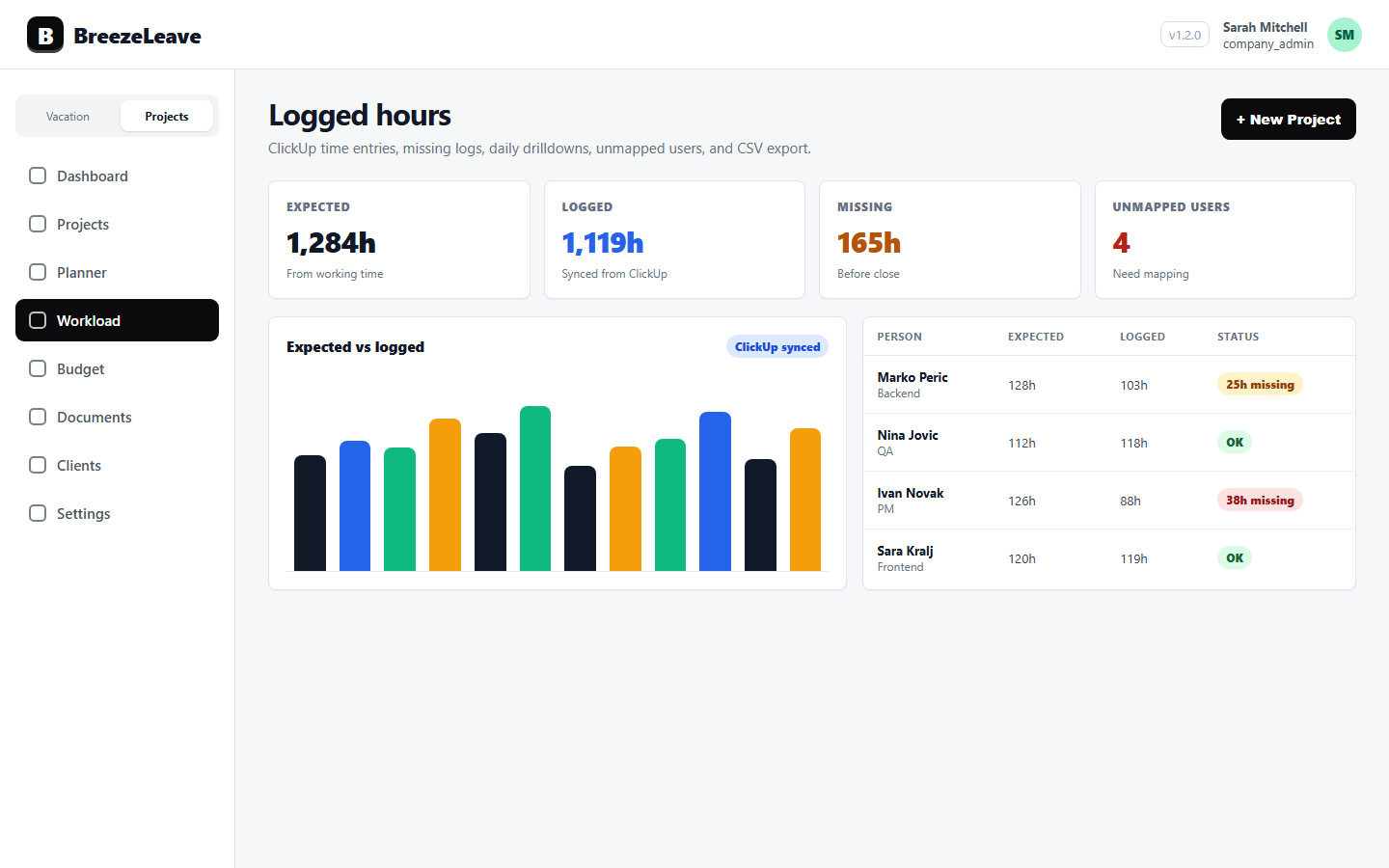
Planned hours and logged hours rarely match. The gap is where capacity problems live. A delivery lead who plans 30 hours for a designer next week and sees 18 hours logged at the end of the week has a problem to investigate. The explanation might be approved PTO that came in late, a public holiday she forgot, or scope creep on another project. All three are useful signals.
For agencies on ClickUp, BreezeLeave pulls logged hours and matches them against planned hours per project. The ClickUp time tracking piece explains the integration. The logged hours hygiene piece covers the day-to-day habits that make the data useful rather than noise.
The Monday capacity review
Agencies that get this right run a 20-minute Monday capacity review. The delivery lead and the project managers open the workload view together. The agenda:
- Scan the next four weeks for over-allocation. Any person with more planned hours than available hours after PTO and holidays is flagged.
- Look at upcoming holiday clusters. Any week where more than 25 percent of the team is off due to public holidays needs a project review.
- Review pending PTO requests. Any unapproved request that would push a project over capacity is a conversation, not a default approval.
- Decide actions. Move scope, pull in another resource, push a deadline, or accept the over-allocation with the team's knowledge.
The meeting works only if the data is current
A Monday capacity review with stale data is worse than no review at all, because the decisions feel informed when they are not. The integration between BreezeLeave and the workload view exists so the data is current every Monday morning without anyone exporting anything.
When the agency has more than one company entity
Larger agencies sometimes operate under more than one company entity, often for tax or hiring reasons. A Croatian entity and a Serbian entity might be separate on paper but operate as one delivery team. Multi-company support in BreezeLeave keeps the entities separated for payroll while letting the delivery lead see the combined capacity in the workload view.
The multi-company leave management piece covers the setup. The capacity benefit is in the combined view, where the delivery lead does not have to flip between entities to plan a project that crosses both.
What the delivery lead's week looks like after the change
Before the change, the delivery lead spends Monday morning building a capacity capacity sheet from three sources: the PTO tracker, the holiday list per country, and the project plan. Two hours, every Monday. The data is stale by Wednesday. She rebuilds it again on Friday for the partner meeting.
After the change, the workload view shows the capacity number per person per week with PTO and public holidays already subtracted. The Monday review is 20 minutes, the partner meeting opens the same view, and the delivery lead spends the time saved on the conversations that actually move projects forward.
The short list
A multi-country agency has capacity planning that holds up when the following are true:
- Each operating country has its public holiday calendar configured, and every employee is assigned to a country.
- Approved PTO subtracts from the capacity view immediately and per person.
- Project timelines include buffer for known holiday clusters in May, June, July-August, and December.
- Logged hours are visible alongside planned hours per project.
- The Monday capacity review runs from a single workload view, not three tabs.
- Multi-company entities, if any, roll up into the same delivery view.
Hit those six and the agency stops losing capacity to surprises. To run capacity with PTO, holidays, and logged hours in one view, plan capacity around PTO, holidays, and logged hours in BreezeLeave, or start from the project capacity planning overview if you want the feature detail first.