Managing Leave Across Multiple Companies from One Dashboard
Multi company leave management from one dashboard. Separate policies per entity, one place to run them all.
I run 3 companies. Technically they're all part of the same agency group, but legally they're separate entities. One is a creative studio in Zagreb. One is a dev shop registered in Berlin. The third is a consulting arm that operates out of Amsterdam. Different countries, different employment laws, different holiday calendars, and until about a year ago, three completely different systems for tracking leave.
The Berlin entity used a Google Sheet. The Zagreb team had a shared calendar someone set up in 2021 that nobody fully trusted. Amsterdam was using a tool that cost more per month than the actual leave it tracked. I was the person responsible for all three, and I was spending half a day every week just trying to get a clear picture of who was off where.
If you operate an agency, a holding company, or any kind of multi-entity business, you already know this problem. Multi-country leave management is not something most tools are built for. They assume one company, one policy, one set of rules. But that's not how business groups actually work.
The Usual Bad Solutions
Before I found something that worked, I tried every configuration I could think of. None of them were good.
Option A: Separate tools per entity
Each company runs its own leave management. The Berlin office uses one tool. Zagreb uses another. Amsterdam has a third. The managers in each entity are happy because they see a clean view of their people. But as the group admin, I have no unified picture. I'm logging into three dashboards, cross-referencing data manually, and hoping nobody made a mistake. When someone transfers between entities (which happens more often than you'd think), their leave balance doesn't follow them. It just vanishes.
Option B: One big spreadsheet for everything
This is the approach that feels simple until it isn't. You dump all three companies into one sheet, add a "Company" column, and tell yourself the filters will handle it. They don't. Managers from Zagreb end up seeing Berlin's data. Nobody's sure which holiday calendar applies to which rows. The approval chain is a mess because you can't assign different approvers per entity in a spreadsheet. And when Berlin's HR asks for a report on just their employees, you spend twenty minutes filtering and praying the formulas still work.
Option C: One tool, but pretend it's one company
You pick a leave management tool, create a single "company," and organize teams by entity. This sort of works for small groups. But you can't set different leave policies per entity. You can't have different holiday calendars. You can't restrict a manager in Zagreb from seeing Amsterdam's leave data. It's a hack, and it breaks the moment your entities have meaningfully different rules.
| Approach | Pros | Cons |
|---|---|---|
| Separate tools per entity | Clean per-entity views for managers | No unified view, transfers break, 3x the admin work |
| One big spreadsheet | Everything in one place | No data separation, no per-entity policies, formula chaos |
| One tool, pretend it's one company | Single tool, single login | Can't set different policies, holidays, or access per entity |
| True multi-company platform | Separation and consolidation at the same time | Fewer tools support this natively |
The core issue
Multi-entity businesses need separation and consolidation at the same time. Each company must run independently with its own policies and approvers. But someone at the top needs to see across all of them without switching tools or merging spreadsheets. Most leave management software does one or the other. Not both.
What Multi-Company Leave Management Actually Means
When I say "multi-company support," I mean something specific. Not just organizational labels or team names. Actual company-level separation within a single platform.
Separate leave policies per entity
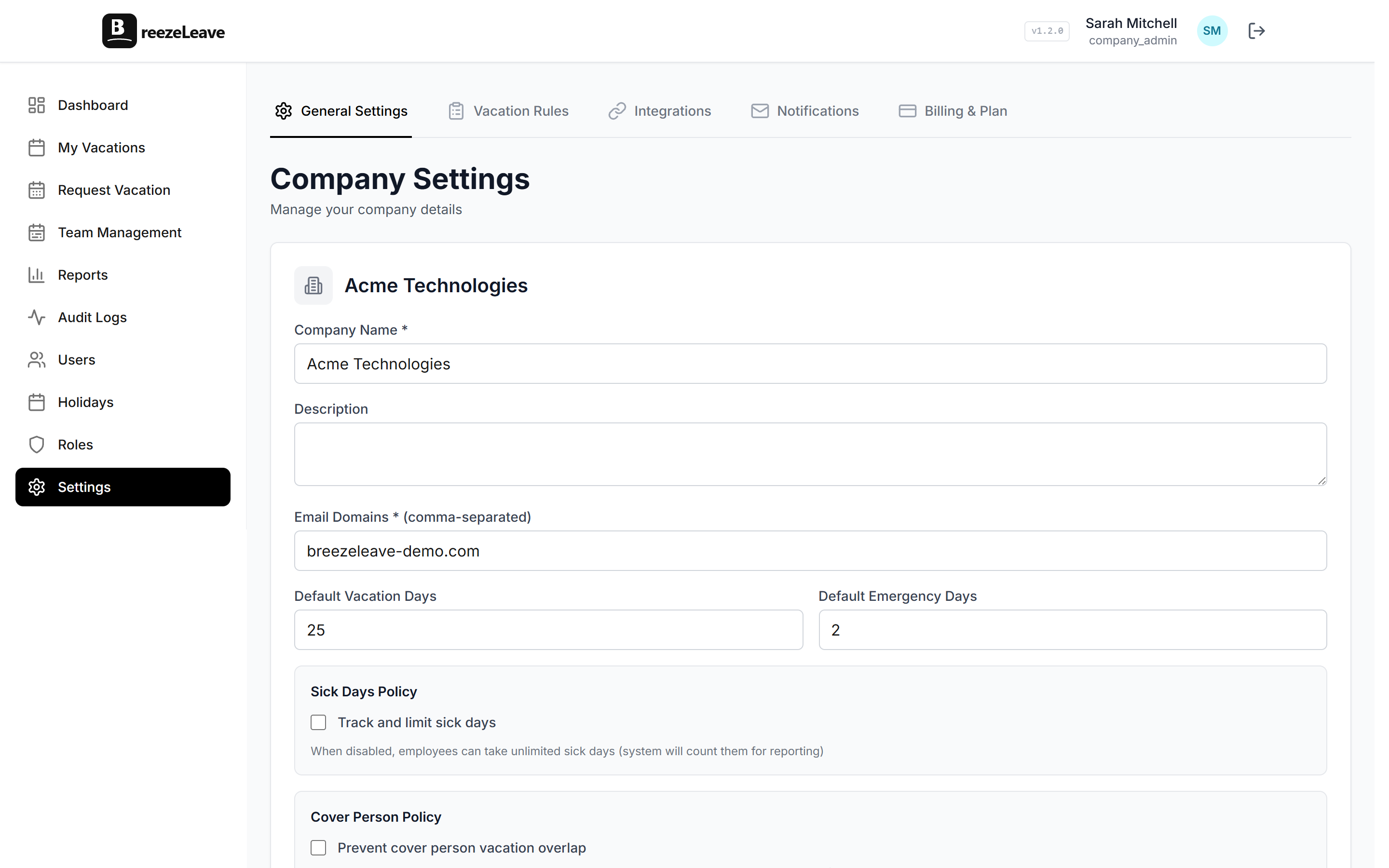
The Berlin entity gives 28 vacation days per year. Zagreb gives 22. Amsterdam gives 25. These are different legal minimums in different countries, and they can't be averaged or simplified. Each company needs its own default entitlement, its own accrual rules, and its own carryover limits. If your entities are in different countries, our guide on managing PTO across countries covers the statutory differences in detail.
Separate holiday calendars
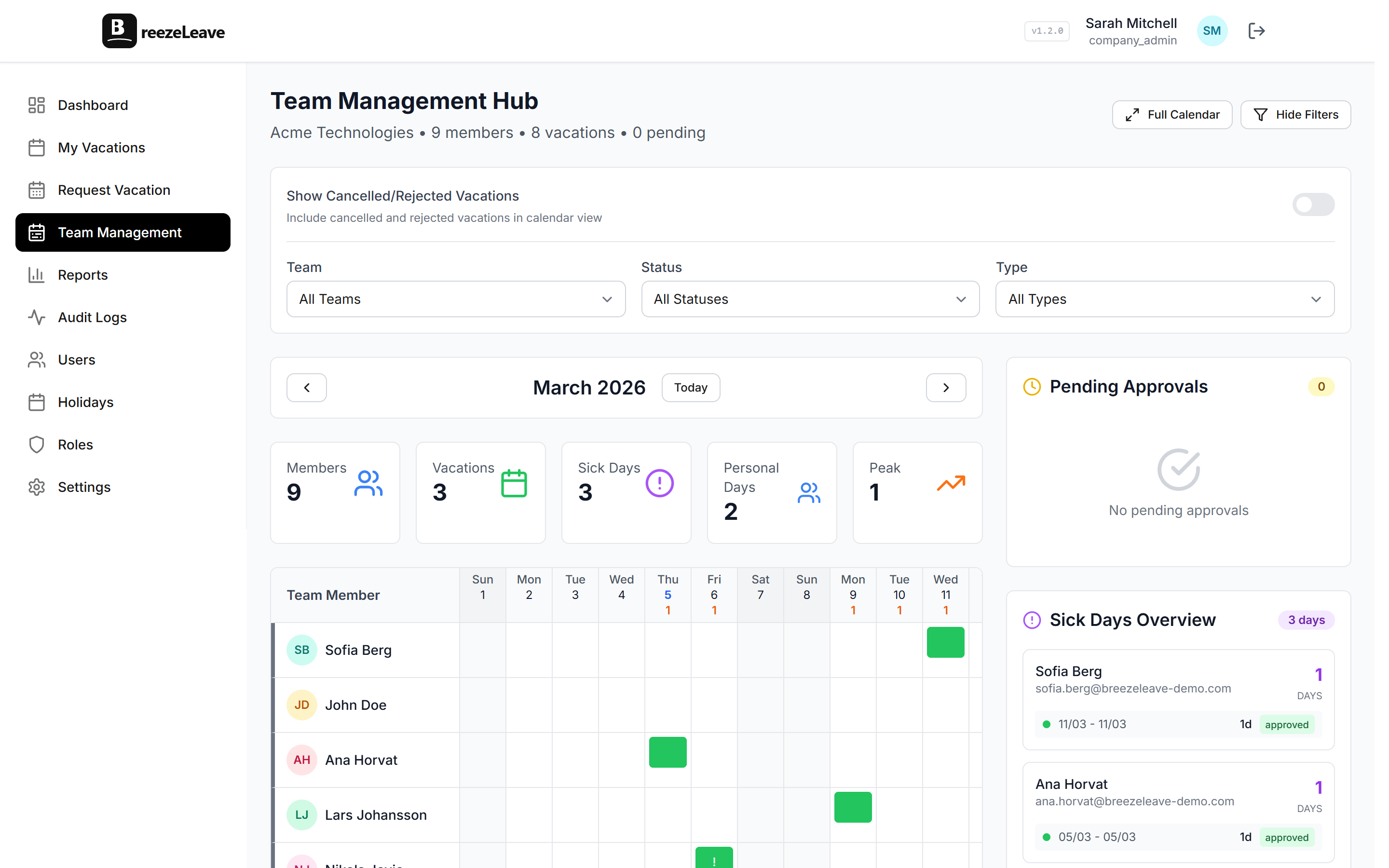
German public holidays are not Croatian public holidays. Dutch holidays are different again. A leave request in Berlin during German Unity Day should automatically exclude October 3rd from the calculation. The same week requested by someone in Zagreb should count as 5 working days because Croatia doesn't observe that holiday. This has to happen automatically per entity. No manual overrides.
Separate teams and managers
The team lead in Berlin approves leave for Berlin employees. The Zagreb manager handles Zagreb. They should not see each other's requests, balances, or calendar views unless they have a specific reason to. This is about privacy, data boundaries, and not cluttering a manager's view with information that isn't relevant to them. We wrote about how role separation works in practice in our piece on role-based access in leave management.
Unified view for the group admin
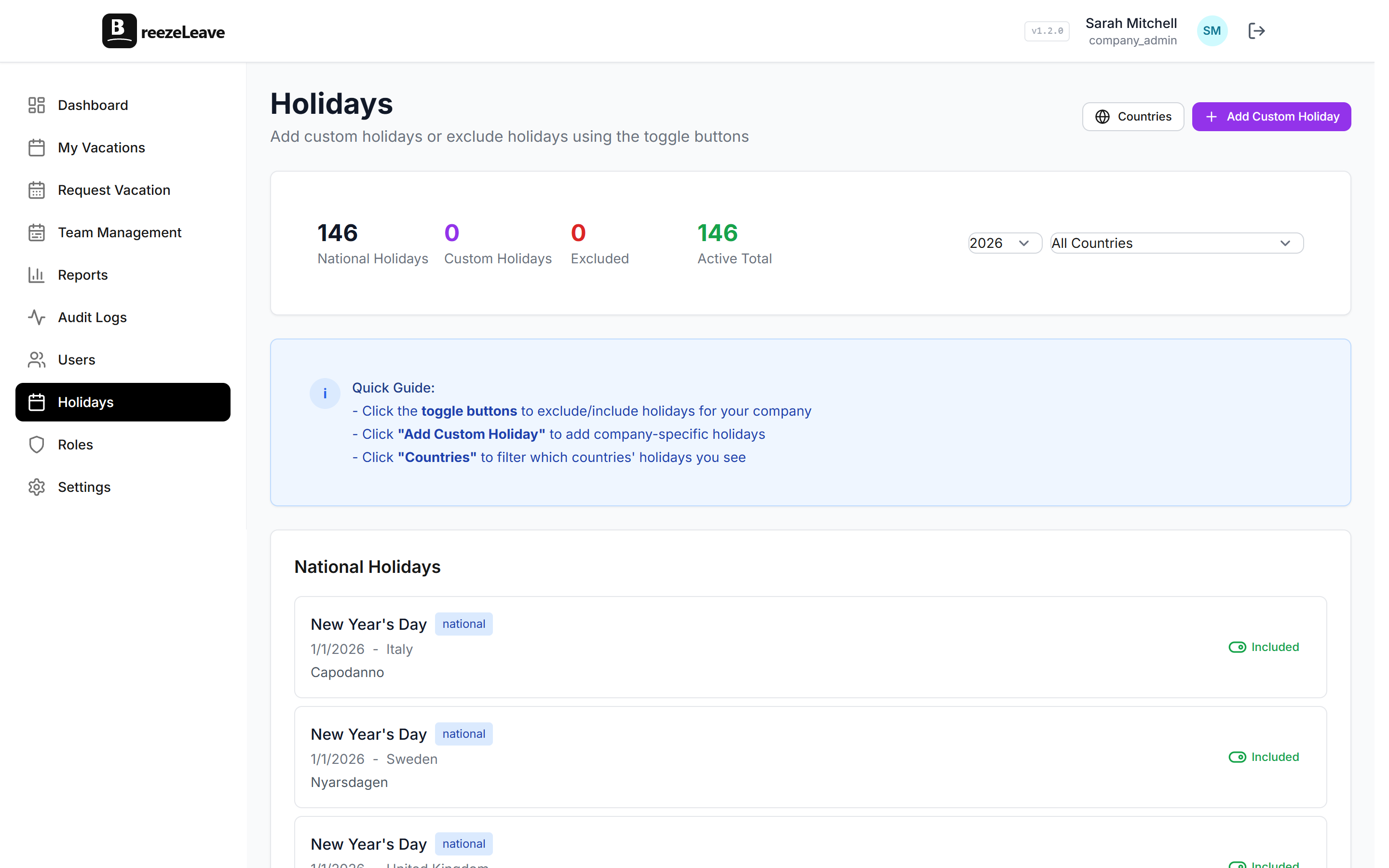
And then there's my view. I need to see all three entities at once. Total headcount off this week across the group. Pending requests by entity. Leave balances that are getting dangerously low before year-end. A single dashboard where I can switch between the group-wide view and an individual company view without logging into a different account.
Who Actually Needs This
Not every company with 50 employees needs multi-entity leave tracking. But a specific set of organizations hits this wall hard, usually around the time the second or third legal entity gets created.
- Agencies with subsidiaries. Creative agencies, digital agencies, and marketing groups often operate multiple brands under one roof. Each brand might be its own legal entity for client contracts, liability, or tax reasons. The people all report to the same leadership team, but on paper they work for different companies.
- Holding companies. If you own or manage a portfolio of small businesses, each with 10 to 50 employees, you need holding company PTO visibility without micromanaging each entity. The local managers run their day-to-day. You monitor from above.
- Companies with entities in multiple countries. This is increasingly common with remote-first businesses. You hire in Germany, so you create a German GmbH. You hire in the Netherlands, so you register a BV. Same company in spirit, but different legal entities with different employment law requirements.
- Consulting firms with client-facing teams. Some consulting companies operate teams under different legal names depending on the client contract. Team A is billed through Entity X. Team B through Entity Y. The leave policies might be the same, but the organizational separation matters for reporting and compliance.
A common pattern
Most multi-entity businesses start with 2 to 5 companies and 30 to 200 total employees across the group. They grow by adding entities, not by scaling one company to thousands. That growth pattern breaks tools designed for single-company use.
How the Admin Roles Work
The role structure makes or breaks multi-company leave management. Get this wrong and you'll have managers seeing data they shouldn't, or group admins locked out of company-level settings.
In the setup we use with BreezeLeave, there are two distinct admin levels:
Company Admin
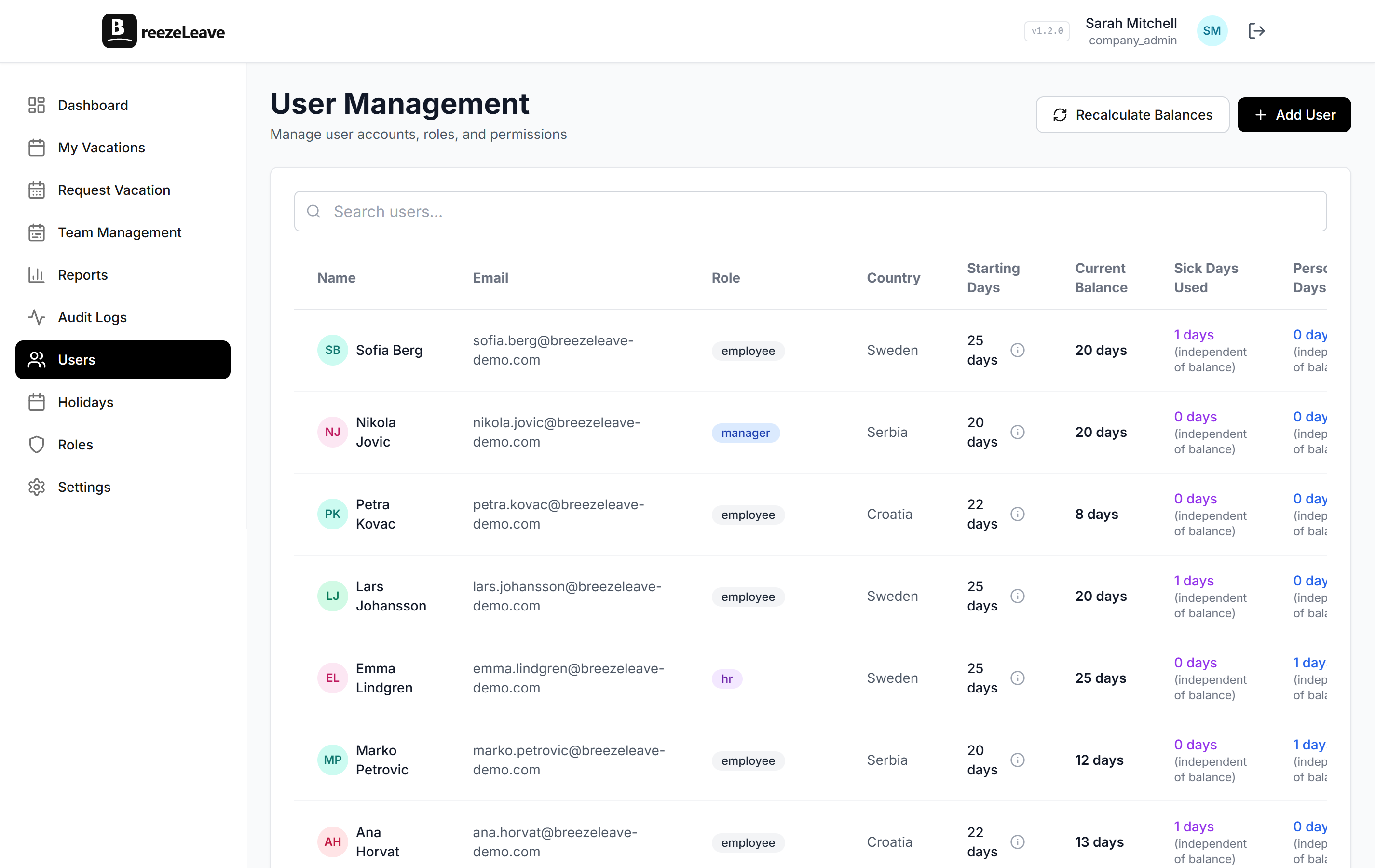
This person manages one specific entity. They configure leave policies, set holiday calendars, manage teams, and handle approvals for their company. A Company Admin in Berlin sees only Berlin employees. They can't view Zagreb's leave balances or Amsterdam's pending requests. Their world is scoped to their entity. This is the right level for an HR lead or operations manager who runs one office or one subsidiary.
Group Admin (or Super Admin)
This is the holding company level. The Group Admin sees across all entities. They can:
- View aggregated leave data across the entire group
- Switch between company views
- Pull reports that span all entities
- Drill down into a specific entity and see exactly what the Company Admin sees
This role is for the COO, the agency founder, or the head of group operations. Someone who needs the full picture without asking three different people to send spreadsheets.
A Company Admin should feel confident that their entity's data is contained. A Group Admin should feel confident that they can access anything without friction. Both should be able to work without stepping on each other.
If you're thinking through how this applies to growing headcount, our article on vacation tracking for growing teams covers the scaling side of access control.
Setting Up a New Entity: 15 Minutes, Not 15 Days
One thing that surprised me was how fast additional companies can go live once the first one is configured. When we added our Amsterdam entity, the whole process took about 15 minutes.
- Create the new company in the dashboard. Give it a name, assign the country, set the default leave entitlement. 2 minutes.
- Configure the holiday calendar. In BreezeLeave, you pick the country and the public holidays are pre-loaded. If your entity operates in the Netherlands, you select the Netherlands and Dutch holidays populate automatically. You can tweak individual dates if your company observes additional days. 3 minutes.
- Set up the leave policy. Define how many vacation days, sick days, and any custom leave types this entity offers. Specify carryover rules. Set the approval chain. 5 minutes.
- Invite the Company Admin and managers. Send invite links. They log in, see their scoped view, and start adding their team members. 5 minutes to send invites, and the managers handle the rest at their own pace.
That's it. No migration project. No consultant. No multi-week onboarding. The second and third entity are always faster than the first because you already understand the workflow. If your entities share similar policies, you can clone a holiday calendar from an existing company and adjust the differences instead of building from scratch.
On scaling
We went from one entity on the platform to three in under an hour. The hardest part was not the tool setup. It was getting the Amsterdam managers to agree on their carryover policy. That took a week of emails. The software was ready in minutes.
What Changes When Everything Is in One Place
Running all three entities from a single dashboard changed how I think about group operations. Some of the benefits were obvious. Some caught me off guard.
Cross-entity visibility without cross-entity confusion
I can see that 8 people across the group are off next Tuesday. I can drill down and see that 5 of them are in Zagreb (Statehood Day), 2 are in Berlin (personal leave), and 1 is in Amsterdam (sick). That kind of insight used to take three logins and mental arithmetic.
Employee transfers become trivial
When a designer moved from our Zagreb entity to the Berlin entity last year, we just reassigned them in the system:
- Their remaining leave balance carried over.
- Their new holiday calendar applied automatically.
- Their new manager got approval rights.
Before this, a transfer meant manually calculating the prorated balance, deleting the person from one tool, and re-adding them in another.
Year-end reporting for the entire group
At the end of the year, I can pull a single report showing leave usage, remaining balances, and carryover amounts across all three entities. That's one export for the accountant instead of three separate files with three different formats.
Consistent experience for employees
Everyone in the group uses the same interface to request leave, check their balance, and see their team calendar. The policies differ per entity, but the experience is the same. Nobody in Amsterdam is using one tool while Zagreb uses another.
The Short Version
If you run multiple legal entities and you're managing leave separately for each one, you're doing more work than you need to. Multi-company leave management from a single dashboard is not a luxury feature. For agencies, holding companies, and multi-entity businesses, it's the baseline.
- Each entity gets its own leave policies, holiday calendars, teams, and approvers
- Company Admins see only their entity. Group Admins see everything
- Adding a new entity takes about 15 minutes, not 15 days
- Employee transfers, year-end reports, and group-wide visibility all get simpler
- The setup scales from 2 entities with 20 people to 10 entities with 200+ people
I spent two years stitching together spreadsheets and separate tools before switching to a single platform that understood multi-entity structures. The weekly time I spent on leave administration dropped from half a day to about 20 minutes. And I stopped dreading the year-end reconciliation entirely.
If you're at the point where you're managing more than one company and still using separate systems for each, consolidate. It's the kind of change where the only regret is not doing it six months earlier.