How a 50-Person Agency Manages PTO Across 3 Countries
A creative agency with offices in Sweden, Croatia, and Serbia shares how they went from spreadsheet chaos to automated leave management across three very different labor markets.
Imagine you run a creative agency. Fifty people. Three offices: Stockholm, Zagreb, and Belgrade. You landed your first international client two years ago and grew fast, hiring locally in each market because the talent was there and the costs made sense. Business is great. Leave management is not.
This is roughly the story of a company very similar to several BreezeLeave customers. The names and details are composited, but the problems are real, and they come up in almost every conversation we have with agencies running distributed teams across European borders.
"We had one Google Sheet for vacation tracking. It worked when we were twelve people in Zagreb. By the time we hit thirty across two countries, it was a liability."
Three Countries, Three Sets of Rules
The first thing that catches agency founders off guard is how different the vacation landscape looks across even neighboring countries. Sweden, Croatia, and Serbia are all European, all within a two-hour flight of each other, and they have almost nothing in common when it comes to leave policy.
| Detail | Sweden | Croatia | Serbia |
|---|---|---|---|
| Statutory minimum (days/year) | 25 | 20 | 20 |
| Public holidays | 13 | 14 | 11 |
| Total paid days off | 38 | 34 | 31 |
| Common seniority bonus | Rare (already high base) | +1 day per 4-5 years | +1 day per 5 years (common) |
| Summer culture | 4-week July shutdown | 1-2 weeks Aug typical | 1-2 weeks Aug typical |
That table looks simple enough. But when you multiply it by fifty people, three different holiday calendars, and the reality that your Swedish art director gets 25 vacation days while your Serbian developer gets 20, the administrative complexity compounds fast.
For a deeper dive into how statutory minimums vary across Europe and why it matters for your planning, see our guide on managing PTO across countries.
Challenge 1: The Holiday Calendar Collision
The agency in this story learned about holiday collisions the hard way. They had a major campaign launch scheduled for late June. The Stockholm team was gone for Midsommar. The Zagreb team was available but missing their Swedish creative leads for sign-off. The Belgrade team was working, but nobody had told them the campaign assets were still pending approval in Stockholm. The launch slipped by a week.
The root cause was simple: nobody had a single view of which holidays applied to which office. Sweden's Midsommar falls on a different Friday every year. Croatia's Anti-Fascist Struggle Day (June 22) sometimes lands in the same week. Serbia's Vidovdan (June 28) can stack on top. In a bad year, your entire agency has fragmented availability for the last two weeks of June, and nobody realizes it until deadlines start slipping.
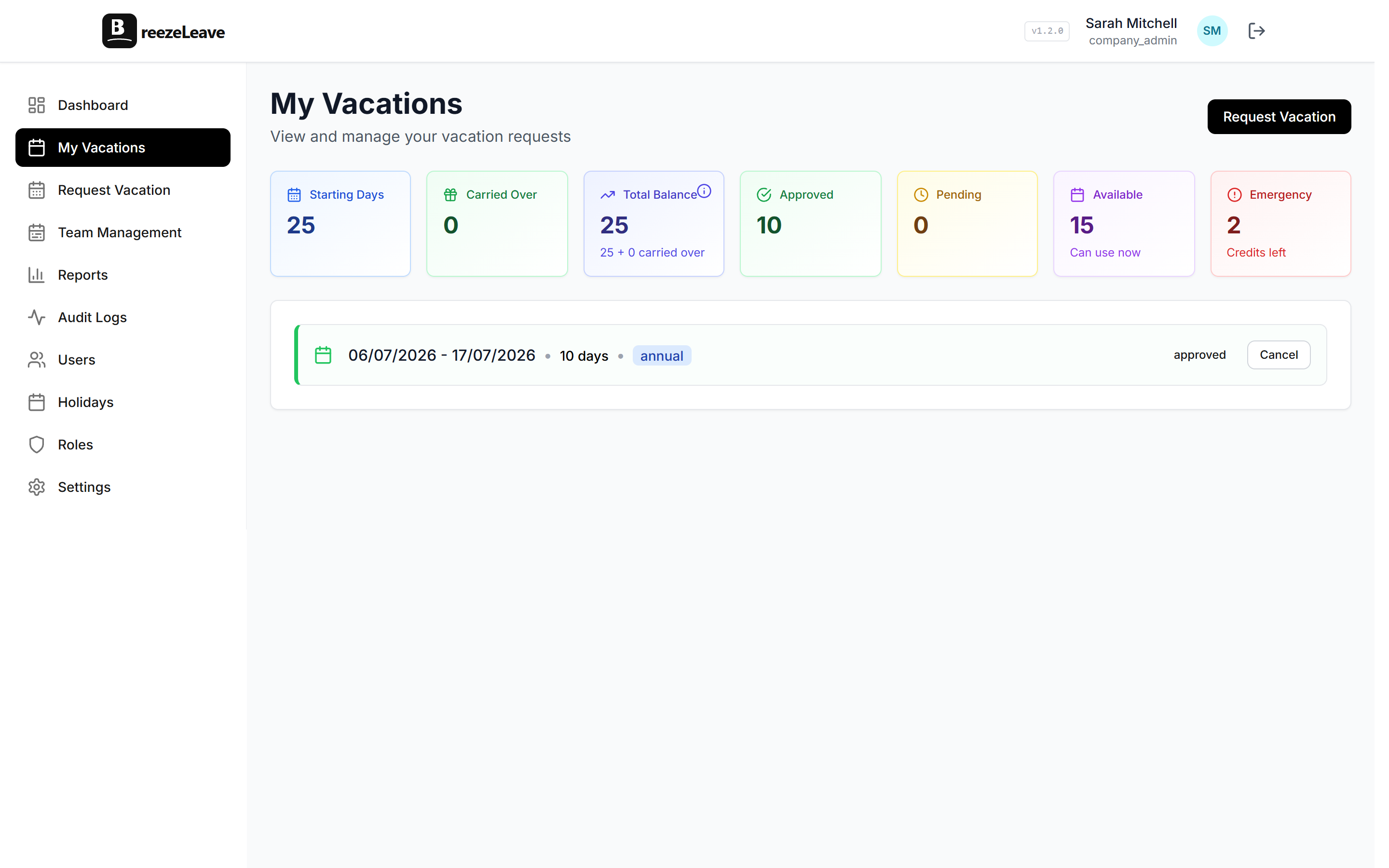
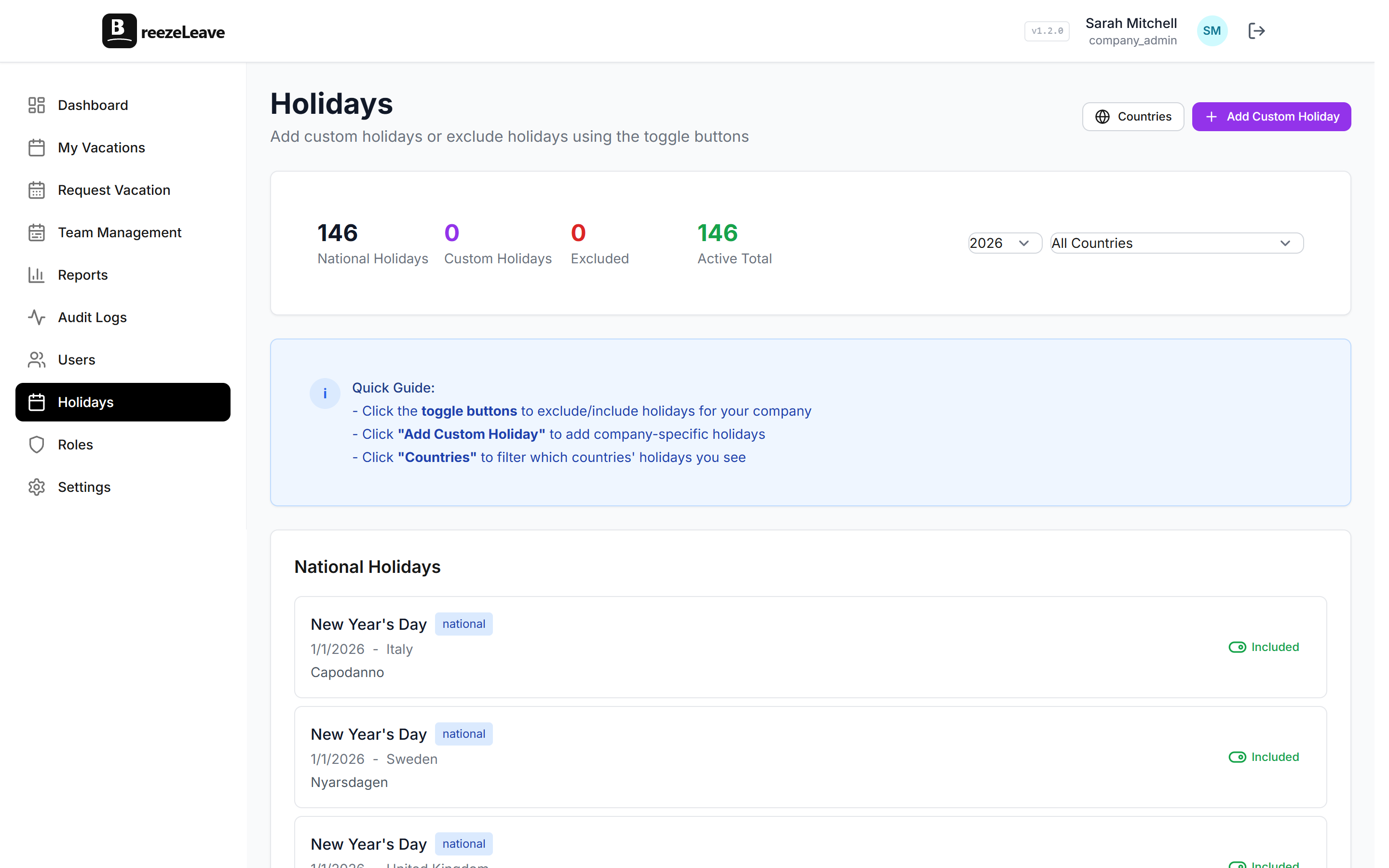
The fix was straightforward once they had the right tool. In BreezeLeave, each employee is assigned to a country. That country drives their holiday calendar. When someone in Belgrade requests June 28th off, the system knows it's already a public holiday and doesn't deduct a vacation day. When someone in Stockholm requests the same date, it counts as a regular vacation day. No manual checking required.
Challenge 2: Different Vacation Allowances, Same Team
This one creates friction if you don't handle it transparently. A designer in Stockholm gets 25 days. A designer in Belgrade doing the same work gets 20. Both are fully compliant with local labor law. But if they're on the same Slack channel and one mentions having "ten days left in October" while the other is already running on fumes, it feels unfair even when it isn't.
The agency solved this with a combination of transparency and seniority-based accruals. They published their vacation policy openly: everyone gets their country's statutory minimum, plus additional days based on years of service. A developer in Belgrade who's been with the company for five years gets 22 days. Someone in Zagreb with three years gets 21. The Swedish team's base is already high enough that seniority bonuses weren't necessary there.
Seniority accruals remove the manual work
BreezeLeave's vacation rules let you configure automatic accruals based on years of service. Set it once ("after 3 years, add 1 day; after 5 years, add 2 days") and balances update automatically on each employee's work anniversary. No spreadsheet formulas, no annual HR review. See our full guide on seniority-based vacation accruals.
Per-country vacation day defaults
Instead of setting one global number and then adding bonuses on top, you can set a different base allocation for each country directly. Sweden gets 25 days, Croatia gets 20, Serbia gets 20. New hires in each country automatically receive the correct allowance without any manual adjustment. Country-specific defaults live in your company settings, right next to the global fallback.
Challenge 3: Local HR Needs Local Access
At fifty people across three countries, you can't have one person in Stockholm handling every leave request. The agency hired office managers in Zagreb and Belgrade who handle local HR tasks: onboarding paperwork, sick leave documentation, and yes, vacation approvals.
But those office managers shouldn't see everyone's data. The Zagreb office manager doesn't need to know how many sick days a Stockholm employee has taken. The Belgrade coordinator doesn't need access to Croatian salary-related leave adjustments.
This is exactly what external HR users were built for. Each local HR person gets HR-level permissions scoped to their country. They can approve requests, view balances, and run reports, but only for employees assigned to their countries. The global HR lead in Stockholm retains full visibility across all three offices.
Challenge 4: Nobody Knows Who's Off Today
In a single-office agency, you look around the room. In a three-country agency, you look at Slack and guess. The account manager in Belgrade needs to know if the copywriter in Zagreb is available for a client call tomorrow. The project manager in Stockholm wants to schedule a sprint review but isn't sure which developers are on vacation next week.
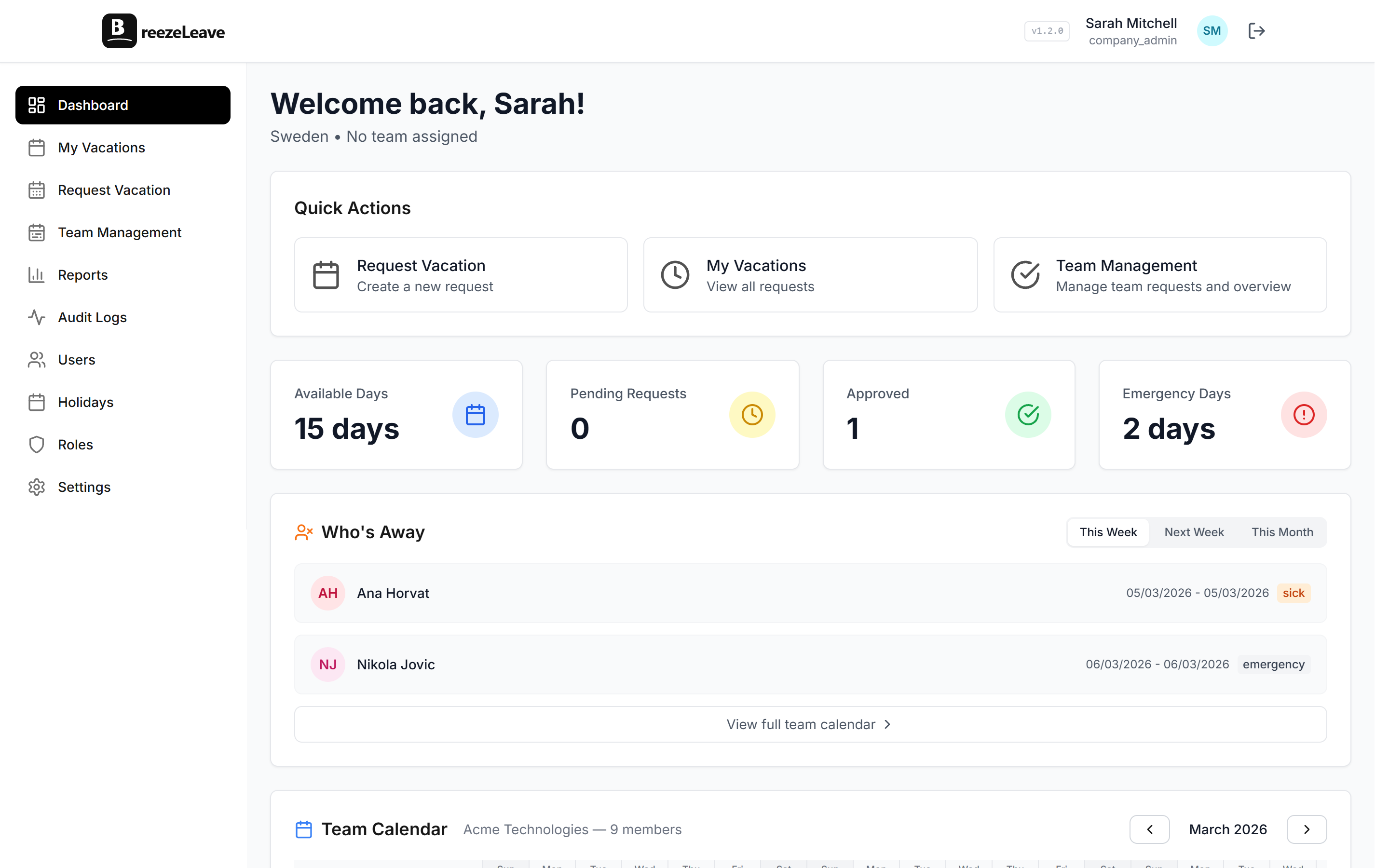
The team calendar solved this. Everyone across all three offices sees the same dashboard showing who's off today, who's off this week, and what's coming up. It's not complicated technology. It's just having one source of truth instead of three separate spreadsheets that nobody updates consistently.
The Cultural Layer Nobody Warns You About
Beyond the legal and logistical differences, there's a cultural dimension that takes time to learn. In Sweden, the four-week July vacation is sacred. The entire country effectively shuts down. Trying to schedule anything meaningful with your Stockholm team between Midsommar and August is an exercise in futility.
In Croatia and Serbia, the pattern is different. People tend to take shorter breaks but use bridge days aggressively. If a holiday falls on a Thursday, the entire office takes Friday off. This creates predictable mini-shutdowns that are invisible to anyone outside the country.
The agency learned to plan around these patterns rather than fight them. They don't schedule major launches for July (Stockholm is gone) or late December (everyone is gone). They build buffer time into Q2 timelines because Croatia has a dense cluster of holidays in May and June. They front-load Serbian projects in the first half of January because Serbia's Orthodox Christmas and New Year holidays clear out the Belgrade office for nearly two weeks.
"The tool handles the math. The culture, you have to learn by paying attention. But once you know the patterns, you stop being surprised."
What Changed After Switching to Automated Tracking
The agency moved from Google Sheets to BreezeLeave when they were at about 35 people. The immediate wins were:
- No more balance errors. The spreadsheet had accumulated roughly a dozen calculation mistakes over two years: holidays counted as vacation days, seniority bonuses missed, half-days tracked inconsistently. Automated country-specific calculations eliminated all of that.
- Approval time dropped from days to minutes. Instead of emailing an HR person who might be in a different timezone, employees submit requests through the app and managers approve from Slack. Average approval time went from 2.3 days to under 4 hours.
- Year-end reconciliation became trivial. What used to take the HR lead an entire week of cross-referencing three spreadsheets, verifying balances, and handling disputes, now takes about an hour of spot-checking.
- New hire onboarding got simpler. Assign a country, set the start date, and vacation rules apply automatically. No manual balance calculation for partial first years.
Start simple, then layer on complexity
You don't need to configure everything on day one. Start with country assignments and holiday calendars. Add seniority rules once your policy is defined. Set up external HR users when your local offices are ready to self-manage. The system grows with you.
Key Takeaways for Multi-Country Agencies
If you're running an agency across multiple countries (or about to start), here's what three years of real-world experience distills down to:
- Don't treat international PTO as a scaling problem you'll solve later. The mistakes compound. A wrong balance in January becomes a dispute in December.
- Country-specific holiday calendars are non-negotiable. Manual tracking breaks at about 15-20 people across 2+ countries.
- Give local HR people local access. They know their labor law better than your central team. Let them manage their region.
- Make absence visibility the default. Everyone should be able to see who's off across all offices without asking.
- Learn the cultural patterns. Statutory rules tell you the minimum. Culture tells you what actually happens.
The agencies that get this right don't just avoid administrative headaches. They build trust across their international teams, and trust is what keeps distributed agencies delivering great work across borders.