Sick Leave Tracking in Europe: A Country-by-Country Reality Check
Sick leave tracking in Europe varies wildly by country. A practical guide to what happens when employees call in sick across the EU.
I have managed HR for teams across five European countries. The first time a German employee handed me a Krankschreibung and told me their doctor had signed them off for three weeks, I nodded, said "get well soon," and then spent an hour figuring out what we owed them. Six weeks at full pay? That can't be right. It was right.
Every country in Europe does sick leave differently. And I don't mean a little differently. I mean the whole system is different. The waiting periods, the pay percentages, the point where the government steps in. If you're running a company with employees in more than one European country, you need to understand all of it, because your payroll, budgets, and team coverage depend on it.
This is a practical guide to sick leave tracking in Europe. The rules you'll actually run into, and what to do about them.
Why Sick Leave Tracking in Europe Is Harder Than You'd Expect
In the US, sick leave is largely whatever the employer decides. In Europe, it's a statutory right. Every country specifies who pays, how much, and for how long. Employees are well protected. That part is great.
The difficult part is that no two countries agree on the details:
- Germany gives six weeks at full salary.
- Sweden docks the first day entirely, then pays 80%.
- France makes employees wait three days with nothing.
- Croatia puts the employer on the hook for 42 days.
- The UK? A flat-rate statutory payment that barely covers lunch.
If you're tracking sick days across multiple countries with a spreadsheet, you'll get it wrong. I have gotten it wrong. The employee sick leave policy in each European country has enough quirks that you need either a flawless spreadsheet or a tool that handles the variation for you. If you're already managing PTO across countries, you know how quickly the complexity adds up.
European Sick Leave Regulations: What Each Country Actually Requires
Below is what the rules look like in practice, for the countries I see come up most often. These are the regulations that affect your payroll, your budgets, and the conversations you'll have with employees when they're out sick.
Sweden
Sweden has one of the more distinctive systems. Day one of any sick leave is called the karensdag, a qualifying day where the employee receives no pay at all. It was designed to discourage single-day absences, and it works. Swedes tend to either push through day one or call in sick for several days.
- Day 1: No pay (karensdag)
- Day 2 to Day 14: Employer pays 80% of salary
- Day 15 onward: Forsakringskassan (national social insurance agency) takes over
- Absences longer than 7 days require a doctor's certificate
Germany
Germany is the most generous for employees.
- Employer pays 100% of salary for the first six weeks (42 calendar days)
- After 6 weeks: Health insurance fund pays Krankengeld (sickness benefit), roughly 70% of gross salary, capped at 90% of net, for up to 78 weeks
- A doctor's certificate (Arbeitsunfahigkeitsbescheinigung, yes, that's one word) is required from day one in most cases, though some employers waive this for the first three days
- Six weeks at full pay resets for each new illness
France
France has a three-day waiting period (delai de carence) with no sick pay, unless a collective bargaining agreement says otherwise. And many do.
- Days 1 to 3: No pay (unless overridden by CBA)
- After 3 days: Social security pays roughly 50% of daily salary, capped at a ceiling amount
- Many employers top this up to 90% or 100% depending on seniority
- Typical CBA arrangement: 30 days at 90% then 30 days at 66% (varies by sector)
- A doctor's certificate (arret de travail) is required from day one
Croatia
Croatia puts a long obligation on employers.
- Employer pays sick leave for the first 42 days at 70% of average salary (calculated over the previous six months)
- After 42 days: Croatian Health Insurance Fund (HZZO) takes over
- For certain conditions (workplace injuries, complications during pregnancy), HZZO covers from day one
Forty-two days is a long time to carry someone on your payroll at reduced pay while they're not working. It's the kind of thing that catches employers off guard if they haven't budgeted for it.
United Kingdom
The UK takes a different approach.
- Days 1 to 3: "Waiting days" with no statutory payment
- Day 4 onward: Statutory Sick Pay (SSP) is a flat rate (currently around £116 per week), not a percentage of salary
- Same rate regardless of whether someone earns £25,000 or £125,000
- Many UK employers offer contractual sick pay on top of SSP, sometimes full pay for a set number of weeks, but they're not required to
The gap between SSP and actual salary is large enough that employees notice it immediately.
Netherlands
The Netherlands puts the heaviest burden on employers in Europe.
- Employers must pay at least 70% of salary for the first two years of illness
- Most pay 100% in year one and 70% in year two (collective agreements vary)
- The employer must also actively work with the employee on a reintegration plan during that period
Two years. The financial load sits squarely on the employer's side.
Sick Days Tracking by Country: A Quick Comparison
When you're managing a sick leave management tool or setting up policies across borders, this is the table you'll keep coming back to.
| Country | Waiting Period | Employer Pays | Pay Rate | Then What? |
|---|---|---|---|---|
| Sweden | 1 day (karensdag) | Day 2 to 14 | 80% | Forsakringskassan takes over |
| Germany | None | 6 weeks | 100% | Krankengeld (~70% gross) |
| France | 3 days | Varies (CBA) | 50 to 90% | Social security daily allowance |
| Croatia | None | 42 days | 70% | HZZO takes over |
| UK | 3 days | Up to 28 weeks | Flat rate (SSP) | No further statutory pay |
| Netherlands | None | 2 years | 70 to 100% | WIA disability assessment |
Look at that table and tell me a single spreadsheet handles all of it. Different trigger points, different pay rates, different waiting periods. If you have employees in three of these countries, you're tracking three completely different systems at the same time.
The Real Reasons Sick Leave Tracking Matters for Your Business
The regulations above aren't just HR trivia. They create concrete problems for anyone managing a team across borders.
- Payroll accuracy: Paying a German employee at 80% when the law says 100% is a compliance violation. Paying a Swedish employee for their karensdag is an overpayment. Getting the percentage and duration wrong shows up in payroll every single month.
- Budget forecasting: In Germany, one employee sick for six weeks at full pay is a significant unplanned cost. In the Netherlands, a long-term illness sits on your books for two years. If your headcount budget doesn't account for sick leave costs by country, your numbers are gonna drift by Q1.
- Pattern recognition: Frequent Monday absences or repeated short absences from one team might signal burnout or a management problem. You can't spot patterns in data you aren't collecting.
- Team coverage: When someone calls in sick at 8 AM, their 10 AM meeting doesn't cancel itself. The team needs to know immediately so work gets redistributed.
- Government reporting: In Sweden, report to Forsakringskassan after day 14. In Germany, notify the health insurer at the six-week mark. In Croatia, HZZO needs documentation at day 42. Clean records make these handoffs straightforward.
What a Sick Leave Management Tool Should Actually Do
After years of dealing with this, here is what I need from any sick leave management tool handling European teams:
- Separate sick leave from vacation. Non-negotiable. Sick days must never deduct from annual leave. In most European countries, mixing them is illegal. Different entitlements, different laws.
- Instant team notifications. When an employee logs a sick day, the manager and teammates should know within minutes. Not through forwarded emails, but through automatic calendar updates and alerts.
- Auto-approval for sick leave. Nobody needs their manager's permission to be sick. Log it, notify the team, show it on the dashboard. Done.
- Historical data. Sick leave trends over months and quarters, per employee and per team. This is what turns absence data into something useful for workforce planning. For a deeper look at tracking leave data over time, check out our guide on automating vacation balance tracking.
How BreezeLeave Handles It
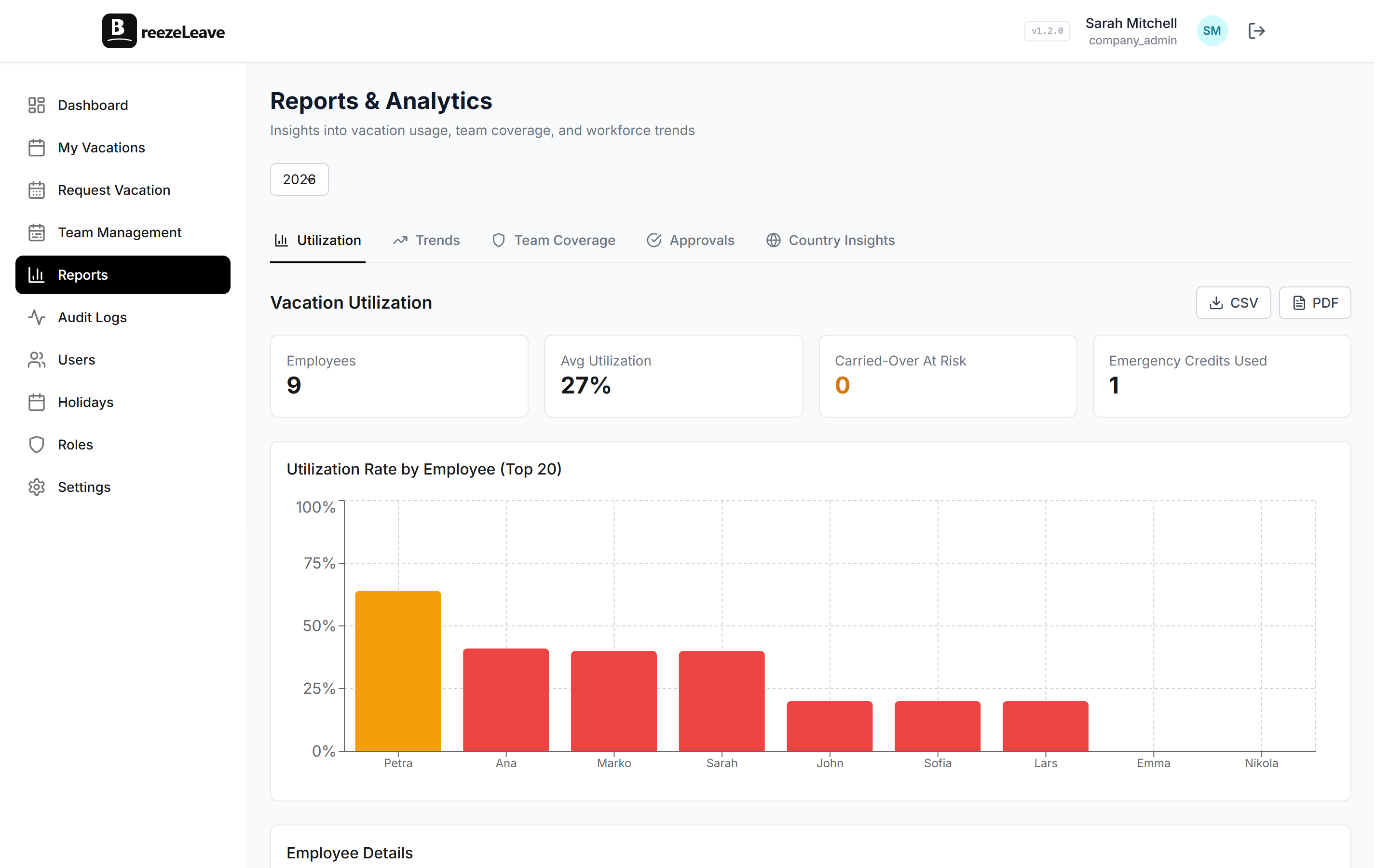
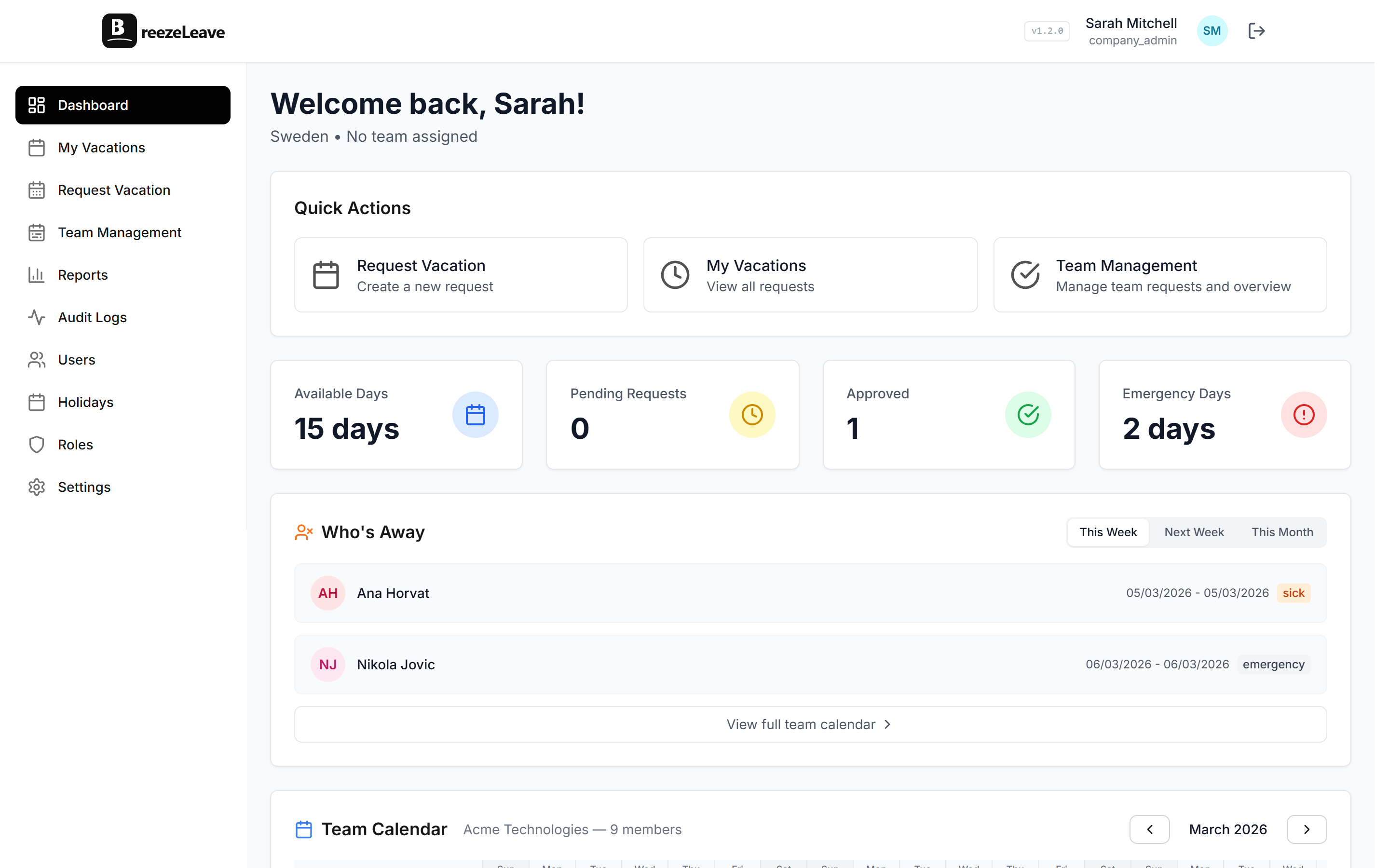
In BreezeLeave, sick leave works exactly this way. It's a separate leave type that auto-approves, notifies the team instantly, and keeps data separate from vacation balances. The team sees it on the shared calendar right away, and managers can pull usage reports without digging through emails.
Common Mistakes in Sick Leave Tracking Across Europe
I've made most of these. Save yourself the trouble.
- Applying one country's rules to everyone. If your HQ is in Germany and you apply six weeks at 100% to Croatian employees, you're overpaying. Apply Croatian rules to German employees and you're underpaying, and breaking the law. Each country's rules apply to employees in that country. Period.
- Forgetting about waiting periods. Swedish employees lose day one (karensdag). French and UK employees lose three days. If your system doesn't account for these, payroll is wrong from the start.
- Not tracking the government handoff. Miss the six-week mark in Germany and you keep paying when the health insurer should be. Miss reporting to Forsakringskassan in Sweden and the employee's state benefit gets delayed.
- Using sick leave as a performance metric. In most European countries, employees have a legal right to sick leave. Penalizing them for using it creates legal risk and destroys trust. Track for operations and budgeting, nothing else.
- No medical certificate policy. Germany typically requires a certificate from day one. Sweden after seven days. France immediately. Know the rules per country and tell your employees clearly.
Medical Certificate Requirements at a Glance
| Country | Certificate Required From |
|---|---|
| Germany | Day 1 (some employers waive for first 3 days) |
| France | Day 1 |
| Sweden | Day 8 |
| Croatia | Day 1 |
| UK | Day 8 (self-certification for first 7 days) |
| Netherlands | Employer may request via company doctor (Arbo) |
Making European Sick Leave Tracking Actually Work
European sick leave regulations aren't hard to comply with individually. Sweden's rules are clear. Germany's are clear. The difficulty is managing them all at once, across a single company, with one set of processes. But it's doable if you set things up right.
What Works
- Assign each employee's country in your tracking system
- Record every sick day as it happens, separate from vacation
- Automate notifications so the team finds out immediately
- Know your employer-pay windows (14 days in Sweden, 42 in Croatia, 6 weeks in Germany) and have a process for the government handoff when those windows close
If your team is scaling, take a look at how vacation tracking for growing teams works, because the same principles apply to sick leave.
Tools like BreezeLeave exist because managing this across countries with a spreadsheet eventually breaks. If you are dealing with teams in multiple countries, our multi-country leave management page covers how BreezeLeave handles the complexity. Not because spreadsheets are bad. The rules across six countries are just different enough that manual tracking introduces errors. And errors in sick leave show up in payroll, in compliance, and in how much your team trusts you to handle the basics.
Your employees in Europe have strong protections when they're sick. That's a good thing. Get the tracking right, and the rest follows.