PTO Accrual Rule Examples for Growing Teams
PTO accrual rule examples for growing teams: monthly vs yearly, seniority tiers, pro-ration for mid-year hires, and how to set the carryover and exit-payout edges.
Three accrual questions show up every quarter at any company past 20 employees. How does the new joiner's balance work if they started on April 17? Why does a five-year employee have the same days as someone hired last March? And what happens to the unused balance when someone leaves in October? Each answer should already be a configured rule, not a back-and-forth between HR and finance.
This article is for the HR admin building the accrual rules that will run for years on its own. Below are five concrete examples a growing company can lift directly: a monthly accrual baseline, a seniority tier, a mid-year pro-ration, an exit-payout rule, and an unlimited-PTO accounting model. Each example includes the rule, the configuration, and the edge cases that surface in the first quarter.
Why monthly accrual is the default at scale
A yearly accrual model credits the full balance on January 1 (or on the employee's anniversary). It is simple, but it creates two problems for growing teams. A December hire gets a full year of days on January 1 having worked for two weeks. A May leaver takes their full year's balance with them having worked five months. Finance ends up making manual adjustments to keep accrual aligned with time worked.
Monthly accrual fixes both. Days accrue at a steady rate (annual entitlement divided by 12), so the balance always reflects time worked. A May leaver has accrued about five-twelfths of their annual entitlement. A December hire starts their first January with one month of accrued days, not 25.
| Annual entitlement | Monthly accrual rate | Days available at month X |
|---|---|---|
| 20 days | 1.667 days | 10 days at end of June |
| 25 days | 2.083 days | 12.5 days at end of June |
| 30 days | 2.5 days | 15 days at end of June |
Monthly accrual does have one tradeoff: an employee cannot take their full annual leave at once until they have accrued it. Most companies accept this in exchange for the cleaner exit and onboarding math. A few allow advance use up to the full annual entitlement; if you do, set a recovery rule for leavers who used more than they accrued.
Example 1: tiered seniority accrual
A seniority tier rewards tenure. The most common pattern is two to four tiers based on years of service, with a small increment between them.
- Year 0 to 2: 22 days per year, accrued at 1.833 per month.
- Year 2 to 5: 25 days per year, accrued at 2.083 per month.
- Year 5 to 10: 27 days per year, accrued at 2.25 per month.
- Year 10+: 30 days per year, accrued at 2.5 per month.
The tier change is triggered by the employee's hire-date anniversary. The accrual rule should pick up the new tier from the following month, so an employee crossing their second anniversary on April 5 starts accruing at the higher rate from May. Mid-month transitions create small rounding fights that are not worth the complexity for most companies.
The product side of seniority tiers is described in the seniority-based vacation accruals article. The tier transition logic lives in the rules engine and applies automatically once configured.
Example 2: pro-ration for mid-year hires
A new hire starting on April 17 has worked roughly 75 percent of the year. Their first-year entitlement should reflect that. Two common pro-ration approaches:
- Monthly accrual from start date. The cleanest option. The employee accrues the monthly rate from their start month and ends the year with a balance matching the number of months worked.
- Yearly grant pro-rated by months remaining. An April 17 start gets 9 of 12 months of entitlement credited up front. Simpler messaging, harder on finance if they leave mid-year.
The first option is preferred for most growing companies because it is consistent with the rule applied to long-tenured employees. The second is occasionally used when monthly accrual is too unfamiliar for the employee base.
Edge case
A mid-month start (April 17) raises a question: does the employee accrue any April days? Most companies round to the next full month for simplicity, meaning April 17 starts accruing from May 1. A handful pro-rate within the month. Either is defensible; pick one and document it.
Example 3: exit payout rules
When an employee leaves, the accrued-but-unused balance has to be settled. Two rules cover most cases:
- Pay out accrued, forfeit advance. The leaver gets paid for days they accrued but did not take. They do not get paid for days that were granted in advance and not yet accrued.
- Recover negative balance. If the leaver took more days than they accrued, the difference is deducted from final pay. This rule is only enforceable in some jurisdictions; check local employment law.
These rules should be visible in the leave tool's configuration and in the employment contract. Misalignment between the two is the most common source of exit disputes.
For the payroll side of leaver reconciliation, the payroll export article walks through the CSV format and the fields finance needs.
Example 4: accrual plus carryover with caps
Accrual rules interact with carryover rules at the year boundary. The combined rule is what employees actually experience.
A typical setup for a 25-day annual entitlement:
| Rule | Value | Behaviour |
|---|---|---|
| Accrual | 25 days/year, monthly | 2.083 days added on the 1st of each month |
| Carryover cap | 5 days | Anything above 5 unused days is forfeited on January 1 |
| Carryover expiry | March 31 | Carried-over days must be used by end of Q1 |
| Year start | January 1 | New year's accrual begins; carried days tracked separately |
An employee who finishes December with 7 unused days starts January with 5 carried days (cap applied) plus 2.083 accrued. The carried days expire on March 31; the accrued days do not. This separation is what lets the rules engine apply both without one cancelling the other.
The carryover side of this combined rule is covered in detail in the vacation carry-over article and the carryover use case page.
Example 5: tracking unlimited PTO
Some companies use unlimited PTO. The marketing version says "no accrual, just take what you need". The accounting version is harder. Even without a formal balance, the company still needs to track who took how much, to spot the people who never take time off and the rare cases of misuse.
A useful accrual model for unlimited PTO:
- No accrual cap, no carryover, no balance shown to the employee.
- Approved leave is still recorded in the tool with date range and reason.
- HR and managers see year-to-date totals per employee.
- A soft target (e.g., 20 days minimum) prompts a manager check-in for employees below it.
Unlimited PTO without tracking creates the well-known problem that people take less, not more. The tracking part is what keeps the policy honest.
Configuration order that avoids rework
Accrual rules touch most other settings. Configure them in this order to avoid having to redo work.
- Set the annual entitlement per country and role.
- Choose monthly or yearly accrual.
- Configure seniority tiers if you use them.
- Set the pro-ration rule for mid-year hires.
- Set the carryover cap and expiry date.
- Set the exit-payout rule and confirm with finance.
- Import users with their hire dates and starting balances.
- Run two test cases: a one-year employee and a five-year employee. Confirm the next month's accrual matches expectation for both.
The two test cases at the end are the most useful step. They catch tier mistakes, rounding mismatches, and country-default-overrides before any real employee notices.
Annual review: what to recheck once a year
Accrual rules do not need attention every month, but they do need a yearly review. Three things to recheck:
- Statutory minimums. EU countries occasionally update minimum vacation entitlements. Confirm your rule still meets or exceeds them.
- Carryover effectiveness. Count how many employees hit the cap; if many do, the cap may be too low. Count how many lose carried days to expiry; if many do, the expiry communication needs work.
- Tier transitions. Count how many employees moved tiers in the year. Confirm the rule applied correctly for each.
A 30-minute review in early December catches issues before the year-end rollover runs.
Putting the rules to work
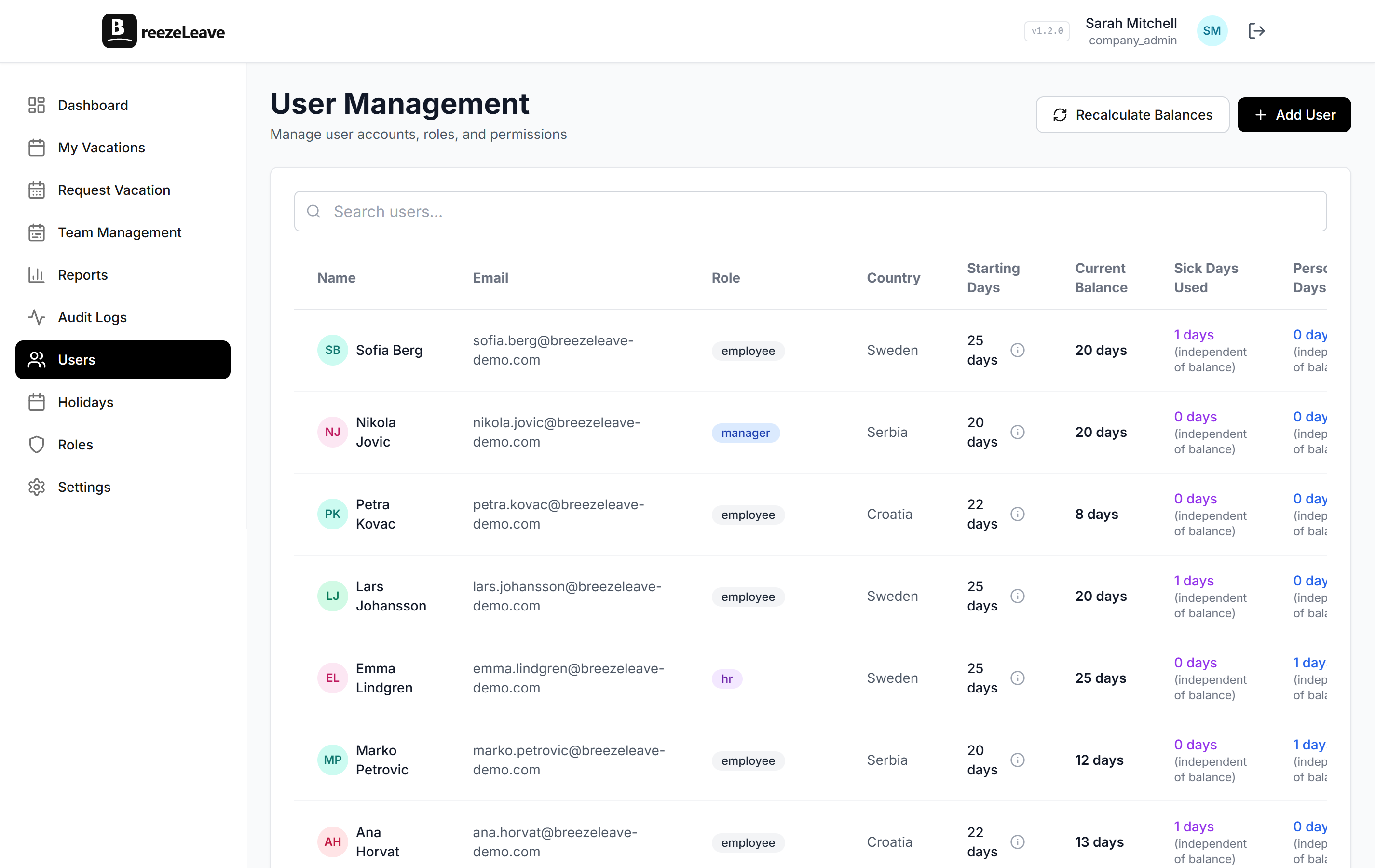
The five examples above cover the accrual decisions a growing team makes during the first year of running a leave tool. Once configured, the rules engine applies them automatically: monthly accrual on the 1st, tier transitions on anniversaries, carryover on January 1, expiry on March 31, exit payout on termination.
To build approval and accrual rules end-to-end, the vacation rules engine page shows the configuration screens with each rule type, and the rules engine policy examples article covers the carryover, blackout, and probation rules that sit alongside accrual.