Project Timeline Buffer Guide for Agencies
A practical reference for agency delivery leads and project managers: how to add timeline buffers per phase, when buffer matters, how to defend it to clients, and how to use it for unplanned work.
It is week six of a 12-week brand engagement. The project plan shows a clean rectangle from kickoff to launch. The delivery lead is looking at the same plan and a Slack channel where the client just asked for "one more small revision" on the homepage design. The senior developer is out sick. A third-party API the team depends on has a planned migration in week eight. None of these things are on the plan. All of them will move the launch. The agency has two choices: tell the client the launch is slipping, or admit the plan never had buffer in the first place.
Timeline buffer is the most underused tool in agency project management. Agencies sell calendars that look efficient and then delivery absorbs reality by working evenings. This article is a reference for delivery leads and project managers who want to plan buffer on purpose, defend it to clients, and use it for the unplanned work that arrives in every engagement.
What buffer is, and is not
Buffer is extra time allocated for a phase or a person, on purpose, for unplanned work. It is not hidden slack. It is a named block of capacity that the team can spend on revisions, sick days, dependency delays, scope drift, internal reviews, or the unfamiliar bug that always shows up in week eight.
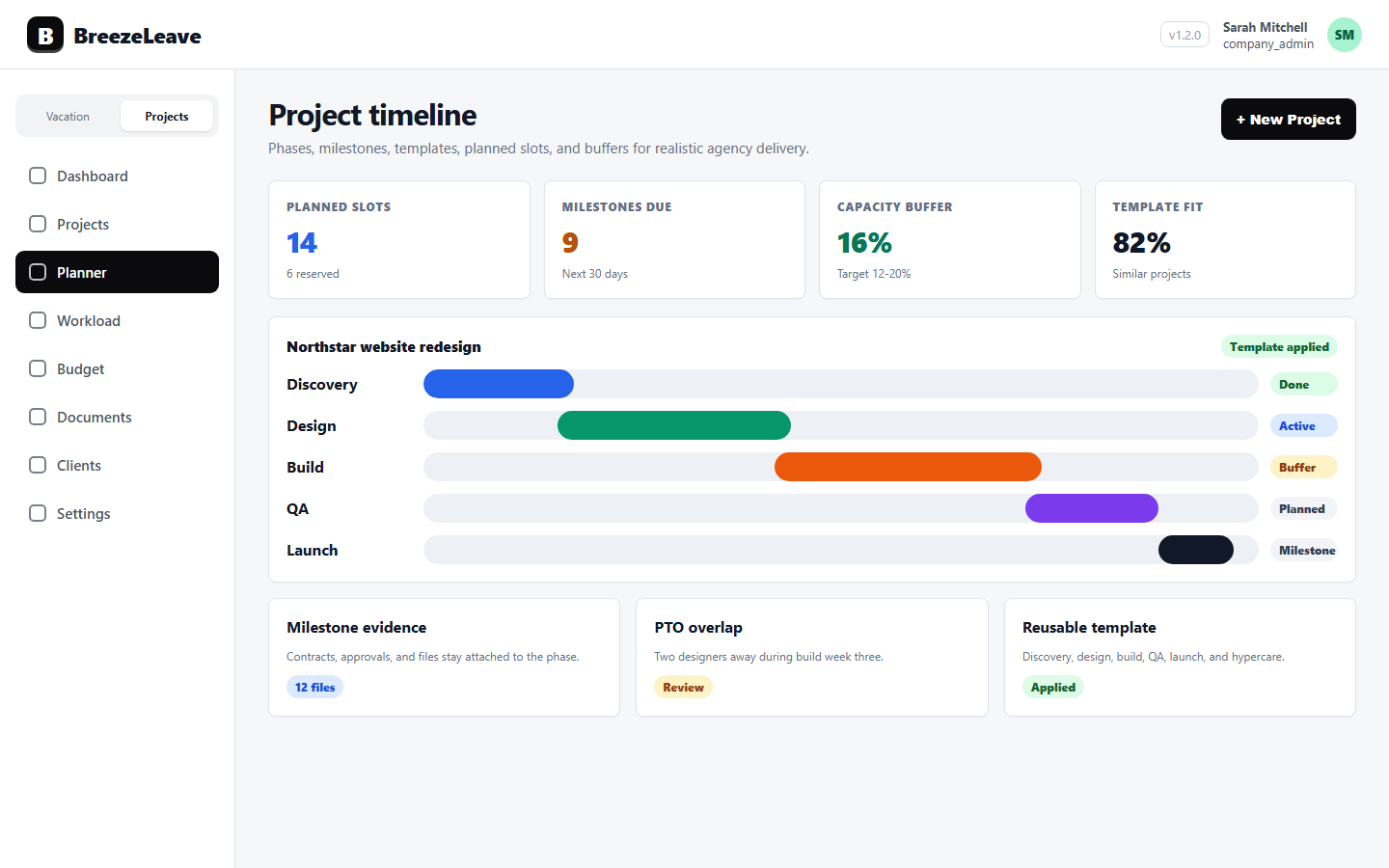
BreezeLeave treats buffer as a first-class thing on the project timeline. Each phase has a planned duration and a buffer alongside it. The buffer is visible to the project manager, the delivery lead, and the agency owner. It does not pretend to be planned work.
Naming buffer changes how a team uses it. Hidden slack gets consumed silently by the first person who notices the gap. Named buffer is a budget; spending it requires a reason. That is the whole point.
Three kinds of buffer worth planning
Not every buffer means the same thing. The three kinds below cover most agency engagements.
| Buffer type | What it absorbs | Typical size |
|---|---|---|
| Phase buffer | Extra revisions, late dependencies, internal review time | 15 to 25 percent of the planned phase length |
| Person buffer | Sick days, ad-hoc account requests, internal meetings | 10 to 15 percent of weekly planned hours |
| Project tail buffer | QA, last-mile client feedback, launch-day surprises | 5 to 10 percent of total project duration |
The percentages are starting points, not rules. An engagement with a known sponsor and a clear brief can run with smaller buffers. A new client, a new platform, or a tight launch date needs bigger ones. The point is to choose a number on purpose and write it down.
When buffer is worth fighting for
Buffer always looks expensive at the start of a project and cheap in the middle. Three situations make it worth the negotiation before kickoff.
- Fixed launch date. If the client cannot move the launch, the team needs more buffer, not less. A fixed date with no buffer is the same as a soft date with a hard deadline.
- Multiple approvers. Each new approver adds review time. A board sign-off in week ten is not the same as a single sponsor in week ten.
- Unknown unknowns. A migration to a new platform, a new agency relationship, a first project with a complicated legal team. The team cannot estimate well because they have no history.
In each case, the conversation is not "we are slower." It is "we plan honestly." Most senior clients respect that, particularly when the alternative is an emergency call in week eleven.
Building a timeline with named phases and buffers
A timeline in BreezeLeave is a sequence of phases. Each phase has a start, an end, a planned duration, a buffer, and milestones. The buffer column sits next to the planned duration, not hidden inside it. The pattern below is the version a delivery lead can copy as a starting point for a 12-week engagement.
| Phase | Planned | Buffer | Milestone |
|---|---|---|---|
| Discovery | 2 weeks | 3 days | Approved brief |
| Strategy | 2 weeks | 3 days | Approved strategy |
| Design | 3 weeks | 1 week | Approved direction |
| Build | 3 weeks | 1 week | Staging ready |
| QA and launch | 2 weeks | 4 days | Launch |
The total planned time is 12 weeks. The total buffer is roughly 18 working days, or about three calendar weeks. The engagement looks like a 15-week plan, not a 12-week one. That is the honest version. The team can still aim for week 12. If they hit it, the buffer was a planning safety margin. If they slip, the launch is still inside the contracted window.
Using buffer for unplanned work
Buffer is most useful when the team treats it as a budget. A revision the client asked for in week seven is paid for from the design phase buffer, not from week eight's planned work. A developer sick day is paid for from the person buffer for that week, not from the build phase.
BreezeLeave's project planner makes this visible. Unplanned work items (revisions, dependency waits, sick days, internal meetings) consume buffer the same way planned work consumes planned hours. At the end of each phase, the delivery lead can see how much buffer was used, what consumed it, and how much is left. That becomes the input for the next conversation: either the next phase needs more buffer, or the team's estimates are honest.
For the planned-slots and unplanned-work view that pairs with this, see the planned slots workflow. For the workload picture across the team, the workload capacity planning view shows where buffer consumption lands by person.
How to defend buffer to a client
Clients sometimes push back on buffer because they read it as slack. The conversation goes better when the agency reframes it.
- Buffer is for the client's revisions. Most buffer gets consumed by the client requesting changes. Removing buffer means removing room for client feedback.
- Buffer absorbs dependency risk. Late assets, slow legal review, third-party APIs. None of these are agency fault, and all of them eat the calendar.
- No buffer means weekend work. Either the team works evenings to hit the date, or the date slips. Buffer is the alternative to both.
- Buffer is reviewed at each milestone. If a phase finishes early, the buffer is returned to the project, not spent automatically.
The strongest argument is the contracted launch date. A 12-week engagement with 12 weeks of planned work and zero buffer is a promise to slip the launch the first time anything unplanned happens. A 12-week engagement with three weeks of buffer is a promise to hit the launch even when the unplanned happens.
Reusable templates with buffer baked in
Every engagement does not need to start from a blank canvas. BreezeLeave supports reusable project templates with phases, milestones, and buffers preset. A web build template, a brand engagement template, and a discovery template can each carry the buffer profile the agency already trusts.
Templates also stop the slow drift toward optimistic plans. A new project manager who copies the template inherits the buffer, even if they would have planned tighter on day one. After two or three engagements run with the template, the team has data on how much buffer was actually consumed. The template gets refined from history, not from hope.
For the broader project ops view, see project management software built for agencies.
A worked example: the missing buffer
Take the 12-week brand engagement from the opening. The plan carried no explicit buffer. The senior developer was sick for three days in week six. The client asked for a homepage revision in week seven. The third-party API migration ran over by four days in week eight. None of these are unusual.
Together, they cost the team about eight working days. With no buffer, the team absorbed those days by working evenings in weeks nine and ten and slipping QA into week twelve. Launch happened on time, barely, and the team finished tired.
Run the same engagement with the template above. Phase buffers absorb the three categories of slip. The team works normal hours. Launch happens on the same day. The post-mortem shows buffer was used as intended, not as emergency overflow.
Where buffer planning usually breaks
- Buffer is hidden inside planned hours. The team calls it "padding" and consumes it silently. The fix is to put buffer in its own column on the timeline.
- Buffer is too small. Five percent of a phase covers one half-day. The fix is to size buffer to the actual risk profile of the engagement.
- Buffer is too big. 40 percent of every phase is a different problem; clients refuse the plan, or the team learns to ignore the calendar. The fix is to start from 15 to 25 percent and adjust by history.
- Buffer is consumed without a reason. If the team uses a week of buffer in week three with no note, the delivery lead loses the ability to forecast week eight. The fix is to write down what consumed each block.
- Buffer is never returned. A phase finishes early and the team automatically pulls forward. The fix is to treat finished-early buffer as project margin, not a free week.
Put buffer on the calendar
Timeline buffer is not generosity to clients or laziness in the team. It is the planning decision that says unplanned work is normal, the team knows it will happen, and the calendar has a place for it. The launch date holds because of that decision, not despite it.
Want phases, milestones, and explicit buffers on every project timeline, with reusable templates and a record of how buffer is actually consumed? Plan project phases, milestones, and buffers in BreezeLeave.
Related articles
Agency Project Timelines: Phases, Milestones, Templates, and Capacity Buffers
Project Planner for Agencies: Planned Slots, Unplanned Work, and Capacity