
Project Planner for Agencies: Planned Slots, Unplanned Work, and Capacity
How agencies can use planned slots and unplanned project intake to avoid committing delivery dates before capacity is clear.
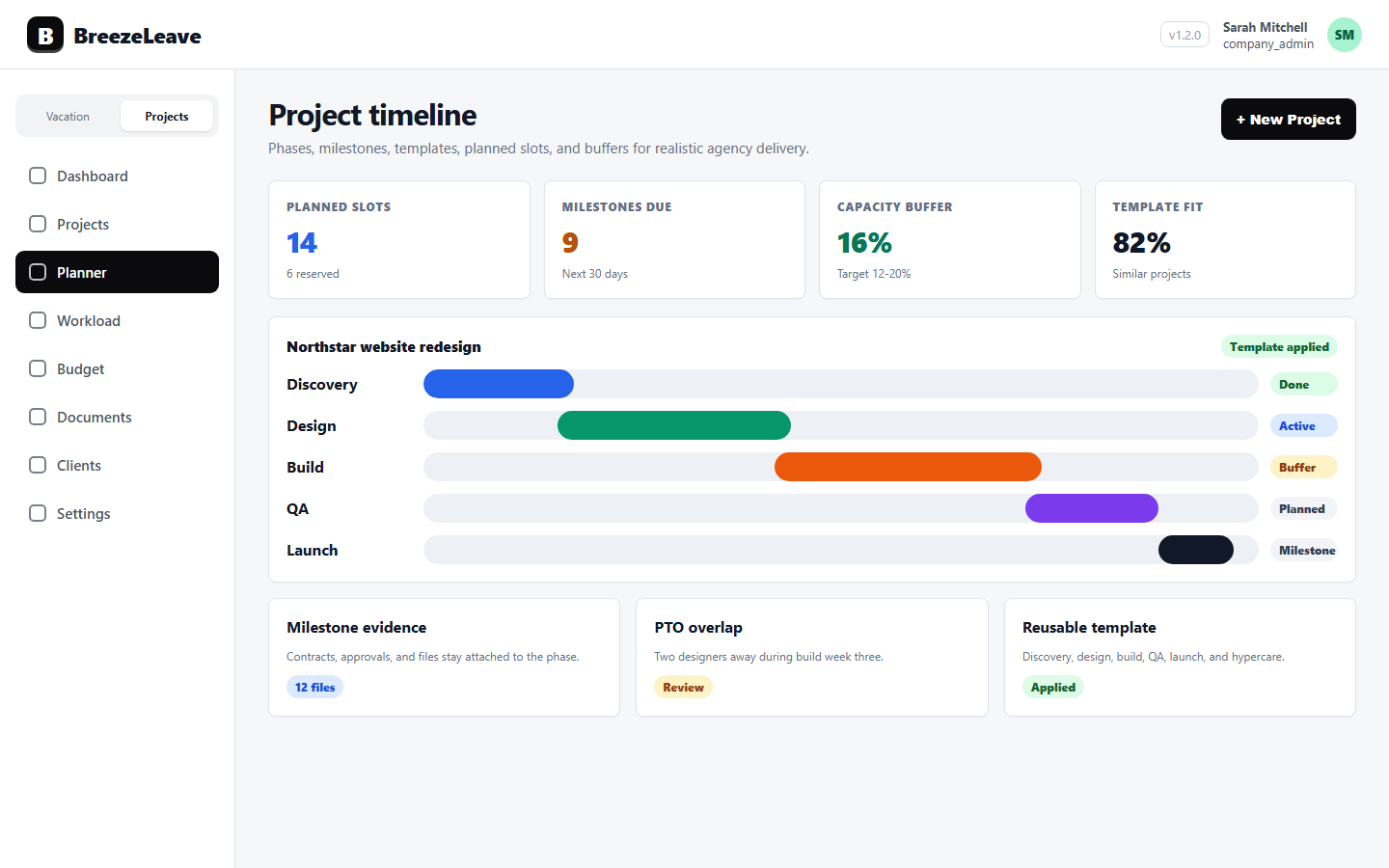
Agencies often lose control of capacity before the project even starts. A proposal gets accepted, the client asks when kickoff can happen, sales wants to keep momentum, and the delivery team inherits a date that sounded reasonable in the closing call. Then someone checks the calendar and finds out the lead designer is on PTO, QA is split across two retainers, and the only developer with context is already planned above capacity.
That is the gap a project planner should close. Not by making the process heavier, but by creating a disciplined pause between "we won the work" and "we promised the delivery window." BreezeLeave supports that pause with unplanned project intake and planned slots, so new work can be reviewed against real team capacity before the plan becomes a client commitment.
The important distinction is simple: signed work is not automatically scheduled work. It is work the agency needs to place somewhere responsibly.
Why unplanned work is not a backlog failure
In a lot of agencies, "unplanned" sounds like a warning label. It should not. Unplanned does not mean forgotten, ignored, or lost in someone's inbox. It means the project is visible, but the agency has not yet committed it to a delivery window.
That distinction protects the team from one of the most common delivery mistakes: treating a commercial event as a capacity decision. A contract can be signed today while the realistic delivery slot is three weeks from now. A client can be ready to start while the agency still needs to confirm people, documents, milestones, and role coverage.
- The right people may already be allocated to another client project.
- Approved PTO may remove a key person from the proposed start window.
- Public holidays may quietly reduce the number of real working days.
- The project may need a role that is not available yet.
- Retainers may already be consuming the same team's monthly capacity.
- Sales assumptions may be missing the handoff details delivery actually needs.
Keeping the work unplanned until those checks happen is not bureaucracy. It is a small buffer that prevents the agency from making promises with incomplete information.
The goal is not to slow down new work. The goal is to stop pretending a project has capacity before anyone has checked capacity.
Useful rule
If the agency cannot name the owner, delivery window, core roles, known absences, and competing work, the project should stay unplanned. It can still be visible. It just should not be treated as scheduled.
The handoff moment where plans usually break
The risky moment is often the sales-to-delivery handoff. Everyone is acting in good faith. Sales wants the client to feel looked after. Delivery wants enough detail to plan the work. Finance wants the commercial picture to be clean. The problem is that each team is looking at a different slice of the truth.
A practical handoff should answer five questions before a project moves from unplanned intake into a planned slot:
- What was actually sold? Scope, assumptions, documents, deadlines, and any client-specific constraints need to be visible before capacity is promised.
- Who owns delivery? A project needs a real owner, not a vague "delivery team" label that becomes a meeting after the fact.
- Which roles are needed? Design, development, QA, PM, strategy, and account capacity are not interchangeable just because the total team headcount looks healthy.
- Who is unavailable? PTO, sick leave, public holidays, and country-specific closures all reduce the window before anyone touches the scope.
- What work is already committed? Retainers, active projects, support load, and late-running tasks compete for the same people.
We cover the broader handoff process in the agency sales-to-delivery handoff checklist. The short version: a clean handoff does not just move information from sales to delivery. It gives delivery permission to say, "we need to place this in a realistic slot."
Use planned slots as capacity commitments
A planned slot is a better commitment than a hopeful start date. It tells the agency that the work has been placed into a realistic delivery window after reviewing availability, existing workload, role demand, and project context.
This matters because agency calendars can lie in a very convincing way. A Monday two weeks from now may look open until you add the details: two days of public holidays in one country, a senior developer on vacation, a retainer using half the design team's week, and a project that was supposed to finish last Friday but is still in QA.
In BreezeLeave, project planning connects to the same operating context as PTO-aware capacity planning, workload reporting, and project records. That lets managers ask better questions before assigning a slot:
- Which team members are available during this window?
- Which projects or retainers already use this capacity?
- Are key people on vacation or affected by holidays?
- Does the work need design, development, QA, PM, or account coverage?
- Are documents, milestones, or resource assumptions still missing?
- Would placing this slot make an existing client commitment fragile?
A planned slot should be treated as a capacity commitment. It does not need to be perfect, because project plans change. But it should be honest enough that the agency can explain why the window works.
A simple example: the project that fits until PTO is included
Imagine a small web project that needs one project manager, one designer, one developer, and QA support. On paper, the agency has room next month. The team calendar looks busy but manageable. The client wants kickoff in the first week.
Then the planner checks the real delivery window:
- The designer is out for three days during discovery.
- The developer is already assigned to a retainer for half the week.
- The QA person has a public holiday in their country during the test window.
- The project manager is covering another client while a teammate is away.
None of those facts kill the project. They just change the honest slot. Maybe kickoff moves by one week. Maybe discovery starts with the PM and client while design starts later. Maybe QA needs to be planned in a different week. The point is that the agency can make those decisions before the client has been promised a date that depends on unavailable people.
This is where leave management and project planning belong in the same conversation. PTO is not an HR side note. It changes the number of delivery hours available for client work. For a deeper look at the leave side of that equation, see our guide to team capacity planning.
What to check before assigning a planned slot
The slotting review should be boring in the best possible way. Same questions, every time. The value comes from consistency, not from a heroic project manager rebuilding the forecast from scratch every Friday afternoon.
| Check | What to confirm | Why it matters |
|---|---|---|
| Availability | Approved PTO, public holidays, and known absences | Headcount is not the same as usable capacity |
| Role coverage | Design, development, QA, PM, strategy, and account needs | A free person is not always the right person |
| Current workload | Active projects, retainers, support work, and overdue tasks | New work competes with commitments already made |
| Project readiness | Documents, scope, milestones, owner, and client inputs | Capacity is wasted if the work cannot actually start |
| Commercial context | Retainer limits, budget assumptions, and payment timing | A feasible schedule still needs to be a healthy project |
If one of these checks is unclear, keep the project visible as unplanned intake and resolve the gap. That is much cheaper than moving the project into an active plan and discovering the gap during kickoff.
Planning habit
Review unplanned intake on a fixed weekly rhythm. If the agency waits until a client chases for dates, the slotting conversation starts under pressure. A standing review keeps the queue visible before it turns into urgency.
Retainers make slotting harder than it looks
One-off projects are easier to reason about because they have a shape: kickoff, delivery, QA, launch, and support. Retainers are quieter. They often consume capacity in smaller chunks across the month, which makes them easy to underestimate when a new project arrives.
This is why planned slots should not only check project timelines. They should also check the recurring obligations already sitting inside the same team:
- Monthly content, design, development, or support allocations
- Client review meetings and account management load
- Recurring QA, reporting, or maintenance work
- Retainer work that tends to spike near month-end
A team can technically have an empty week and still be unavailable for a new project if the retainer pattern around that week is heavy. For that operating rhythm, pair planned slots with retainer capacity planning so recurring work does not disappear from the decision.
A practical planning workflow
The workflow does not need to be complicated. It just needs a clear gate between intake and commitment.
- Capture the work. Let signed or manually created projects land as unplanned when capacity is not confirmed.
- Clean up the project record. Confirm client, owner, project type, commercial context, documents, and any known milestones.
- Review the capacity picture. Check people, PTO, public holidays, workload, role demand, retainers, and current project mix.
- Choose the slot. Assign the project to a planned slot only when the delivery window is realistic.
- Communicate the commitment. Move the project toward active delivery with the client, documents, and milestones in place.
- Re-check during delivery. Compare the plan with logged hours and workload signals so the slot stays connected to reality.
That last step matters. Planned slots are not a one-time ceremony. Once the project starts, the agency should keep comparing planned work with what is actually happening. If logged hours are higher than expected, a milestone slips, or PTO changes the week, the planner needs enough visibility to adjust before the client feels the miss.
The weekly operating review can stay lightweight:
- What unplanned work is waiting for a slot?
- Which planned slots depend on people who are away?
- Which active projects are consuming more capacity than expected?
- Which retainers are crowding out new work?
- Which client commitments need a scope, timing, or staffing conversation?
For the workload side of that review, continue with workload capacity planning with PTO and logged hours.
What this changes for clients
This kind of planning is not only internal hygiene. It improves the client conversation. Agencies often worry that saying "we need to check capacity" sounds weak. In practice, it is usually the more professional answer.
A client does not need to hear every staffing detail. They do need a date the agency can defend. There is a big difference between:
"We can probably start next Monday."
and:
"We are placing this into the next available delivery slot. Kickoff on the 18th gives us the right team in place and keeps the first milestone realistic."
The second answer sounds slower for about five seconds. Then it sounds like an agency that knows how to protect delivery quality. Planned slots give account managers and project managers a shared language for that conversation.
The short version
A project planner is useful when it stops new work from becoming accidental delivery pressure. For agencies, that means treating unplanned intake as a visible waiting state and planned slots as real capacity commitments.
- Keep signed work unplanned until capacity has been reviewed.
- Check PTO, public holidays, role coverage, retainers, and current workload.
- Assign planned slots only when the delivery window is realistic.
- Connect the slot to project records, documents, milestones, and ownership.
- Re-check the plan against logged hours and workload once delivery starts.
For the public product overview, see project capacity planning and project management software for agencies.
Related articles
Project Capacity Planning for Agencies: Connecting PTO, Workload, and Budget
Resource Planning for Agency Projects: Roles, FTE, Assignments, and Capacity