Multi-Company HR Admin Guide
An operational checklist for the HR admin who runs leave for two or more legal entities: policies, balances, approvers, holidays, and the audit trail across companies.
Three legal entities. Two HR coordinators. One person (you) who has to sign off on the year-end leave report for all of them. Berlin runs 24 days with 5-day carryover. Zagreb runs 20 days with no carryover. Stockholm runs 25 days plus statutory bridge days. Each company has its own approver chain, its own holiday list, and its own payroll cutoff. The question is not whether you can run all three in one BreezeLeave admin. It is which steps you do before the first request gets approved in the wrong entity.
This checklist is for the HR admin or group HR lead who has been handed responsibility for two or more companies. Each section is a real decision with an owner. Use it as a meeting agenda for the rollout, then keep it as the operating procedure for the months that follow.
Before the first request: the setup checklist
Before any employee submits a request, the company-level data must already be correct. Five items, in order.
| Step | Owner | Done when |
|---|---|---|
| Create each legal entity | Group HR admin | Each company shows in the company switcher |
| Set the operating countries per company | Group HR admin | Each entity has at least one operating country |
| Load holiday calendars per country | Local HR coordinator | National holidays imported, custom holidays added |
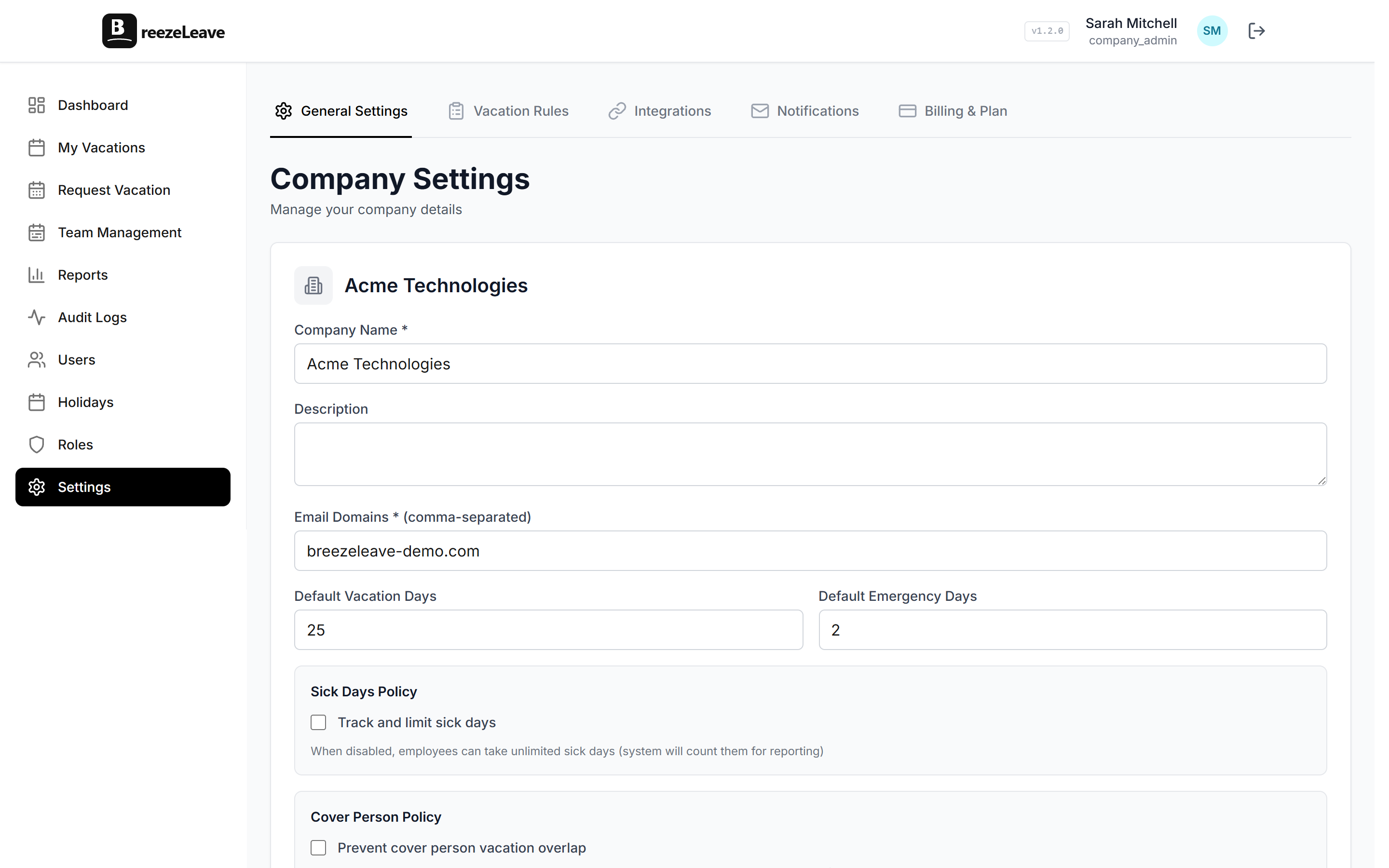
| Set per-company vacation policy | Local HR coordinator | Accrual, carryover, and approval rule set per entity |
| Assign approvers and scoped roles | Group HR admin | Every employee has a primary approver in their entity |
The order matters. Holiday calendars affect working-day calculations, which affect balance deductions. Policies depend on the country setup. Approver chains depend on user assignments. Setting them out of order means reconciling balances later.
Separating policies without losing the group view
The tension every multi-entity HR admin faces is the same. Local HR needs clean, separate company views. The group needs one place to pull a cross-entity report. Both should be true.
BreezeLeave separates the two layers. Each company holds its own:
- Vacation policy. Annual entitlement, accrual cadence, carryover cap, exit-payout rule.
- Holiday calendar. National holidays per operating country, plus custom company days.
- Approver chain. Manager-first, then HR, with optional escalation. Different chains per entity are normal.
- Balances and accruals. Each employee belongs to one entity. Balances accrue under that entity's policy.
- Audit log. Each company has its own audit history. Cross-entity audit views are available to group admins.
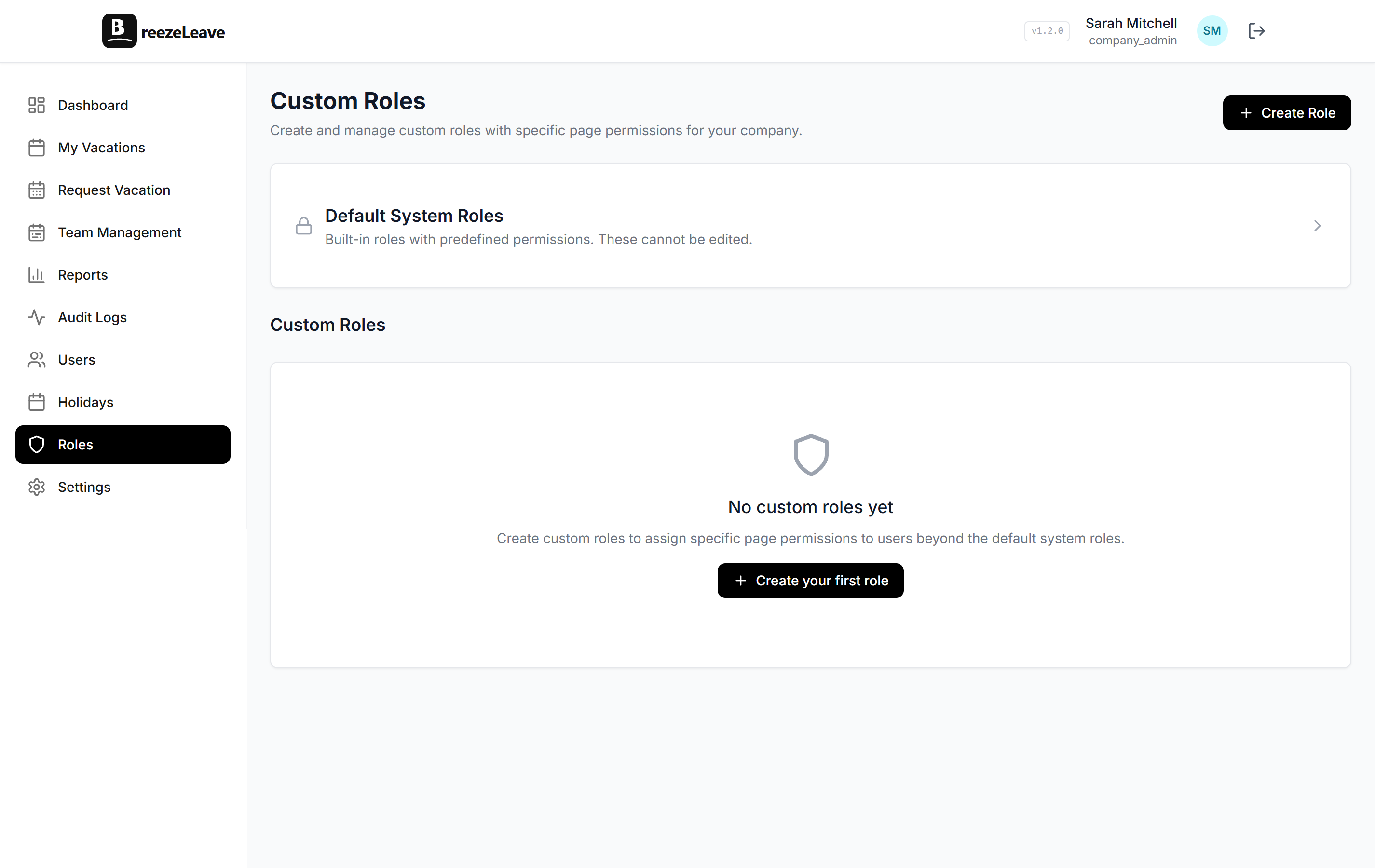
Above all of that sits the group-level admin view: one company switcher, one unified report, one place to add a user and assign them to the right company. The setup details live in our pillar on managing leave across multiple companies.
When an employee transfers between entities
This is the scenario that breaks naive multi-company setups. An engineer moves from the Zagreb entity to the Stockholm entity on May 1. Three questions show up the same week.
- Does the balance follow them? Sometimes yes, sometimes no. If the move is a legal employer change, the old entity usually pays out the accrued balance. If it is an internal transfer with the same employer of record, the balance carries.
- Which policy applies to the rest of the year? The policy of the new entity, prorated from the transfer date. The old entity's policy applies to days taken before the transfer.
- Which holiday calendar applies? The new entity's calendar applies from the transfer date. The old entity's calendar applies before. Working-day calculations switch automatically.
BreezeLeave records the transfer as an event on the audit log. Both the outgoing and incoming entity HR see the transfer date, the closing balance, and the new starting balance. That single audit entry is the document finance needs at year-end.
A transfer scenario
Engineer transfers from Zagreb (20 days/year, no carryover) to Stockholm (25 days/year + bridge days) on May 1. Zagreb pays out 6.7 accrued days. Stockholm opens with 16.7 accrued days for the remaining eight months. Public holidays switch from the Croatian to the Swedish calendar from May 1 onward. The audit log records the transfer event.
Approver chains across entities
Most companies start with one rule: the employee's direct manager approves. That works inside a single entity. With multiple entities, two complications show up.
Cross-entity managers
A delivery lead in the Berlin entity might be the line manager for a designer registered to the Zagreb entity. The approver chain crosses the company boundary. BreezeLeave allows this: the designer's primary approver is the Berlin lead, even though the designer's balance lives in Zagreb.
HR escalation per entity
When the manager is on vacation, the request escalates to HR. The HR approver is per-entity, not per-manager. Zagreb HR handles Zagreb employees even when their line manager is in Berlin. This protects local labor-law reviews from leaking into the wrong entity.
The matrix that explains who can approve what (and where the boundary sits) lives in the role-based permissions matrix.
Year-end reconciliation across companies
The end of the calendar year (or the end of the fiscal year for entities that run a non-calendar year) is when multi-company setups earn their keep. The checklist runs in two passes.
Per-entity pass
- Confirm every approved request has a cancellation policy applied.
- Reconcile balance vs accrual ledger for each employee in the entity.
- Apply carryover caps. Pay out or expire excess according to entity policy.
- Export the entity's payroll-ready leave data for finance.
- Snapshot the audit log for the entity.
Group pass
- Pull the cross-entity utilization report.
- Identify anomalies: an entity with much higher or lower utilization than peers.
- Confirm transfer events match between outgoing and incoming entities.
- Archive the group-level snapshot for compliance.
The group pass usually surfaces one or two reconciliation items that the per-entity pass missed. The most common is a transfer where the closing balance in the outgoing entity does not match the opening balance in the incoming entity. The audit log resolves these in minutes.
Reporting that holds together across entities
Cross-entity reporting is where multi-company HR earns its day. The report views to actually read on a monthly basis:
- Group utilization. Days taken vs. days accrued, by entity. Tells you which entity is running hot on PTO and which is banking days for year-end.
- Per-country coverage. Which weeks in which country office have more than 20% of any team off at once. Catches summer and holiday concentration before it hits delivery.
- Approver activity. Average time to approve per entity. A spike in one entity points at a missing or absent approver.
- Adjustment events. Balance adjustments by entity and by HR coordinator. Helps spot training gaps before they become audit findings.
Each report can be filtered to a single entity or rolled up across all of them. The group admin reads the rolled-up view; each local HR coordinator reads the entity-filtered view. Both use the same underlying data.
Outsourced HR providers and external coordinators
Plenty of multi-entity setups use an outsourced HR provider for one or two of the companies. The provider needs HR-level access to that entity, no access to the other companies, and no access to group billing.
That access shape is what the external HR scoped role is for. The provider gets a named login (not a shared account), scoped to the specific entity. The audit log records request, balance, role, and key administrative actions against their named user. When the contract ends, the role is revoked in one step. The details of that configuration are in our external HR scoped access guide.
A monthly operating routine
The recurring rhythm that keeps multi-company HR sustainable is a thirty minute monthly review. Same agenda every time.
- Pull the cross-entity utilization report for the prior month.
- Confirm every entity's approver chain still works. Look for managers who left.
- Review pending requests older than 48 hours. Escalate or close.
- Run the payroll handoff per entity and confirm finance received the export. Our email notifications page covers how to wire HR alerts into this routine so the monthly review becomes a confirmation, not a discovery.
- Spot-check the audit log for unusual balance adjustments.
The monthly review is the routine that keeps two HR coordinators and one group admin aligned across three legal entities. Skip it for a quarter and the year-end reconciliation gets noticeably harder.
Run multiple companies from one admin
Multi-company HR is not a different job from single-company HR. It is the same job with more entities, more holiday calendars, and more approver chains. The trick is not to centralize everything; it is to separate the per-entity layer cleanly and keep the group view on top of it.
BreezeLeave is built for that shape: per-entity policies, per-entity balances, per-entity audit, and a group admin who can see across them all. Manage multiple companies in one BreezeLeave admin and use this checklist as the operating procedure for the first quarter after setup.