Client Health Status Workflow for Agencies
A health status process for agency owners and account leads: how to label clients as healthy, at-risk, or churned, when to review, and what each label triggers.
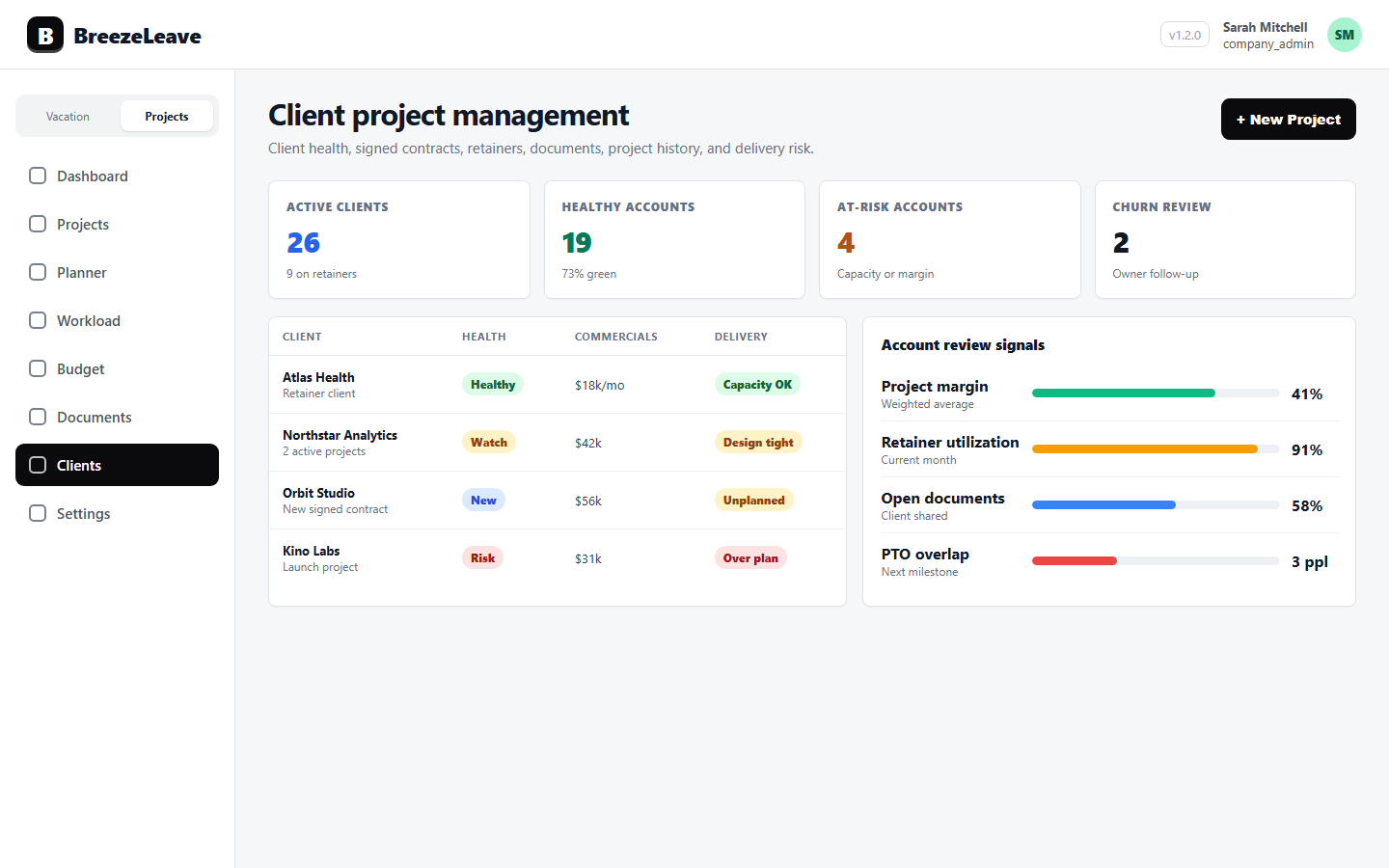
It is the first Tuesday of the month. The agency owner is preparing for the account review with two account leads. There are 34 active clients on the list. Eleven are retainers, the rest are one-off projects in flight. Three clients have paid late twice in a row. One senior client just had their main sponsor leave the company. Two have a kickoff scheduled next week. And one quiet logo project has been open for nine months and no one has discussed renewal. The agency owner does not need a CRM theory. They need to know which of these clients should get a partner call this week, which can stay on default cadence, and which the team is allowed to let go.
A client health status process is the system that produces that answer. It is not a satisfaction score, and it is not a sales pipeline. It is a labelled view of the clients the agency already has, refreshed often enough to drive action. This article is a review cadence an account lead can run with the agency owner once a month, with lighter check-ins in between.
What health status is, and what it is not
BreezeLeave tracks three health labels on each client: healthy, at-risk, and churned. Those labels sit alongside client type (one-off or retainer), signed and churned dates, contacts, related projects, retainers, documents, and payment schedules. The labels are not a marketing scorecard. They are a permission to skip or prioritise a conversation.
Healthy means the account lead has no reason to escalate. The retainer is staffed, the project is on plan, and the next milestone is visible. At-risk means something is real enough to track but not urgent enough to drop everything for. Churned means the relationship is over for now, the documents are archived, and the team can stop reserving capacity for them.
The label has to mean the same thing for every account lead. If one lead uses at-risk for "they did not reply to my last email" and another uses it for "they paid 60 days late", the review becomes noise. Agree on the triggers before the review, not during it.
The triggers for each label
Health is observable, not vibes. Below is a starter trigger list. An agency should keep its own version next to the clients page so every account lead applies the same definitions.
| Label | Triggers | Action required |
|---|---|---|
| Healthy | Payments on time, sponsor stable, project on plan, retainer hours used as planned, no open commercial dispute | Default account cadence, no extra owner attention |
| At-risk | Late payment twice, sponsor changed, retainer underused for two months, scope dispute open, missed milestone, NPS drop | Owner call within 14 days, retention plan, risk note on the client record |
| Churned | Contract ended without renewal, written notice from the client, formal offboarding completed | Set churned date, archive active documents, remove from capacity, share lesson with delivery |
The triggers do not need to be perfect. They need to be written down. Two account leads applying the same imperfect rules produce more signal than one lead applying perfect rules in their head.
The monthly review, step by step
The point of the process is the review. A 45-minute monthly meeting is enough for an agency with up to 50 clients. The agency owner and two account leads sit with the clients page open and walk through the labels.
- Sort by health, then by retainer value. The list opens with at-risk clients on top. Anything that has stayed at-risk for more than 60 days is reviewed first.
- Confirm every at-risk label. Either the trigger is resolved (move to healthy), the trigger is real and a retention plan is captured, or the client has churned and the date is set.
- Spot-check healthy retainers. Pick five at random. For each, open the retainer and confirm monthly hours are tracking against the plan. A retainer at 30 percent of expected hours for two months is at-risk even if the sponsor is friendly.
- Review churned clients from the last 90 days.Note the dominant reason in the client record. That field becomes the agency's churn ledger over a year.
- Close the loop with delivery. Each at-risk client should map to a delivery action (resource swap, scope reset, retainer rebalance) or a commercial action (renewal call, payment conversation).
The meeting ends with the agency owner's short list: three to five clients that need owner attention this week. Anything not on that list is delegated by default.
What each label changes operationally
A label only earns its place when something downstream changes. The agencies that get health status right wire it into the rest of the operating model.
- Capacity: An at-risk retainer should not silently consume the same senior people for another quarter. The next capacity review needs to see the risk note.
- Budget: Churned clients are removed from forward revenue. At-risk retainers should have a haircut scenario in the budget review.
- Documents: Churned client documents move to archive; expired share links are revoked; signed agreements are retained per policy.
- Payment schedules: Late-paying at-risk clients should have an escalation contact on the record before delivery starts the next phase.
- Handoff: A new signed contract from a previously at-risk client is a moment for the owner to review, not a default intake into delivery.
For the broader operating model around projects, retainers, and documents, see client project management. For the recurring-revenue side of the same picture, see retainer management software.
A worked example: the quiet retainer
Take a retainer that looks healthy on a Tuesday and turns at-risk by the end of the month. The client signed a 60-hour monthly retainer eight months ago. The sponsor is friendly, payments are on time, and the account lead has no anxiety on the record.
During the spot-check, the agency owner opens the retainer. Logged hours have averaged 18 of 60 for the last two months. The strategist on the account has shifted attention to a noisier project. The client has not complained because the agency keeps invoicing the full retainer. The label changes from healthy to at-risk. The retention plan is a sponsor call within two weeks to either expand scope or reduce the retainer for the next quarter. Either outcome is honest. Continuing to bill 60 for 18 is not.
For the retainer-side of this conversation, the retainer capacity planning guide walks through monthly allocations and staffing decisions.
Lighter weekly check-ins between reviews
A monthly review is the formal session, but health labels can drift in three weeks. A short weekly check between the agency owner and each account lead is enough to keep the labels honest.
- Five minutes per lead, four leads, twenty minutes total.
- Only at-risk clients are discussed. Healthy clients are skipped on purpose.
- The questions are the same each week: any change in trigger, any new risk, any owner action needed this week?
- Any churn decision is captured immediately; the date and reason are set on the client record before the meeting ends.
That weekly rhythm protects the monthly review from becoming a retrospective. The monthly meeting can stay strategic because the operational moves already happened week by week.
Where the review usually breaks
Health reviews fail in predictable ways. Each one is fixable, and each one shows up early.
- One person owns every label. If only the agency owner can mark a client at-risk, the list never refreshes between reviews.
- Labels are not tied to triggers. Vibes become labels, two account leads disagree, and the review becomes debate.
- Churned clients stay on capacity views. The retainer keeps appearing as a planning unit even after the client has left. The clients page needs the churned date set for the downstream views to update.
- At-risk has no expiry. A client stays at-risk for six months with no plan and no movement. Either the agency takes action or the label moves back to healthy with the reason documented.
- Health is reviewed without retainer hours. A retainer underused for two months is the most common early sign of churn. The review needs to see logged hours next to the label.
The shared cause is treating health as a feeling instead of as a view. The review only works when the data behind the label and the action after the label are both visible in the same place.
Hand the review to a successor
The test of a health review is whether a new account lead can pick it up in their first week. If the answer is yes, the agency has a process. If the answer is "ask me, I keep it in my head", the agency has a habit, and habits do not survive growth.
Three artefacts are enough: the trigger table, the monthly review agenda, and the clients page with current labels. Any new account lead reading those three can run the next monthly review with the agency owner without ceremony.
Want to run this review against your own client list with health, retainers, documents, and project context in one view? Track clients, retainers, and project health in BreezeLeave.