Small Business Leave Policy Setup Guide
An operational checklist for small business owners and first HR hires setting up a leave policy: entitlement, accrual, holidays, approvers, and the documents employees need on day one.
The leave policy conversation in a small business usually starts when someone is already gone. The shop manager texts the owner at 7 a.m. saying she is sick. The warehouse lead announces a wedding in three weeks and assumes that is fine. The bookkeeper asks how many vacation days she has left because she wants to fly home in August. The owner does not know any of these answers. There is no policy document, no balance file, and no agreed approver for anything that is not the owner herself.
This guide is for the small business owner, or the first HR hire walking into a business that has never written its leave policy down. The goal is a policy that you can hand to a new employee on day one, that an approver can apply without calling you, and that holds together when the team grows from 8 to 25 people. The work breaks into six decisions and one short document.
Decision 1: How many paid days off, and for which roles
Pick the annual entitlement before anything else. In most small businesses the debate is whether everyone gets the same number or whether managers and long-tenured staff get more. Both are defensible. Whatever you pick has to be written down, because new hires will ask in interviews and your existing team will notice the inconsistency the first time someone is told no.
The statutory minimum in your country is the floor. In the US there is no federal minimum, but 10 to 15 days is common in small businesses. In most of the EU the minimum is 20 to 25 working days. If you operate in more than one country, the rules are different in each one, and you need a baseline per country rather than one company-wide number.
Owner check
Write down the entitlement before you write down anything else. Everything downstream, including accrual schedules and exit payouts, depends on this number. If you are not sure, pick a defensible default such as 20 working days and revisit it after the first full year.
Decision 2: Accrual schedule and what happens on hire
There are two common choices for small businesses. The first is a yearly grant: each employee receives their full entitlement on January 1, and new hires receive a pro-rated grant on their start date. The second is a monthly accrual: every employee accrues roughly 1.6 to 2 days each month and the balance grows over the year. Yearly grants are easier to explain. Monthly accruals are safer when someone leaves mid-year because you do not over-pay an exit balance.
Whichever you pick, decide the pro-ration rule for new hires. A typical rule: anyone hired before the 15th of a month accrues for that whole month, anyone hired on or after the 15th accrues from the following month. The detail matters because the first balance an employee sees in the tool is the one they will challenge if it is wrong.
Decision 3: Holidays you observe as paid
National holidays seem obvious until someone asks whether the day after Thanksgiving is paid, or whether Good Friday is paid in a country where it is not a public holiday. Pick the list once, per operating country, and put it in the handbook. A retail business often closes for fewer holidays than an office. A professional services business often closes for more. There is no right answer, only a written one.
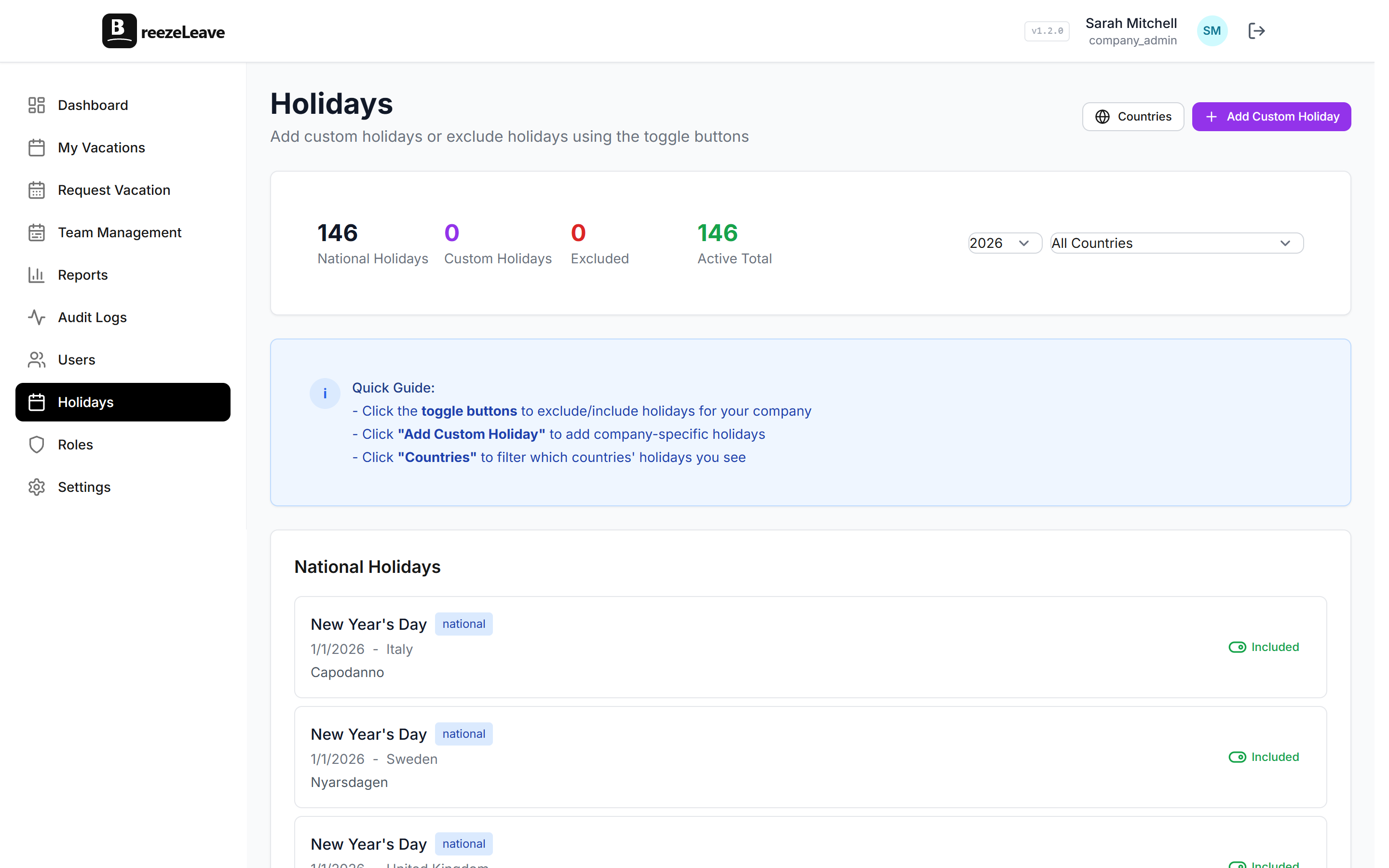
- National holidays you close for: the official paid days off. BreezeLeave loads a default list per country which you can adjust.
- Optional holidays the company observes: Christmas Eve, the Friday after Thanksgiving, half-days before major holidays, or a year-end shutdown between Christmas and New Year.
- Religious and cultural days you accommodate without paying: for example, employees can use vacation days for personal religious holidays not on the company list. Write the rule, do not improvise it case by case.
The detail of how working-day calculations interact with public holidays is in the holiday management guide and matters most for businesses with mid-week public holidays.
Decision 4: Who approves leave
In a five-person business the owner approves everything. In a twelve-person business with a shift manager, a senior tradesperson, and a part-time bookkeeper, that no longer scales. Pick the approver per role before you grow past ten people, because the cost of fixing it later is one missed shift or one double booking that you will hear about for months.
| Team | Approver | Backup approver |
|---|---|---|
| Shop floor and warehouse | Shift manager | Owner |
| Sales and customer service | Sales lead | Owner |
| Office and admin | Office manager | Owner |
| Owner | Co-founder or business partner | External advisor or accountant |
The backup column is the one that surprises people. The first time the shift manager is on her own vacation, somebody else has to approve a request, and the request will arrive on a Sunday evening. Decide the backup now so the answer is not "ask the owner" forever.
Decision 5: Sick days, personal days, and unpaid leave
Vacation is the easy category. The categories that cause confusion are sick days, personal days, and unpaid leave. A clear small business policy answers four questions:
- How many paid sick days are included, and do they reset each year or accumulate?
- Do personal days exist as a separate bucket, or do employees use vacation days?
- When is a doctor note required, if ever?
- When does unpaid leave become an option, and who approves it?
The pattern that works in small businesses: a small fixed bucket of paid sick days (often 5 to 10), vacation used for personal days, and unpaid leave available in genuine emergencies with the owner's sign-off. Write the rule. Apply it the same way to everyone. Inconsistent treatment of sick days is one of the most common reasons small business teams lose trust in the owner.
Decision 6: Carryover and what happens at year-end
Carryover is the rule that decides what happens to unused vacation on December 31. Three common options:
- No carryover. Unused days are lost on January 1. Simple, but tends to trigger a December stampede of last-minute requests that creates coverage problems.
- Carryover with a cap and an expiry date. Employees can carry up to five days into the new year, and those carried days expire on March 31. This is the most common small business choice.
- Full carryover. Any unused days roll forward. This balances grow quickly, especially with employees who never take time off. Avoid unless you have a payout policy you can defend.
The carryover decision is the one that the bookkeeper or accountant will care about most, because unused vacation is a liability on the books. Pick the rule and tell finance before you tell the team.
The handbook page
Once the six decisions are made, write one page. Not ten pages, not a legal document, not a slideshow. One page that lives in the employee handbook and that a new hire can read in three minutes. The page covers entitlement, accrual, holidays, approver, sick days, and carryover. Each section is two or three sentences.
What the handbook page looks like
- Vacation: 20 working days per year, granted on January 1, pro-rated for new hires.
- Holidays: the company observes the national public holidays plus December 24, 26, and 31. The full list is in the leave tool.
- Approver: your direct manager. Requests over 10 days also require the owner.
- Sick days: 7 paid sick days per year. A doctor note is required after 3 consecutive days.
- Carryover: up to 5 unused days carry into the new year and expire on March 31.
- Exit: unused vacation is paid out at the daily salary rate on the last day of employment.
That page is the test. If you cannot fit the policy on one page, the policy is too complicated for a business your size. Cut until it fits.
Where the tool fits
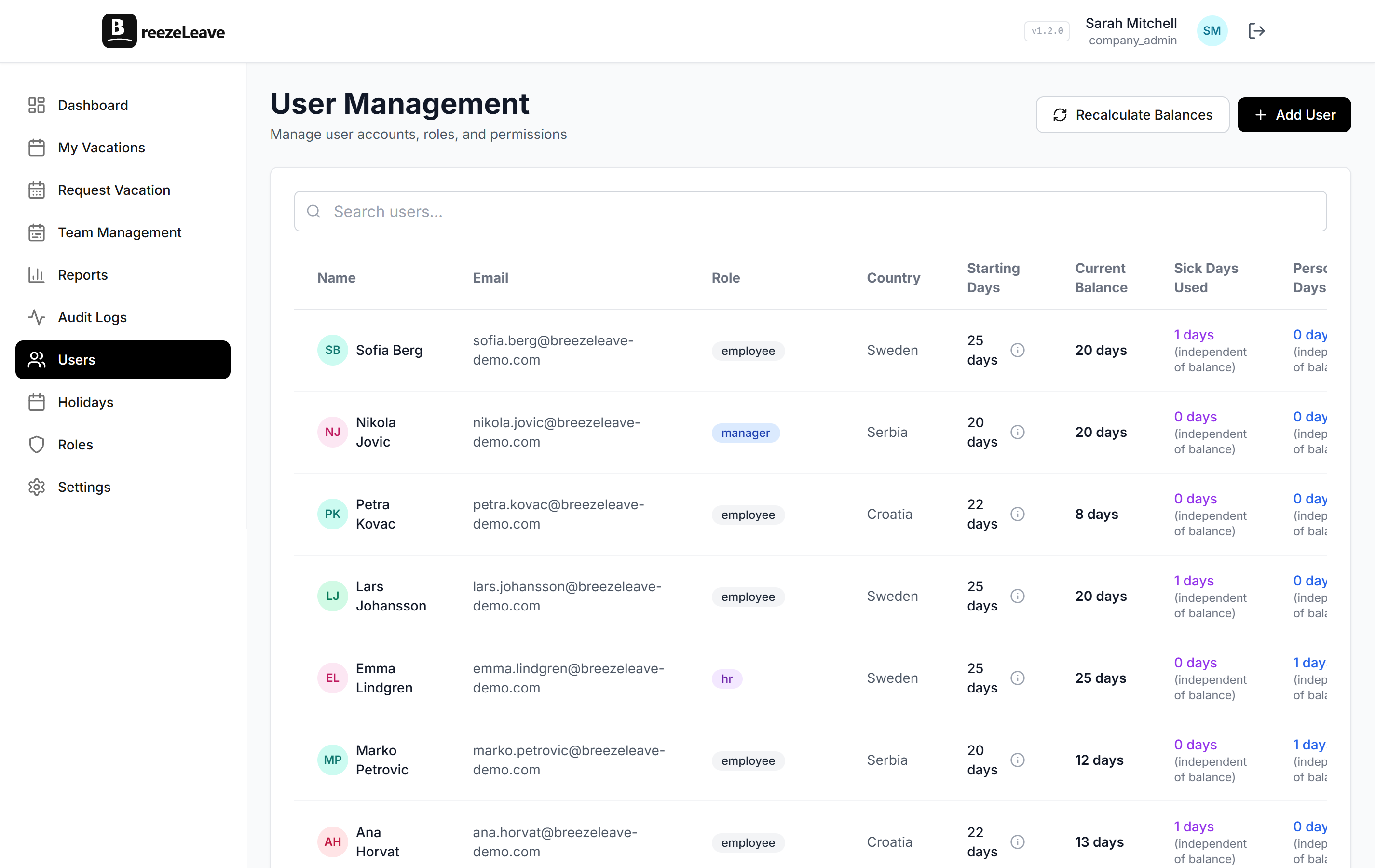
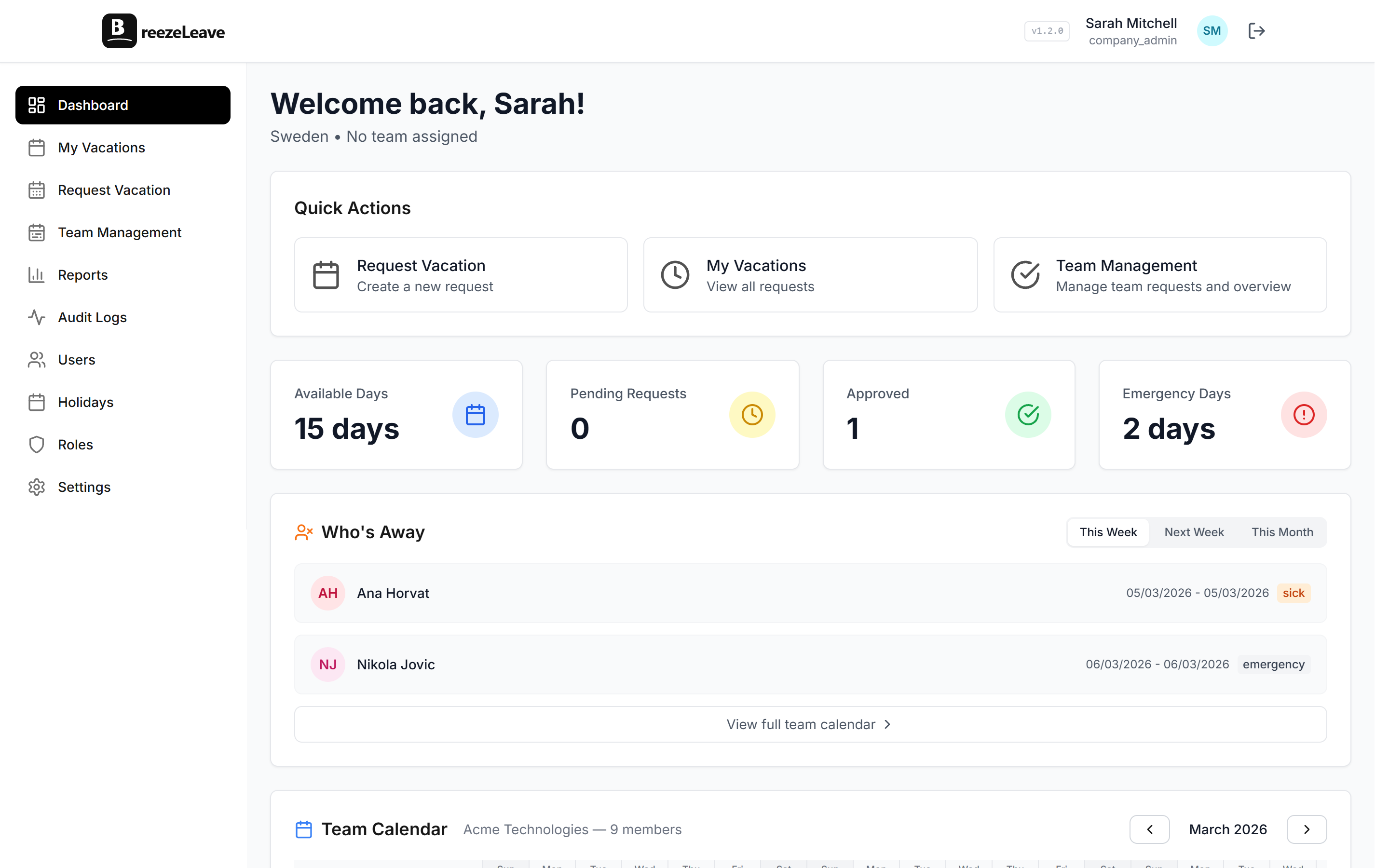
With the policy written, you need a place to track it. For small businesses, BreezeLeave is free up to ten users and covers the things that matter at that size: balances per employee, requests with an approver chain, a shared calendar so the team sees who is off, and holiday calendars per country.
The leave management software page walks through what the dashboard looks like at small business scale, with the rules from this checklist mapped directly to the configuration screens.
The first month in the tool
Once you turn the tool on, the first month is about closing the gap between the written policy and the day-to-day reality. Expect three things:
- Balance disputes from one or two long-tenured employees. They remember a verbal agreement from three years ago that bumped their entitlement. Hear them out, decide whether to honor it, and adjust the balance in the tool with a note explaining why.
- A surprise public holiday. A holiday you forgot to add appears in someone's request as a deducted vacation day. Add it to the holiday list, re-run the day count, and refund the balance.
- Requests that arrive outside the tool. Someone texts the owner instead of submitting through the app. Reply with a one-liner pointing them to the request screen. Repeat until the habit forms.
After the first month, balance adjustments should drop to almost zero. If they do not, the policy or the starting balances need another pass. The balance automation guide explains where balances usually drift and how to keep them honest.
What changes when you cross ten employees
Most small business leave policies stop scaling somewhere between 10 and 20 employees. The owner can no longer approve every request because she is on the road. A shift manager becomes the approver. A second country joins the team. Year-end balances start mattering for the bookkeeper. The audit log becomes useful the first time someone disputes a balance two months after the fact.
The good news is that none of these transitions require a new tool. The same leave tracker grows with you, as long as the policy decisions above are documented and applied consistently. Most small business leave problems are policy problems pretending to be tool problems.
The short list
The small business leave policy is ready when the following are true:
- The entitlement number is written down per country and per role.
- The accrual schedule is decided and applied to new hires consistently.
- The list of paid holidays is published and matches what the tool shows.
- Every employee knows who approves their leave and who the backup is.
- Sick days, personal days, and unpaid leave have clear rules.
- Carryover is configured with a cap and an expiry date.
- The policy fits on one page in the employee handbook.
When those seven are true, leave stops being a recurring source of friction. To try the setup end-to-end with your real team, start free with BreezeLeave and configure the policy directly in the company settings. The free tier covers up to ten users, which is enough for most small businesses to get through the first full year before paying anything.