Slack vs Microsoft Teams for Leave Approval Workflows
A dated comparison of running leave approvals through Slack or Microsoft Teams: slash commands, adaptive cards, channel patterns, and best-fit scenarios.
Most teams pick Slack or Microsoft Teams because of where their company already lives, not because of how leave approvals will run. That is the right order. The leave system should bend to the chat tool, not the other way around. Still, the two platforms behave differently once you start routing approval requests through them, and the differences are worth knowing before you flip on the integration. This comparison is dated May 13, 2026 against the current BreezeLeave Slack and Teams behavior and the public capabilities of both platforms on that date.
Reader for this piece: an IT admin or HR admin choosing how to set up leave approvals on the chat tool the company already uses. If you are still picking between Slack and Teams as a chat tool, leave approvals should not be the deciding factor. There are bigger reasons to choose one over the other.
What both integrations do
Before the differences, the common ground. The BreezeLeave Slack and Teams integrations both support:
- Inline approval and rejection from the chat message, with the action recorded in the audit log.
- A two-channel pattern: one channel for action items (requests, approvals), one for notifications (who is off).
- Per-user identity mapping so each approval is tied to the right BreezeLeave user.
- Notifications for new requests, status changes, sick day declarations, and pre-vacation reminders.
- The same underlying approval rules. The chat tool is the surface, not the rule engine.
If your team's needs stop at the list above, both tools will get the job done. The differences below matter only once the team grows past a handful of approvers, or once coverage and visibility patterns get more specific.
How the message renders
Slack uses Block Kit. Teams uses Adaptive Cards. Both produce a structured message with approve and reject buttons. From a reading perspective, the two render differently.
| Aspect | Slack (Block Kit) | Microsoft Teams (Adaptive Cards) |
|---|---|---|
| Message density | Compact, tight vertical spacing | More vertical space, larger cards |
| Inline action confirmation | Card updates in place | Card updates in place |
| Mobile rendering | Strong; buttons tappable | Strong; buttons tappable |
| Direct message support | Yes | Yes |
| Slash commands | Yes (e.g. /whoisoff) | Via bot commands |
For day-to-day approvals, the difference is mostly cosmetic. Where the rendering style matters is in busy channels. Slack's tighter cards let an approver scan a list of requests faster. Teams' larger cards stand out more in a channel that mixes leave with other operational threads, which can be useful when leave is not the primary topic.
Channel patterns
Both integrations support the same two-channel pattern. The action channel carries approval-bound messages. The notifications channel carries the who-is-off digest and absence reminders. Splitting the two reduces noise in the action channel and keeps the notifications channel scannable.
Implementation differs slightly:
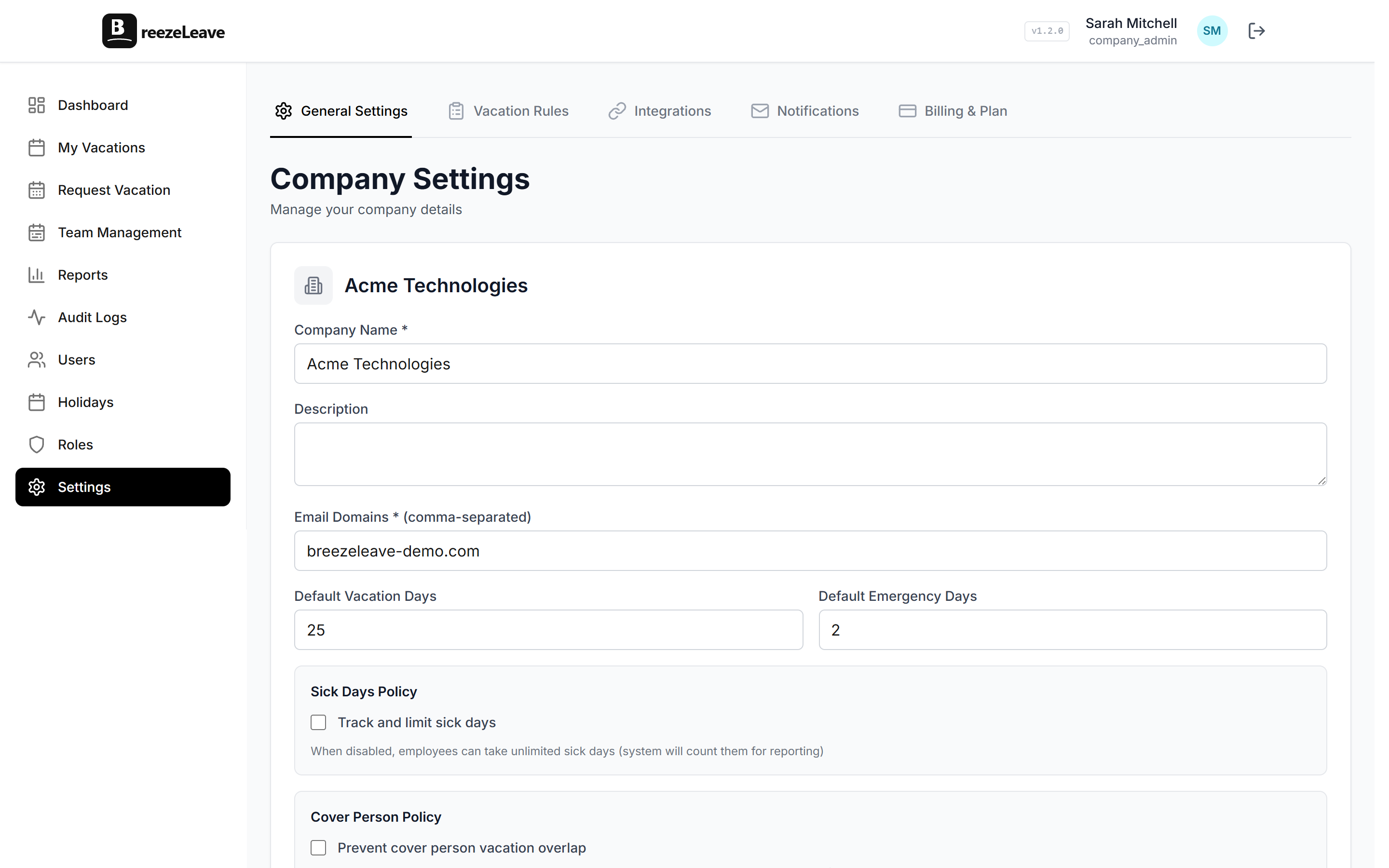
- Slack: the two channels are configured by name in BreezeLeave settings. The bot needs to be invited to each. Private channels work as long as the bot is added.
- Microsoft Teams: channel IDs are stored as a comma-separated list in the company settings. The bot needs to be installed in the team, and channel IDs come from the channel URL.
The Slack model is faster to set up because channel names are more memorable than channel IDs. The Teams model is more durable because renaming a channel does not break the wiring. Both arrive at the same outcome.
Identity mapping
Approvals only work if the chat user is correctly mapped to a BreezeLeave user. Both integrations support this through OAuth-based linking. The difference shows up at scale.
On Slack, the mapping uses Slack user ID and the BreezeLeave email. New hires usually link themselves on first interaction. Mismatches are rare and easy to fix.
On Teams, the mapping uses Azure AD identifiers. For companies that already run Microsoft 365 with SSO into BreezeLeave, the mapping is automatic. For companies that do not, the manual linking step has more friction than Slack's, but only once per user.
If you already run Microsoft 365 as the company identity provider, Teams is the cleaner choice from a provisioning standpoint. If your identity story lives elsewhere, Slack is easier to start with. The blog on how the Teams integration handles approvals and channels goes deeper on the identity flow.
Who-is-off and ad-hoc visibility
On Slack, the /whoisoff slash command returns a short list of who is on leave today and this week. Anyone in the workspace can run it from any channel. The response is private to the user who ran it.
On Teams, the equivalent is a bot command in a chat or channel where the bot is installed. The response is shown in the same conversation, which makes it slightly more public but also more discoverable.
Both surfaces serve the same underlying data. The Slack slash command is the more natural pattern for ad-hoc questions. The Teams bot command is the more natural pattern when the question is part of a broader thread.
Multi-step approvals on chat
Both integrations relay the underlying approval logic. If your company uses a multi-step approval pattern (team lead, then HR, for example), the chat surfaces present each step to the correct approver at the right time. The audit log keeps a record of every decision, regardless of the chat tool.
Where the two diverge is in fallback. Slack messages can be reposted to a channel if a direct message goes unread for too long. Teams messages stay in the same channel by default. For larger approval chains, the Slack fallback tends to feel more flexible. The blog on multi-person approval flows covers the pattern itself, separate from the chat surface.
Best fit for Slack
Slack is the better choice when:
- The company already runs daily operations through Slack.
- Approvers are spread across multiple time zones and need quick fallback to channel reposts.
- Ad-hoc who-is-off questions come from many parts of the organization.
- You want minimum setup friction for new hires.
Slack is the natural fit for smaller and faster-moving teams. The slash-command pattern and the tight card rendering match a chat culture where the leave system should be invisible until it is needed.
Best fit for Microsoft Teams
Microsoft Teams is the better choice when:
- The company runs on Microsoft 365 and Teams is the default collaboration surface.
- Identity is centralized in Azure AD and SSO mapping is already configured.
- Leave conversations need to live alongside operational threads in the same channel.
- The HR team prefers larger, more visible cards over compact ones.
Teams is the natural fit for organizations that have already standardized on the Microsoft stack and want the leave system to feel like another part of that stack rather than a separate tool.
What does not change between the two
Three things are identical between the Slack and Teams setups:
- The approval rules. Rules engine logic, multi-step approvals, auto-approval, and escalations apply regardless of the chat surface.
- The audit trail. Every approval, rejection, and adjustment is logged in BreezeLeave with the chat surface noted on the row.
- The exports. CSV and PDF reports do not change based on the chat tool.
That last point matters most. If you decide later to move from one chat tool to the other, the leave data stays. The integration changes, the rules and history do not.
A short note on sources
This comparison is based on the BreezeLeave Slack and Microsoft Teams integration behavior as of May 13, 2026, on Slack's Block Kit documentation, and on Microsoft's Adaptive Cards documentation. No competitor product is being criticized here; both Slack and Microsoft Teams are mature chat platforms with active development. The fit decision is about your company's stack, not about platform quality.
For the underlying integration mechanics, the Slack vacation bot setup post walks through the connect flow and the slash commands. To connect either integration or to explore the broader integration set, see BreezeLeave integrations.