Sales-to-Delivery Handoff After a Signed Contract
A signed-contract handoff checklist for agency owners and delivery leads: turn the signed agreement into client and project records, attached documents, and a capacity-aware kickoff.
It is 16:30 on a Thursday. A senior salesperson just forwarded a signed agreement to the delivery lead with the subject "Great news, kickoff Monday?" The contract is 22 pages. Three deliverables are bullet points on page nine. The payment schedule lives in an appendix. The named senior designer the client expects is on vacation next week. The retainer clause kicks in on month two but nobody has reserved the hours. By Friday morning the client emails asking for the Monday kickoff invite. The delivery lead has not yet opened the contract.
This is the moment a sales-to-delivery handoff either holds or cracks. A signed contract is a promise. Turning that promise into operating reality needs more than a forwarded email. This article is a handoff checklist for the two days after signature, written for the agency owner and delivery lead who own the bridge between commercial agreement and staffed delivery.
Why the first 48 hours matter
The two business days after a contract is signed decide whether the first month of delivery is calm or chaotic. The agency that handles those hours well inherits clean records, attached documents, named contacts, agreed scope, and a capacity check before the kickoff invite goes out. The agency that does not inherit a Slack thread, a forwarded PDF, and the wrong start date on a calendar invite.
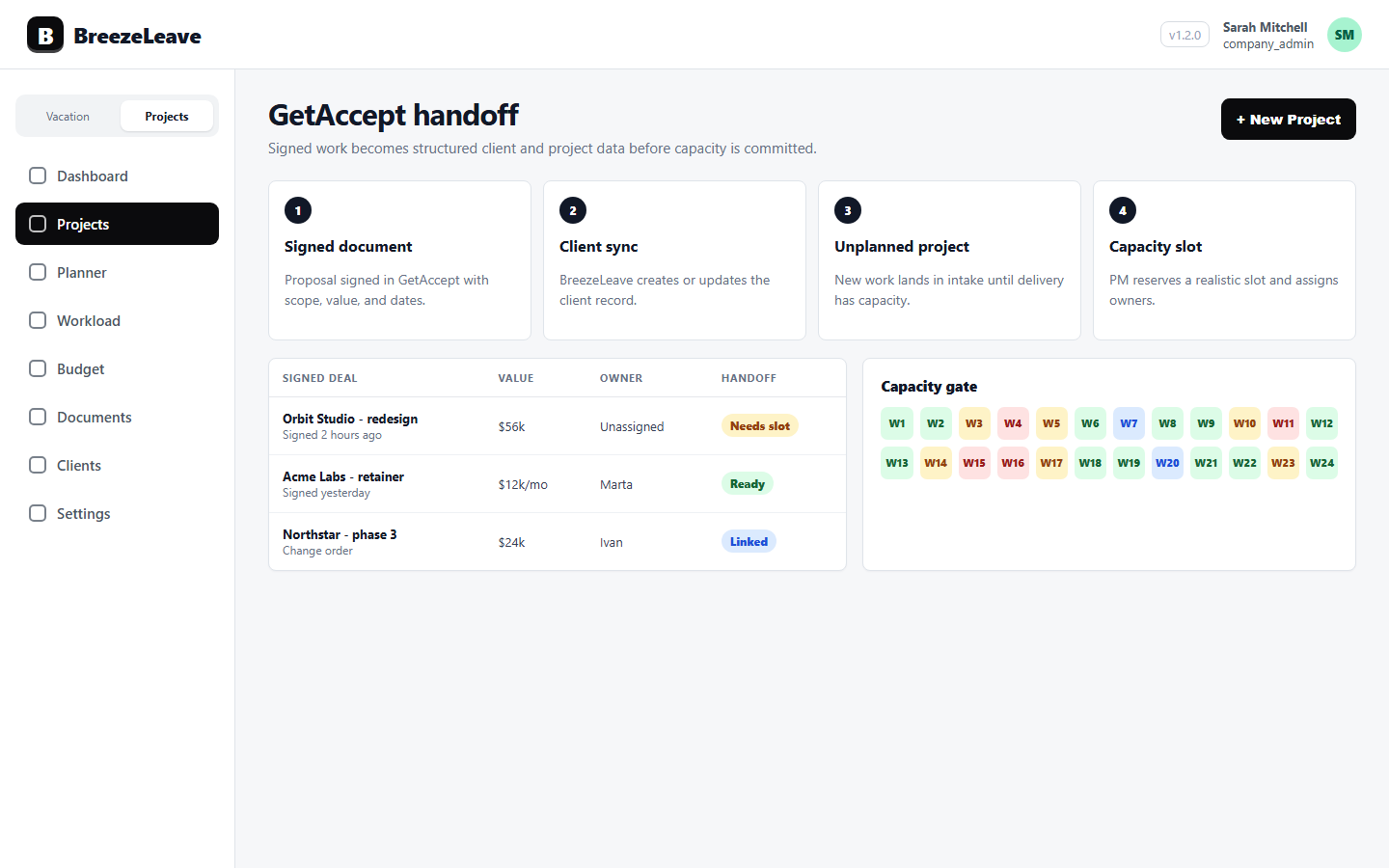
The handoff is not a ceremony to add. It is the chance to convert a signed agreement into a client record, a project record, attached documents, and a capacity-aware delivery plan before momentum carries the team into a date nobody has checked. BreezeLeave's GetAccept project handoff view is built around that conversion: signed documents can create or update clients and projects, and a pending handoffs list shows the deals waiting to be staffed. The integration is currently in Beta and available by request; contact us to enable it for your workspace while we finish the GetAccept marketplace registration.
The 48-hour checklist
The list below is the version a delivery lead can run with the agency owner. Each item has an owner. The clock starts when the contract is signed, not when sales sends the email.
| # | Check | Owner |
|---|---|---|
| 1 | Signed document is attached to the client and project record | Delivery lead |
| 2 | Client record exists with correct contacts and account owner | Account lead |
| 3 | Project record carries the scope summary and project type | Delivery lead |
| 4 | Payment schedule and milestone amounts are captured | Finance lead |
| 5 | Retainer hours, term, and start month are configured | Account lead |
| 6 | Named people promised in the pitch are confirmed available | Delivery lead |
| 7 | Capacity is reviewed against PTO, holidays, and existing work | Delivery lead |
| 8 | Work stays as unplanned intake until the capacity check passes | Delivery lead |
| 9 | Sensitive scope, exclusions, and special promises are noted | Sales |
| 10 | Kickoff invite is only sent after the realistic start date is set | Account lead |
The list looks long. In practice, a clean handoff takes 60 to 90 minutes of focused work split across three people. The cost of skipping it is a first month that runs on assumptions.
Hour 0 to 4: convert the signature into records
The first hours are about making the deal real inside the operating tools. Sales has the signed PDF. Delivery has nothing yet. The first action is to create or update the client and project, attach the signed document, and confirm the account owner.
If the deal flowed through GetAccept, the signed document can trigger client and project creation in BreezeLeave directly. The handoff view shows pending records waiting for a delivery decision. That removes the most common failure of this stage: a contract that lives only in sales tooling while delivery operates on memory.
A new client gets a record with the signed party, the billing contact, the operational contact, and the account owner. An existing client gets the new project linked to their existing record and existing retainers. If the deal extends a retainer, the term and hours are updated on the existing retainer, not created as a duplicate.
Hour 4 to 12: read the contract, not the summary
The salesperson knows the deal. The delivery lead needs to know the contract. Those are different documents. The summary email leaves out the appendix where the payment schedule lives, the clause that says the senior designer must be the same person from kickoff to launch, and the limit on weekend hours.
A 20-minute read with a highlighter (digital or otherwise) is enough. The delivery lead pulls the operational items out of the contract:
- Deliverables: what gets produced, reviewed, and accepted.
- Milestones: what events trigger payment.
- Exclusions: what was explicitly removed during negotiation.
- Named people: who the client expects on the work.
- Approval cycle: how many rounds, with what response times.
- Termination terms: what notice applies if the relationship breaks.
These points become the operating brief for the project. They live on the project record next to the signed PDF. A new project manager joining the account next month can read this brief and the contract without reconstructing the deal from memory.
Hour 12 to 24: run the capacity check before the date
The most common failure of this stage is committing a kickoff date before checking who is actually available. The signed contract often names a senior person the client expects. That person is also the one with three other engagements, two retainers, and a planned PTO week.
Before the kickoff invite goes out, the delivery lead reviews:
- Approved vacation and pending PTO for the named team.
- Public holidays in the first six weeks.
- Existing retainer commitments for the named team.
- Active project load on the same roles.
- The realistic earliest start date, role by role.
BreezeLeave keeps the new project as unplanned intake until that review is complete. Once the team and dates are confirmed, the project moves into a planned slot. That sequence keeps the agency from promising a Monday kickoff on a Friday afternoon. The underlying capacity view lives on the project capacity planning page; the broader people-and-handoff sequence is covered in the broader handoff checklist.
Hour 24 to 48: confirm the kickoff and write the email
Only at this stage does the kickoff date become external. The account lead now has a record-backed start date, a named team, a scope summary, and the signed document attached to the project. The kickoff email becomes short:
Confirming the kickoff for the new engagement on the agreed start date. The delivery lead and the named team will join. Agenda attached. The signed agreement is on file with us and a copy is attached for your reference.
That paragraph is the opposite of the chaotic version: it carries no excuses, no soft dates, and no "we will get back to you with the team." The client experiences a clean handoff from sales to delivery as professionalism. They do not need to see the checklist behind it.
A worked example: the rush kickoff
Take the Thursday signature from the opening. The contract is signed at 15:40. Sales forwards the PDF at 16:30. Under the checklist, the delivery lead does not respond with a yes or no for Monday. They open the signed document, create the project from the GetAccept handoff view, and read the contract by 18:00.
On Friday morning, the capacity check reveals two facts: the promised senior designer has approved PTO for the second week, and one public holiday lands inside the first month. The delivery lead proposes a kickoff for the following Tuesday, not Monday, and flags the PTO week so the client understands the deliverables before that window. The account lead writes the kickoff email by Friday afternoon. The client gets a confident, accurate start. The team gets a realistic plan.
Without the checklist, the same deal would have produced a Monday kickoff invite, a missing senior designer in week two, and a client phone call asking why the work has slowed down.
Where the handoff usually breaks
- The signed PDF is the only artefact. No client record, no project record, no attached document inside the operating tool. The fix is to create the records before sales sends the kickoff email.
- Sales summary replaces the contract. The delivery lead works from a paragraph, not the appendix. The fix is a 20-minute contract read on day one.
- Capacity is reviewed after the kickoff is promised.The Monday calendar invite arrives before the PTO check. The fix is to keep the project unplanned until capacity is confirmed.
- Retainer hours are not configured. Month two arrives, the retainer kicks in, and nobody has reserved hours. The fix is to configure the retainer on day one, not after the first invoice.
- Sensitive promises stay in sales memory. The named senior designer, the faster turnaround, the special reporting format never reach delivery. The fix is to write them on the project brief.
The shared cause is treating the signature as the end of sales instead of the start of delivery. The checklist makes the start of delivery visible.
Connect the contract to delivery
A clean handoff turns a signed PDF into a staffed project in the first 48 hours. The agency keeps the client record, the project record, the attached document, and the capacity-aware date in one place. The client experiences a coherent team. The delivery team starts work on Monday with a brief, not with a search through Slack.
Want signed contracts to create clients, projects, and unplanned intake automatically, then move into planned slots after a real capacity review? Read about the GetAccept handoff in BreezeLeave . The integration is currently available by request while we finish marketplace registration.