Google Calendar PTO Sync vs Shared Vacation Calendar
A dated comparison of syncing PTO to each employee's Google Calendar versus using a shared vacation calendar, with best-fit guidance for HR and team leads.
The question usually arrives from a team lead on a Tuesday morning: "Sara is out this week, can we put it on the team calendar so I stop being surprised?" The answer is either "yes, here is the shared vacation calendar" or "yes, her PTO already shows up on her own Google Calendar, you just need to subscribe to her availability." Both answers are correct, but they solve different problems. This article compares the two patterns side by side and helps pick the right one for the way your team plans. The comparison is dated May 13, 2026 against the current BreezeLeave Google Calendar integration and the broader behavior of Google Workspace on that date.
Reader for this piece: an HR admin or team lead deciding how vacation visibility should flow through the company's calendars. If you have both a shared calendar and a sync running and nobody trusts either, you are not alone. The fix usually starts with picking one as the source of truth.
The two patterns side by side
Both patterns answer the question "is this person out?" but they answer different downstream questions too.
| Aspect | PTO synced to each Google Calendar | Shared vacation calendar |
|---|---|---|
| Where the event lives | Each employee's own Google Calendar | In BreezeLeave, viewed by team leads and HR |
| Who sees it | Anyone with calendar access to that person | Anyone with access to the shared calendar view |
| Meeting conflict detection | Strong, native Google Calendar busy time | Weaker, requires a manual check |
| Coverage planning view | Limited, one person at a time | Strong, full team on one screen |
| Setup effort | Per-user OAuth, then automatic | Configured once for the team |
| Risk of double-source-of-truth | Higher if employees manually add PTO too | Lower |
Most teams need both views to be available, but only one of them as the source of truth. Picking which one matters because the patterns drift if both are treated as equal.
How the BreezeLeave Google Calendar sync works
The Google Calendar integration runs per user. Each employee connects their own Google account through OAuth. When a leave request is approved, BreezeLeave creates an event on that employee's primary calendar. When a request is cancelled, the event is removed. On first connect, the integration backfills existing approved leave so the calendar starts in sync.
Three behaviors are worth knowing before turning it on:
- Events appear as out-of-office or all-day events. Meeting schedulers see the busy time and avoid the dates.
- Disconnect cleans up. If an employee disconnects, the synced events can be removed.
- Cancellation propagates. If HR cancels an approved request, the calendar event disappears the same day.
The Google Calendar sync setup post walks through the connection flow and the permissions involved.
How the shared vacation calendar works
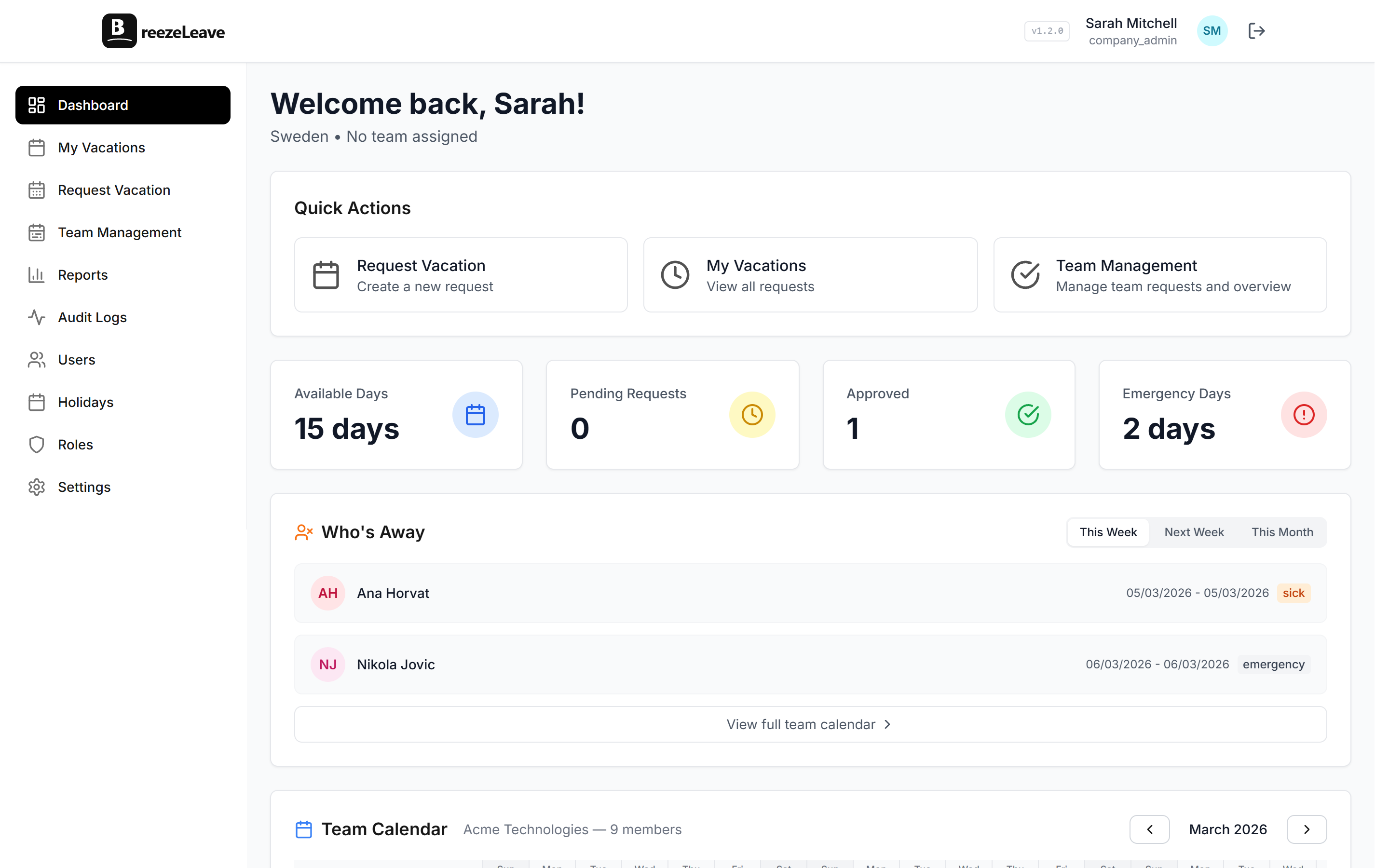
The shared vacation calendar is a view inside BreezeLeave. It shows approved leave for a team, a department, or the whole company, on a single calendar grid. It is not a Google Calendar. It does not appear in Google's interface. Access is controlled by BreezeLeave's role-based permissions.
Three behaviors define what it does well:
- Full team on one screen. Team leads see overlapping leave at a glance.
- Coverage filters. Filter by team, country, or leave type when looking for a specific overlap pattern.
- Always current. Because it reads from BreezeLeave directly, there is no syncing lag.
For a deeper look at how the shared view supports team-level planning, see the post on the shared team vacation calendar.
Where each pattern fits
The two patterns are complementary in most companies. The interesting question is which one carries the operational weight for a given team.
The Google Calendar sync is the better primary view when:
- The company runs heavily on Google Workspace and people live inside Google Calendar.
- Meeting scheduling is the main reason vacation visibility matters.
- The team is small enough that a one-person-at-a-time view is enough.
- Coverage planning is informal and lives in chat conversations rather than reports.
The shared vacation calendar is the better primary view when:
- Team leads plan coverage explicitly and need to see overlapping leave at a glance.
- The team spans multiple countries with different holiday calendars.
- Approval decisions depend on who else is out, not just on the request itself.
- HR runs coverage reports as part of the monthly review.
Mid-size teams (20 to 50 people) typically need both. The Google Calendar sync stops people from scheduling meetings into someone's vacation. The shared view keeps the team lead from accidentally approving three people for the same week.
The double-source-of-truth trap
Running both views is fine. Running both with no convention for which one wins is the common trap. Three habits keep it clean:
- BreezeLeave is the source of truth. If someone manually adds a PTO event to their own Google Calendar, the synced event will not match it. Train the team to log time off through BreezeLeave so the sync stays authoritative.
- Cancellations go through the system. If a vacation is cancelled, do it in BreezeLeave. Deleting the calendar event in Google leaves the request approved on the books, which corrupts the balance.
- The shared calendar is for planning, not for booking. Team leads can see the overlap; the booking still goes through the request form so approvals and balances are tracked.
Once these habits are in place, the two views stay in sync and the team stops second- guessing them.
Permissions and visibility considerations
The two patterns expose vacation data differently. That matters in regulated environments and in companies where leave type sensitivity varies.
- Google Calendar visibility depends on the user's settings. An employee can choose to show only busy time, hide event details, or share full details. The BreezeLeave sync respects the calendar's visibility model.
- The shared vacation calendar respects BreezeLeave permissions. Team leads see their team. HR sees the whole company. Employees see what their role allows.
For teams that need fine-grained access controls, the BreezeLeave view is the more predictable surface. For teams that rely on Google's existing sharing model, the synced events follow Google's rules. The post on role-based access in leave management covers the permission model in more depth.
Common failure modes
Three issues come up often enough to mention.
- Employee never connected their Google account. The sync only works once OAuth is granted. New hires sometimes skip the step. Run a quarterly check on who is connected and nudge the rest.
- OAuth token expired. Long-tenured employees can hit token expiry. BreezeLeave surfaces the disconnection in settings; act on it within the week to avoid a stale sync.
- Event spans a holiday. If a vacation request includes a public holiday and the holiday is configured in BreezeLeave, the calendar event reflects only the actual leave days, not the holiday. Confirm the holiday calendar is accurate so the event ranges match what employees expect.
A pragmatic recommendation
For most companies, the answer is: turn on both, and treat BreezeLeave as the source of truth. The Google Calendar sync solves the meeting-conflict problem. The shared vacation calendar solves the coverage problem. Together they cover the two operational questions vacation visibility needs to answer.
If you can only turn on one, pick based on which problem is louder. Meeting conflicts louder than coverage gaps points at the sync. Coverage gaps louder than meeting conflicts points at the shared view.
A short note on sources
This comparison is based on the BreezeLeave Google Calendar integration behavior as of May 13, 2026 and on Google Workspace calendar sharing as documented on that date. No competing leave platform is being criticized here; the choice is between two views inside the same system, not between two products. The shared calendar is a BreezeLeave view, and the synced events live in each user's own Google Calendar.
To set up the sync or to explore the broader integration set, jump into the Google Calendar integration or the full BreezeLeave integrations page.