Birthday and Loyalty PTO Bonus Policy Guide
An HR admin's guide to writing and configuring birthday and loyalty PTO bonus policies in BreezeLeave: trigger rules, one-time versus annual, and how it shows up on the balance.
An HR admin opens the benefits review and the CEO asks the same question they ask every year: "Are we still giving people their birthday off?" The answer is yes, but the spreadsheet that tracks who got the day and who did not is held together by a column nobody is sure how to recalculate. A new joiner whose birthday landed in week three of their tenure already missed it. A five-year anniversary on a Saturday went unnoticed. These are the small bonuses that disappear when they are tracked by hand.
This article is for the HR admin who wants the birthday day off and the loyalty bonus to live as policy, not as a recurring calendar reminder. In BreezeLeave the birthday is a separate leave type the employee requests near their date of birth, the loyalty bonus is a Jan 1 cron that credits qualifying users' starting balance, and the rules engine ties approval behaviour to both.
What a bonus PTO policy actually rewards
Bonus rewards are a small benefit with a real signal value. They tell employees the company sees them as people with anniversaries and birthdays, not as headcount line items. Two common forms cover most policies, and they work through different mechanisms in BreezeLeave:
- Birthday leave. A dedicated leave type the employee requests near their birthday. The eligibility window comes from the date of birth on the profile. The request does not deduct from the standard annual balance and it bypasses the usual advance-notice rule (the same way sick leave does).
- Loyalty bonus. An extra day or two added to the next year's starting balance for employees who used their full annual allocation. A Jan 1 cron runs the rule; the bonus shows up on the balance breakdown on day one of the new year.
The two mechanisms look different to the employee. Birthday leave is a request like any other leave. The loyalty bonus is a number on the balance that did not require asking. The rest of this article walks through the policy choices that make each work.
Compare the two mechanisms side by side
Birthday leave and the loyalty bonus answer different policy questions. Read the comparison once so the policy document and the configuration match.
| Mechanism | Trigger | How the employee receives it | Typical day count |
|---|---|---|---|
| Birthday leave | Employee submits a Birthday leave request near their date of birth | Approved leave, does not deduct from the annual balance, advance notice waived | 1 day |
| Loyalty (full-usage) bonus | Employee used their full annual allocation last year | Auto-credited to the next year's starting balance by the Jan 1 cron | 1 to 2 days |
Some companies pair these with a tenure milestone (3-year, 5-year, 10-year). Tenure milestones live in the rules engine as a separate rule type with its own day count and trigger; they are not auto-credited by the Jan 1 cron, and HR adjusts the balance manually or through an adjustment when the anniversary lands. Decide the policy first, then configure the rule.
Which inputs drive each mechanism
Two fields on the employee record do the heavy lifting:
- The date of birth, used to validate that a Birthday leave request falls inside the eligibility window. A request with no date of birth on the profile will not be eligible for the Birthday leave type.
- The hire date, used by tenure milestone rules and by the full-usage bonus to determine the prior-year allocation.
The Jan 1 cron reads each employee's previous-year usage and credits the loyalty bonus on the qualifying users' new starting balance. The birthday day off is not auto-credited anywhere; the mechanism is triggered when the employee submits the Birthday leave request, not by a recurring job.
What the employee sees
The loyalty bonus appears in the balance breakdown alongside the base accrual and carryover. The reason column says where the day came from, which removes the usual question on day one: "why does my balance show 26 days when policy is 25?"
A balance breakdown for a four-year employee in June might read:
- Base accrual: 22 days
- Carryover from last year: 2 days
- Full-usage bonus (used full allocation last year): 1 day
- Total: 25 days
The birthday day does not show up in this list. It is a separate leave type the employee requests on or near their birthday, and the request runs through the approval chain independently. Payroll sees the loyalty bonus on the balance export and sees the approved Birthday leave on the leave-day export, with each row labelled.
If the loyalty bonus needs to be reversed (for example, a probation employee who left before the next anniversary), the adjustment goes through the same ledger. The vacation adjustments article covers when to log a reversal rather than edit the rule.
Edge cases worth deciding before each goes live
Four situations come up in every birthday or loyalty policy. Decide once, document, then turn each one on.
- Leap-year birthdays. An employee born on February 29 needs a fallback date for the eligibility window. Most companies pick February 28 in non-leap years. Note it in the policy and configure the window to include the fallback.
- New hires whose birthday already passed. Decide whether a new hire can request the birthday day inside the current calendar year if their date already passed. Pick one rule and apply it consistently.
- Leavers whose loyalty bonus would credit on January 1. Decide whether the bonus credits if the leaver is still active on December 31 of the prior year, or only if they remain in seat after the Jan 1 cron runs.
- Part-time employees. A 60-percent role usually receives a pro-rated loyalty bonus and the same single birthday day as a full-time employee. Confirm both rules match the policy before enabling them.
How the two interact with the other rules
The birthday leave type and the loyalty bonus share settings with seniority accrual, carryover, and approval rules. The interactions are usually clean, but worth a quick scan during setup:
- Seniority accrual still runs. The loyalty bonus adds on top of the tenure tier the employee qualifies for. Birthday leave is independent and does not touch the annual allocation. The seniority accrual article covers the layering rules.
- Carryover caps apply to the loyalty bonus. If the policy caps carryover at five days, a loyalty bonus day that goes unused counts toward that cap. Birthday leave does not affect carryover because it never sits on the annual balance.
- Approval rules treat birthday leave like any other leave type. The request goes through the approval chain unless the rules engine auto-approves Birthday requests. Advance notice is waived for the Birthday type the same way it is for sick leave.
A short policy template
A working policy fits in five lines. Adapt the day counts and the eligibility window to the company.
Every active employee may take one paid day off on or around their birthday each calendar year. The day is requested through the leave system as a Birthday leave type and does not deduct from the standard annual allocation. Employees who use their full annual allocation in a given calendar year receive one additional paid day in the following year's starting balance. The Birthday day follows the regular approval process; the loyalty day is credited automatically on January 1.
The matching configuration in BreezeLeave is an enabled Birthday leave type with a date-of-birth eligibility window plus a full-usage bonus rule with a day count. Birthday leave is requested by the employee when their date approaches. The Jan 1 cron credits the loyalty day for qualifying users. Payroll reads both from the leave export.
Configure both in BreezeLeave
The two mechanisms live in different settings. To enable them:
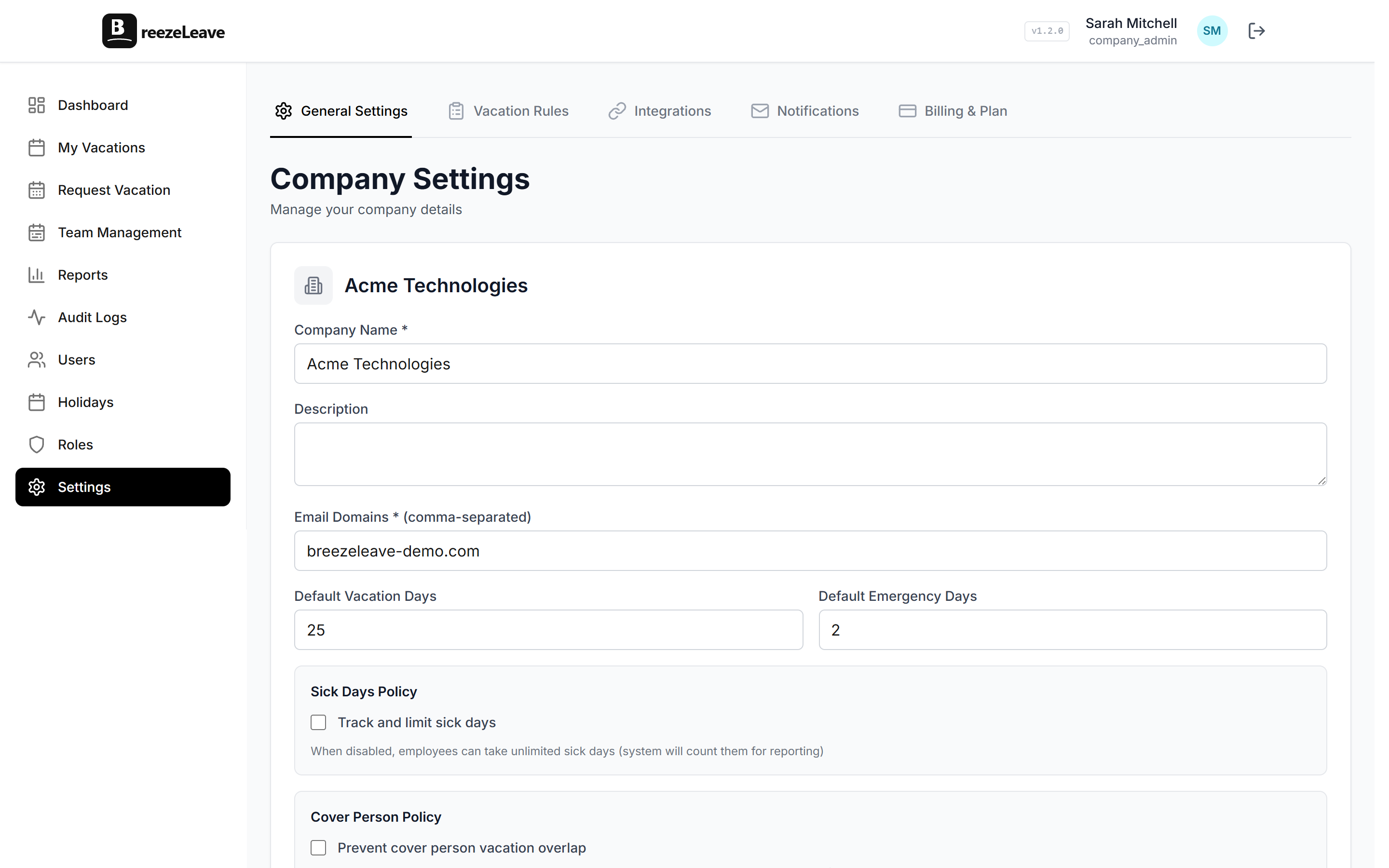
- Open Settings and turn on the Birthday leave type. Set the eligibility window around the date of birth.
- Optionally add an auto-approval rule for Birthday in the rules engine so the request does not wait on a manager.
- Open Vacation Rules and add a Full-Usage Bonus rule with the day count.
- Confirm part-time pro-rating behaviour matches the policy.
- Save. The Jan 1 cron will run against every employee record at the next year boundary; Birthday leave is available immediately for employees with a date of birth on file.
Build approval and accrual rules in BreezeLeave by opening the rules engine settings and configuring the birthday and loyalty bonus alongside auto-approval and seniority. For a longer breakdown of bonus mechanics, the birthday and loyalty bonus feature post covers the underlying flow.